




Porkbun Domain Pricing Offers Transparent Renewal Rates That Save You Money
Article
Starting a small business or launching your first website is exciting. But the excitement can fade fast when you see the bill for your domain name.

Many of the big name registrars hook you with a low first year price, then quietly jack up your renewal. That "cost to buy a domain name" that looked like a steal quickly becomes something else.
You are not alone. Millions of entrepreneurs and small business owners in 2026 are looking for something better. Porkbun domain pricing has caught a lot of attention because it goes the other way. The price you see is usually the price you keep.
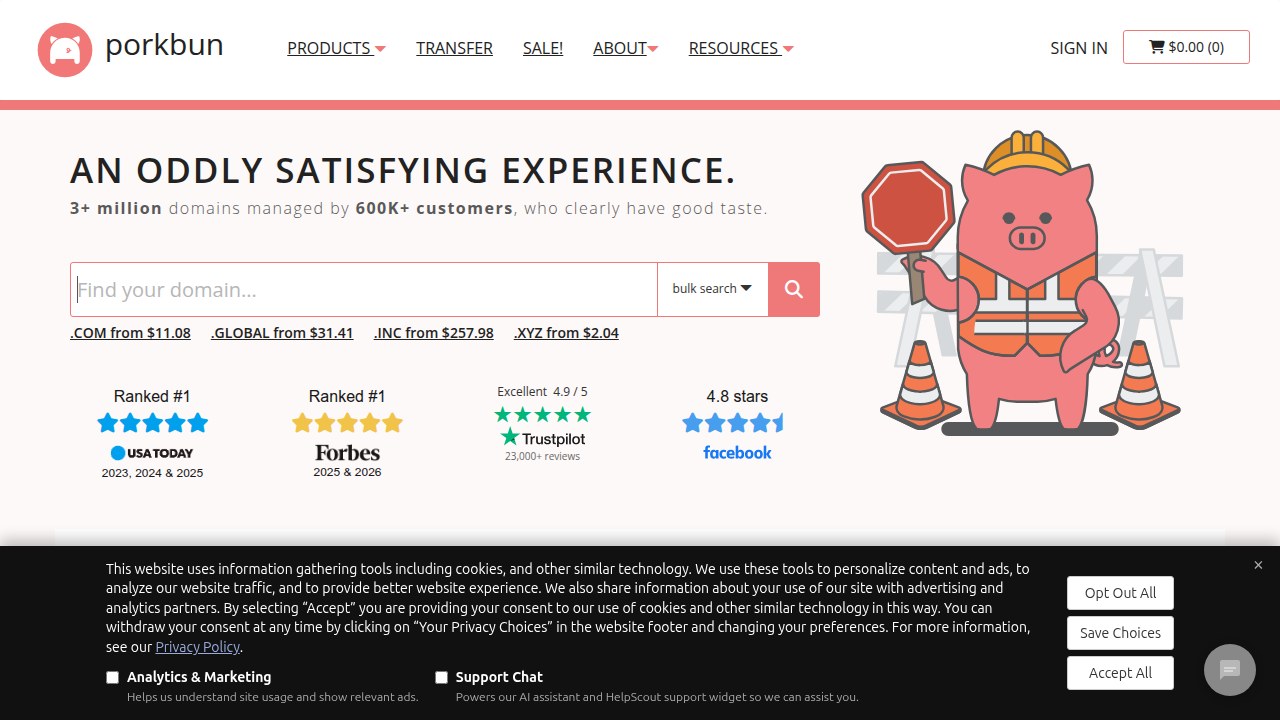
No surprise hikes after year one. No hidden fees buried in the checkout process.
In fact, the best domain services in 2026 prioritize transparent renewal pricing and built in security features like WHOIS privacy and SSL certificates. Porkbun fits that description perfectly.
This guide breaks down exactly how Porkbun works. We will look at the real numbers behind the cost to buy a domain name at Porkbun, how it compares to GoDaddy domain cost and other popular registrars, and whether it makes sense for your business. Choosing where to register your domain is one of the first steps for your online presence, so it helps to understand all your options before you commit.
If you want a deeper look at what makes a registrar trustworthy beyond just price, read our guide on how to find reputable domain name registrars that protect your business. And once you have your domain locked in at a fair price, you will need fast, secure hosting to bring your site to life. Prism Webhost provides reliable hosting infrastructure with the performance and security your growing brand needs.
1. Understanding Porkbun’s Domain Pricing Model
Here is the thing that makes Porkbun stand out in 2026. Their pricing is flat and honest. No gimmicks. No bait and switch.
Most registrars use a loss leader strategy. They offer a .com for two dollars the first year, then hit you with a renewal that is three or four times higher. In fact, GoDaddy domain cost jumps to about $21.99 per year for a .com renewal, according to recent data on domain renewal costs in 2026. That is a shock you do not see coming until your bill is due.
Porkbun goes the other direction.
When you check Porkbun domain pricing on their domain name pricing page, the price you see for registration is very close to the renewal price. They keep it transparent. A standard .com domain costs around ten to twelve dollars per year, and that number stays stable. No surprise hikes. No hidden fees buried in your cart.
Here is what you actually get with that price:
- Free WHOIS privacy. Most registrars charge extra to hide your personal contact information from the public database. Porkbun includes it for free on every domain.
- No forced upsells. You will not have to click through pages of add-ons you do not want.
- Clear renewal rates. They display both the first year price and the renewal price side by side before you buy.
Pricing does vary by TLD. That makes sense because each extension has its own wholesale cost from the registry. A .com, .net, and .org all have slightly different price points. But Porkbun consistently offers competitive rates across the board. In fact, Porkbun has the lowest renewal prices on more of its supported TLDs than any other registrar.
For context, the average domain name registration cost in 2026 falls between $10 and $20 per year for a standard .com. Porkbun sits at the lower end of that range, and they stay there year after year.
That matters because the cost to buy a domain name is not just about the first year. It is about what you pay in year three, year five, and beyond. A stable renewal price means you can budget your online expenses without guessing.
If you want to dig deeper into what makes a registrar trustworthy, our guide on how to find reputable domain name registrars that protect your business covers the warning signs and green flags to watch for.
Once you have a domain locked in at a fair price, the next step is pairing it with reliable hosting. Check out Prism Webhost for secure, high performance hosting that keeps your site fast and protected.
The bottom line is simple. Porkbun domain pricing works because it removes the guesswork. You know what you pay from day one. And that is a rare thing in the domain industry in 2026.
Now that you know Porkbun’s pricing is fair and stable, let’s walk through exactly how to buy your domain. The whole process takes just a few minutes, and there are no surprises. Here is how it works step by step.

Step 1: Search for your domain.
Go to the Porkbun website and type the name you want into the search bar. The system checks availability across hundreds of TLDs instantly. You will see prices for each option side by side, including the registration and renewal cost. If your first choice is taken, Porkbun suggests alternatives. This is one of the cleanest search experiences I have seen.
Step 2: Choose your domain and optional services.
After you pick a domain, Porkbun shows you a simple list of optional extras. These include things like SSL certificates, email forwarding, and domain privacy protection. But here is the good news. WHOIS privacy is already included for free on every domain. So you do not have to add anything unless you want extra features like professional email hosting. The interface keeps upsells to a minimum, so you will not feel pressured to buy things you do not need.
Step 3: Checkout with clear pricing.
The checkout page shows your total upfront. You can see both the first year price and the renewal price before you complete the purchase. No hidden fees, no surprise charges. Porkbun also lets you choose a registration period from one to ten years, and the price per year stays consistent. If you want to see the full list of prices, you can check their domain name pricing page.
Step 4: Manage everything in your dashboard.
Once you complete the purchase, your domain appears in your Porkbun dashboard immediately. You can start managing DNS settings, set up email forwarding, or configure other options right away. Every domain registration includes free DNS management powered by Cloudflare, according to the official support guide. The dashboard is straightforward and easy to navigate, even if you are not a tech expert.
After you have your domain set up, the next logical step is to pair it with reliable hosting. A domain without hosting is like a mailbox without a house. To get your website live and running fast, check out Prism Webhost for secure, performance-optimized hosting that works seamlessly with your new domain. For more on what affects your costs after registration, our guide on web hosting cost in 2026 can help you plan ahead.
3. Porkbun vs. Competitors: A Price and Feature Comparison
So how does Porkbun really stack up against the big names like GoDaddy, Namecheap, and Google Domains? When you look at domain name registration cost over time, the differences can surprise you.
Most domain names cost around $10 to $20 per year to register. But that first year price can be tricky. Many registrars offer a cheap intro rate, then hit you with a much higher godaddy domain cost at renewal. Porkbun takes a different approach. They keep their porkbun domain pricing low from year one and hold it steady year after year.
Here is a quick comparison of what you will typically pay for a standard .com domain in 2026:
| Registrar | Typical First Year Price | Typical Renewal Price | Free WHOIS Privacy | DNS Management |
| :— | :— | :— | :— | :— |
| Porkbun | ~$9.00 | ~$10.00 | Yes | Free (Cloudflare) |
| GoDaddy | ~$0.01 (promo) | ~$20.00 | Extra cost | Included |
| Namecheap | $6.00 | $9.00) | Yes | Included (Cloudflare only) |$14.00 | Yes | Included |$9.00) | At cost (
| Cloudflare | At cost (
Over five years, that "cheap" initial godaddy domain price can add up to over $120, while a transparent option like Porkbun stays around $50. That is a massive difference for the exact same service.
But price is not the only thing that matters. What makes Porkbun stand out is what you get with that low cost. You always get free WHOIS privacy, which protects your personal contact info from spammers. You get free DNS management powered by Cloudflare, which is fast and secure. Many competitors, especially GoDaddy, charge extra for these basic protections.
Of course, there are trade offs. GoDaddy offers more advanced hosting integrations and premium phone support if you ever need to talk to someone. Namecheap has a bigger marketplace for domain investors. But for most small business owners, these extras are not worth the higher cost to buy a domain name over time. The best domain services in 2026 combine clear renewal pricing with built-in security, and Porkbun does that better than almost anyone.
After you lock in your affordable domain, the next step is to pair it with reliable hosting. A great domain is just the first piece of the puzzle. You need a host that keeps your site fast and secure without hidden fees. That is where Prism Webhost comes in. Their performance-optimized hosting works perfectly with your new domain, and they offer the same transparent pricing you just found with Porkbun. For more on planning your full setup, check out our guide on web hosting cost in 2026.
4. Porkbun’s Value-Added Services: Security, Privacy, and More
So you know the porkbun domain pricing is great. But what do you actually get with that low cost? A lot, actually. And many of these extras are things other registrars charge extra for.
First up is WHOIS privacy. This keeps your personal name, address, and phone number out of public databases. Spammers and scammers love to scrape those lists.

At Porkbun, every domain includes free WHOIS privacy automatically. Compare that to GoDaddy, where it often costs extra. For a small business, that is a no-brainer. A nonprofit recently chose Porkbun for this exact reason: low price plus free privacy.
You also get free DNS management powered by Cloudflare. That means fast, secure DNS without any extra fee. And you get free email forwarding for up to 20 addresses. According to Porkbun’s own knowledge base, these come with every single domain registration. No strings attached.
If you need more, Porkbun offers optional add-ons at transparent prices. You can buy SSL certificates to secure your site, get professional email hosting, or use their basic site builder. The prices are clearly listed with no surprises. This makes it easy to cost to buy a domain name and add only the services you need.
Security is a big deal for any website, especially e-commerce shops. Porkbun supports DNSSEC, which adds a layer of protection against fake DNS entries. They also offer DDoS protection to keep your site online during attacks. These are critical for building trust with your customers. As explained in a 2026 comparison guide, Porkbun focuses on domains but provides enough security tools to protect most small businesses.
After you lock in your domain with these protections, you need a host that takes security just as seriously. That is where Prism Webhost fits in. They offer enterprise-grade security features like DDoS protection, free SSL, and isolated hosting environments. Pairing a secure domain with a secure host gives you peace of mind.
For more on choosing a trustworthy provider, check out our guide on how to find reputable domain name registrars that protect your business.
5. Evaluating Porkbun for Your Business: Performance, Scalability & Support
By now you know the porkbun domain pricing is hard to beat. But does the service hold up when your business grows? Let’s take a closer look at how Porkbun performs under real-world conditions.
Performance for everyday sites
Porkbun’s infrastructure handles moderate traffic just fine. If you run a small blog, a local business site, or a simple online portfolio, you probably won’t notice any slowdowns. Their DNS is powered by Cloudflare, which is fast and reliable.
But here’s the thing. If your site gets heavy traffic or relies on advanced caching and a custom CDN, Porkbun’s built‑in tools may not be enough. Their hosting add‑ons are basic. For serious speed, you will likely need a separate host that offers LiteSpeed servers or enterprise‑grade CDN. That’s common for domain registrars. As one 2026 comparison notes, even low‑cost registrars like Namecheap start shared hosting at just $1.98/month, but their performance still can’t match dedicated solutions weblish.io. The same logic applies to Porkbun.
Scalability when you grow
Good news: scaling your domain portfolio with Porkbun is straightforward. They offer bulk domain management, which lets you control dozens or hundreds of domains from one dashboard. Need to transfer many domains at once? Their API makes it easy. That’s a big plus if you’re a developer or a business buying multiple domains.
Porkbun also makes transferring domains in or out simple. No hidden tricks to keep you locked in. That lowers the domain name registration cost over time because you can move your domains if a better deal comes along.
Customer support: what to expect
Porkbun’s support is mainly through tickets and chat. Phone support is not available. Reviews are mixed on response times. Some users say they get a quick answer within a few hours. Others report waiting a day.
That said, for domain‑specific issues like DNS changes, transfers, or billing, most people find the support team knowledgeable. They know domains inside and out. If you run into a problem with a domain transfer or a renewal glitch, you’ll likely get it fixed.
But if you need urgent help with a website crash or a security incident at 2 a.m., you may be on your own. That’s why pairing Porkbun with a separate host that offers 24/7 support is a smart move.
The bottom line
Porkbun is excellent at what it does: registering and managing domains at a low price. But it’s not a full‑service web host. For hosting your actual website, you want a provider that specializes in performance, security, and support. That’s where Prism Webhost comes in. With 99.99% uptime, NVMe SSD storage, and 24/7 support, it gives you the infrastructure your business needs to grow.
If you want to compare your options further, check out our guide on how to find reputable domain name registrars that protect your business. It covers what to look for beyond price.
6. Tips to Save on Domain Registration with Porkbun
You already know that porkbun domain pricing is some of the lowest around. But even with cheap domains, you can save more. Let’s look at a few simple ways to keep your costs down.
Use coupon codes and multi-year deals
Porkbun often runs promotions. Before you buy, search for a coupon code. Many deals give you a discount on the first year or on multi-year registrations. Locking in a longer term is smart because renewal prices can go up. In 2026, domain renewal costs for a .com range from $8 to $20 per year depending on the registrar blog.webhostmost.com. By registering for two or three years upfront with a coupon, you beat future price hikes. Porkbun’s renewal prices are already low compared to many competitors, but a promo makes them even better porkbun.com/blog.
Bundle domains with hosting or email
Another easy trick: bundle your domain with hosting or email plans. If you need both a domain and a place to host your site, signing up for a hosting package that includes a free domain for the first year saves you the upfront cost to buy a domain name. Porkbun offers web hosting add-ons, but for serious performance you’ll want a dedicated host like Prism Webhost. Pairing Porkbun (for low-cost domains) with a reliable host gives you the best of both worlds.
Skip unnecessary add-ons
When you register a domain, you’ll see extras like privacy protection, email forwarding, or SSL certificates. Privacy protection is often worth having, but many registrars include it for free now. Porkbun includes free WHOIS privacy on all domains. So don’t pay extra. Other add-ons like professional email or site builder tools can be added later if you really need them. Avoid clicking everything at checkout. Stick to the basics and your domain name registration cost stays low.
Compare your total costs with other registrars too. For example, GoDaddy domain price often starts low but renewal can jump. Porkbun keeps renewals fair. Check out our guide on how web hosting costs compare in 2026 to see how the full picture matters.
These three tips will stretch your budget further while still getting a reliable domain.
7. Common Pitfalls to Avoid When Registering Domains with Porkbun (or Any Registrar)
You’ve learned how to save money on domains with Porkbun. But saving cash doesn’t matter if you trip up on a simple mistake that costs you big later. Let’s walk through three common pitfalls so you can avoid them from day one.
Renewal Prices Vary by TLD
Here’s a trap many people fall into. They pick a cheap domain extension like .xyz or .fun, only to find the renewal price is triple the first year. Porkbun domain pricing is transparent and low for popular extensions like .com, but not every TLD renews at the same rate. For example, a .io domain can cost $30 or more per year to renew, while a .com stays around $10. Ignoring this difference can blow your budget.
A good rule: check the renewal price before you buy. Many registrars, including GoDaddy, use low introductory offers. The Godaddy domain price might be $2.99 the first year, then jump to $20. Porkbun keeps renewals fair, but you still need to compare. The domain name registration cost upfront isn’t the whole story. To learn more about which extensions are cheapest long term, read our guide on cheapest domain extensions and their real costs. Experts also warn against neglecting domain extensions when choosing a name W3era.
Auto-Renewal and Payment Info Mistakes
You spend time picking the perfect domain name. Then one day, it’s gone because you forgot to renew. Ouch. Failing to enable auto-renewal or letting your credit card expire is a fast way to lose your cost to buy a domain name investment. When a domain expires, someone else can snap it up.
Always turn on auto-renewal in your Porkbun account. Also update your payment information if your card changes. Set a calendar reminder to check every few months. Not renewing on time is one of the most common domain mistakes W3era. Don’t let it happen to you.
Verify Your WHOIS Information
When you register a domain, you provide contact details like your name, email, and address. If this WHOIS information is wrong or outdated, you could run into big problems. Transferring the domain to another registrar might get blocked. If there’s a dispute about ownership, the person with the correct contact info usually wins.
Double check everything before you finish checkout. Make sure your email is spelled correctly. Keep it updated if you move or change email addresses. Mistakes with WHOIS data can lead to critical legal and ownership issues Nominus. A few seconds of checking now saves hours of headache later.
Once you’ve locked down your domain without these mistakes, the next step is to get a hosting provider that matches your care for quality. Domains are just the address; hosting is the engine that powers your site. For reliable, fast, and secure hosting, take a look at Prism Webhost. It’s built for people who want their website to just work.
Summary
This article explains Porkbun’s transparent domain pricing and why it’s a strong choice for small businesses and first-time website owners in 2026. It breaks down Porkbun’s flat, no‑gimmick pricing model, highlights included features like free WHOIS privacy and Cloudflare DNS, and compares long‑term renewal costs with competitors such as GoDaddy and Namecheap. You’ll get a clear, four‑step walkthrough of searching, buying, checking out, and managing a Porkbun domain, plus guidance on performance, scalability, and support limits. The guide also lists ways to save (coupons, multi‑year registrations, bundling) and warns about common pitfalls like TLD renewal variance and missed auto‑renewal. Finally, it recommends pairing Porkbun’s low‑cost domains with a dedicated host for performance and 24/7 support and points to further resources for choosing registrars and planning hosting costs.
