



How to Find Reputable Domain Name Registrars That Protect Your Business
Article
Introduction
Picking a domain name feels exciting. It is the first real step to building your online brand.

But here is the thing: many people rush this step. They choose a cheap domain company without thinking about the long game. And that can cost you big time.
Right now, there are over 386.9 million registered domain names worldwide, up 6.2% from last year according to Instant Domain Search’s 2026 data. The domain name market keeps growing, and the competition for good names is fierce. So it makes sense to grab a domain fast. But picking a fast, cheap option without checking the registrar’s reputation can hurt your whole website.
What happens when you go with a shady or unreliable registrar? You might run into hidden fees that show up at renewal time. You could face poor security that puts your site at risk. And trying to move your domain to a better provider later becomes a headache. Some companies make it really hard to leave. That is the last thing you want when your business relies on a stable online presence.
This article gives you a simple, research-backed way to find reputable domain name registrars. We look at what makes a registrar trustworthy, what to watch out for, and how to pick the best domain registrar for your needs. Whether you are starting a blog, an online store, or a business site, knowing the top domain registrars helps you avoid trouble down the road.
A great domain name only works when it is backed by a solid registrar. And once you have that domain locked in, you also need a reliable home for your website. That is where a service like Prism Webhost can help you keep your site secure and fast with 99.99% uptime and strong protection like DNSSEC and SSL.
Before you hit that "buy" button, take a few minutes to understand what separates a good domain company from a risky one. Your future self will thank you.
What Makes a Domain Registrar "Reputable"?
How do you know if a domain company is trustworthy? It starts with one simple thing: ICANN accreditation. Every legitimate registrar must be approved by the Internet Corporation for Assigned Names and Numbers. You can check any company on the official ICANN list of accredited registrars to confirm they are the real deal.
But that is just the starting point. The best domain registrar for your business also needs three things:
Transparent pricing no hidden fees at renewal time. Some domain companies lure you in with a low first year price, then jack up the cost later. Reputable ones show you the full picture upfront.
Clear terms of service that tell you what happens with your data and your domain. You should never feel confused about your rights.
Strong security credentials. Top registrars offer protections like two-factor authentication and DNSSEC to keep your domain safe from hijackers. Industry certifications and compliance with rules like GDPR also show a company takes your privacy seriously.
Companies like Cloudflare, Namecheap, and Porkbun are examples of ICANN-accredited registrars that offer safer, more predictable domain ownership. They make it easy to see what you pay and what you get.
Once you have found a solid registrar, the next step is pairing it with a reliable hosting provider. A great domain means nothing if your site loads slowly or goes down often. Services like Prism Webhost give you the fast, secure foundation your website needs to thrive, with features like DNSSEC and SSL protection built right in. For more on keeping your site safe, check out this guide on how to prevent downtime and boost security.
Remember: the cheapest option is rarely the best one. A reputable registrar earns your trust through transparency, security, and honest practices.
ICANN Accreditation and Industry Standards
Let’s dig deeper into what makes a company trustworthy. It comes down to one global rulebook. The internet is not a wild west. It is managed by ICANN, and any real reputable domain name registrar must be approved by them.
ICANN accreditation is the strongest trust marker there is. It means the company has passed strict background checks. It also means they agree to follow tough rules that protect you.
You can look up any company on the official ICANN list of accredited registrars. If a business is not on this list, they are just a reseller. That is a big risk.
Accredited registrars must follow specific rules. They must use data escrow, which safely backs up your domain records. They also must agree to dispute resolution if a problem comes up. You can read more about these duties on the ICANN contracted parties page. This process makes reputable domain name registrars much safer to use.
Unaccredited resellers do not have to follow these rules. You could lose your domain or face major headaches when you try to move it. That is why top domain registrars like Cloudflare and Namecheap openly advertise their accreditation VerticalResponse Blog.
Think of ICANN accreditation as your safety net. It makes sure your domain stays yours and your business stays safe.

Once you have a secure domain, you need a host that takes safety just as seriously. Prism Webhost provides fast hosting with DNSSEC and SSL support to protect your site. For more ways to keep your online brand safe, read this guide on finding and trusting secure sources online.
Transparency in Pricing and Terms
Here is where some domain companies try to trick you. They show a very low price for the first year. Then the renewal price hits much harder. A domain that costs $1.99 for the first year might renew at $22.99. Elementor That is a huge jump.
Why does this happen? Some registrars use low teaser rates just to get you in the door. A .com domain might start at $0.99 for the first year but renew at $18. Fueler
Reputable domain name registrars handle pricing differently. They show the renewal cost right next to the intro price. The best domain registrar will list initial, renewal, and transfer prices clearly without hidden fees. Unstoppable Domains
So who are the top domain registrars for honest pricing? Cloudflare passes on the wholesale registry fee, keeping costs low. Others like Porkbun and Dynadot also keep their pricing simple and upfront. Weblish
You should also avoid paying extra for WHOIS privacy. Many good domain companies now include this service for free. You should not have to pay extra just to protect your personal information. Webhostmost
If you are tired of hidden fees and want a provider that values honesty, Prism Webhost offers straightforward pricing and secure hosting infrastructure. To see how your current host performs, check out this guide on checking service status and preventing downtime. For more tips on vetting online services, read this guide on finding and trusting secure sources.
Security Certifications and Compliance
Price matters, but security matters more. The first thing to check is ICANN accreditation. Reputable domain name registrars must be approved by ICANN to sell domains. You can verify any registrar on the official ICANN accredited registrars list.
But the best domain registrar goes further. Look for certifications like ISO 27001. This means the company follows strict international standards for information security. It shows they protect your data the right way. Cybernews notes that top domain registrars like IONOS hold such credentials.
Also check for GDPR compliance. If a registrar handles data from European customers, they must follow these privacy rules. That respect for data protection usually benefits everyone, no matter where you live.
Another sign of a strong registrar: they run independent security audits and offer bug bounty programs. These programs invite ethical hackers to find weaknesses before criminals do. It means the company is proactive, not reactive.
If you want a host that takes security seriously, Prism Webhost pairs honest pricing with strong protections. To check if your current services stay safe, see this guide on checking service status and preventing downtime. And for tips on vetting any online provider, read about finding and trusting secure sources.
Core Security Features Every Trustworthy Registrar Must Offer
So you know the certifications to look for. But what security tools should a registrar actually give you? The basics matter more than you think.
DNSSEC (Domain Name System Security Extensions) is your first line of defense. It prevents hackers from redirecting your visitors to fake sites. Think of it as a digital signature for your domain. As the Dynadot guide to domain security shows, DNSSEC protects the integrity of your DNS data.
Two-factor authentication (2FA) is another must. The Spaceship blog makes this clear: always enable 2FA on your registrar account. It stops attackers even if they steal your password.
Look for DDoS protection too. A good registrar will have tools to absorb attacks that try to knock your site offline. Reputable domain name registrars often include this in standard plans.
The best part? These features usually come at no extra cost from top domain registrars. If a company tries to charge extra for basic security, walk away.
Want a host that includes all these protections? Check out Prism Webhost for secure, worry-free hosting. And if you want to stay on top of your uptime, read this guide on checking service status and preventing downtime.
Do not let weak security at the registrar level put your whole online presence at risk. A little prevention goes a long way.
DNSSEC Implementation
Imagine a customer types your domain into their browser. What if they land on a fake site that steals their credit card details? That is exactly what DNS attacks do. DNSSEC stops this.
DNSSEC stands for Domain Name System Security Extensions. It adds a digital signature to your domain’s data. The APNIC blog explains it as a way to fence off threats like DNS spoofing. This signature confirms the data comes from a legitimate source and has not been changed.
Without DNSSEC, hackers can redirect your site traffic through a process called cache poisoning. Security experts at ZeroFox confirm that DNSSEC provides cryptographic verification. This keeps your visitors safe.
So who offers it? Many of the top domain registrars now provide easy one-click DNSSEC setup. However, not all do. A 2026 comparison of domain registrar features shows that support varies widely. This is a key feature to check when you are looking for reputable domain name registrars.
If you run an online store or a financial site, DNSSEC is a must. It shows your customers you take security seriously. As the Dynadot guide points out, it is a critical part of any modern domain security program.
Once you enable DNSSEC, you also want to monitor your site’s availability. Learn how to stay on top of your uptime in this guide on checking service status and preventing downtime.
Finding a registrar and host that handles DNSSEC automatically saves you a lot of headaches. Prism Webhost includes enterprise-grade security checks like DNSSEC in every plan, so you do not have to be a tech expert to stay protected.
Two-Factor Authentication and Account Protection
DNSSEC protects your domain data from being tampered with. But what protects the account where you manage that data? That is where Two-Factor Authentication (2FA) comes in.

As the Spaceship blog points out, enabling 2FA and choosing a trustworthy registrar go hand in hand.
So what should you look for in a reputable domain name registrar? The best domain registrar options go beyond just SMS codes. Look for support for authenticator apps and hardware security keys for the strongest protection.
But here is the catch. Weak account recovery processes can make your 2FA pointless. If a hacker can easily reset your password through a simple link, your extra layer is gone. The Dotto article on domain security best practices reinforces that strong credentials and secure account recovery are key.
Choosing a provider that makes this entire system easy is vital. This connects to a wider strategy of finding reliable sources online, which you can read about in this guide on finding, trusting, and securing news. A provider like Prism Webhost treats account security as a core part of its infrastructure, giving you the tools to lock down your account without the technical hassle.
DDoS Protection for Name Servers
Imagine your website suddenly goes offline. Your customers see error messages. You lose sales. The culprit might be a Distributed Denial-of-Service (DDoS) attack on your DNS. These attacks flood your name servers with junk traffic, making your domain unreachable.
So how do reputable domain name registrars fight back? The best domain registrar options invest in strong infrastructure. One key tool is Anycast DNS. Instead of one server, Anycast spreads your DNS traffic across many data centers around the world. If one location gets hit, the attack is absorbed by the network. Your site stays online.
Another sign of a top domain registrar is a clear Service Level Agreement (SLA). Look for guarantees on uptime and DNS resolution speed. High SLAs show the company has put real money into its systems. You can learn more about finding trustworthy providers by reading our guide on finding, trusting, and securing news online.
Many domain companies now bundle DDoS protection as a standard feature. According to DomainDetails’ 2026 comparison, security options like DDoS mitigation are a key factor to check when choosing a registrar. A provider like Prism Webhost includes enterprise-grade DDoS protection with over 17Tbps of mitigation capacity, keeping your name servers safe from even the largest attacks.
Comparing the Best Reputable Domain Name Registrars in 2026
You might think all domain companies are the same. They are not. The difference between a good registrar and a bad one can mean the difference between a site that loads fast and a site that gets hacked.
With over 368.4 million domain names registered globally as of early 2025, the market is packed with choices. But not all of those choices are safe. Some are far more reliable than others. So how do you find the best domain registrar for your business?
A side-by-side comparison of key reputation indicators helps narrow your search. The most reputable domain name registrars earn their status through four main pillars: accreditation, security, pricing, and support.
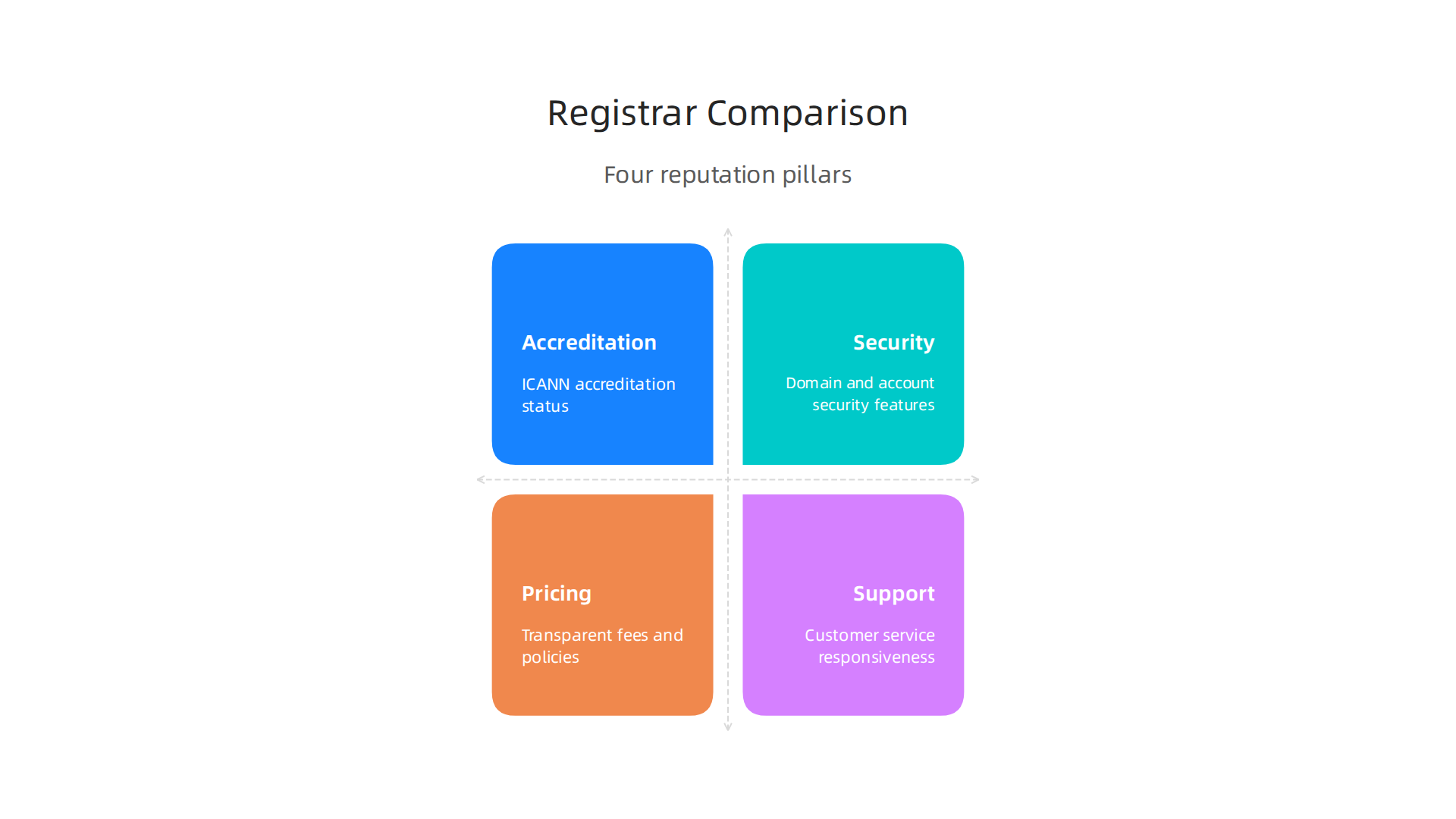
| Feature | What the Best Registrars Do | Why You Should Care |
|---|---|---|
| ICANN Accreditation | They are officially accredited by the Internet Corporation for Assigned Names and Numbers. | This is a basic badge of trust. It means the registrar follows global rules and protects your ownership rights. |
| Security & DDoS Protection | They include strong DDoS mitigation, DNSSEC, and free SSL certificates. | As we covered earlier, DDoS attacks are real and common. Strong security keeps your site online and your visitors safe. |
| Transparent Pricing | They show renewal rates upfront and offer free WHOIS privacy. | No one likes surprise fees. The top domain registrars are honest about costs from day one. |
| Customer Support | They offer fast, 24/7 help from real DNS experts. | When your site goes down, email support is not enough. You need real-time help to fix it fast. |
Market Leaders Set the Standard
The largest domain registrars in 2026, like GoDaddy, Namecheap, and Google Domains, consistently score high marks for transparency and reliability.
They have the money to build strong networks and offer robust security features right out of the box. According to a list of the largest domain registrars from Cybernews, these big players control a massive share of the market for good reason. They make it easy to manage your domain and keep it safe.
The Smaller Registrar Trade-Off
Smaller registrars can be tempting. They might offer lower prices or unique domain extensions like .store or .tech. And according to domain trend reports, these new extensions are growing fast. But here is the thing. Smaller companies sometimes lack the budget for enterprise-level security. They might not have a strong DDoS mitigation system in place. You might save five dollars on a domain but risk losing your entire website to an attack.
What This Means for You
If you run a small business or a personal blog, your domain is your digital front door. You would not build a store in a dangerous neighborhood. So do not put your website with a registrar that cuts corners on safety.
This is exactly why a provider like Prism Webhost is worth considering. Instead of just selling you a domain, they bundle it with hosting that includes enterprise-grade DDoS protection and isolated environments. It is a prime example of a reputable domain name registrar that puts safety first without making things complicated.
For a deeper look at how to keep your site running without issues, read our full guide on how to check service status and prevent downtime. It walks you through the exact steps to take when your domain is under threat.
Hidden Costs to Watch Out For: Renewal Rates, Add-ons, and Transfer Fees
You find a domain for just $0.99. Great deal, right? Probably not. That low price is often a trap. Many domain companies hook you with a cheap first year, then hit you with a renewal fee that is three or even five times higher. For example, a .com domain that starts at $1.99 might jump to $22.99 at renewal, as noted in a complete pricing breakdown from Elementor. That is a 1,000% increase.
Renewal rates are where the real cost lives.
Most registrars charge $12 to $20 per year for a standard .com renewal, according to a domain renewal cost analysis from WebHostMost. The wholesale price from Verisign is only about $9.59. So any registrar charging you more than $20 is pocketing a huge markup. The best domain registrars keep renewal rates close to the wholesale price and show them upfront. A comparison of top registrars at Weblish.io lists companies like Dynadot and Porkbun that offer transparent renewal pricing, starting around $10.99 per year.
Add-ons that should be free
Another hidden cost is the extras. Privacy protection, email forwarding, and basic domain locks are often included for free with reputable domain name registrars. But some companies charge $5 to $10 per year for each add-on. Over five years, that can add $50 or more to your bill. A trustworthy provider bundles these features without extra fees.
Transfer fees keep you stuck
Want to move your domain to a better company? Some registrars make that painful. They might charge a transfer-out fee or require you to unlock the domain through a confusing process. That is a bad sign. The top domain registrars let you transfer your domain easily and at a low cost, usually just the standard renewal fee for one extra year.
What to do about it
Always check the renewal price before you buy. Look at the fine print. Pick a registrar that lists all costs clearly. For example, a service like Prism Webhost pairs domain registration with hosting that includes DDoS protection and clear pricing. Their goal is to keep your site safe without surprise fees. For more tips on keeping your site running smoothly, check out our guide on how to check service status and prevent downtime.
Customer Support and Account Management: What to Expect from a Top Registrar
You sorted out the pricing and found a deal that makes sense. Now imagine this. Your website stops loading at 3 AM. Your customers cannot reach you. Who do you call?
This is where the truly reputable domain name registrars separate themselves from the average ones. Anyone can sell you a cheap domain. But real support? That is harder to find.
Support that actually helps
The best domain registrar offers 24/7 phone, live chat, and email support. And wait times should be measured in minutes, not hours.

According to analysis from Snagged, customer feedback on support time is a major deciding factor when people pick a company. Slow or unresolved tickets are the number one complaint people leave on forums like NamePros when they review the worst performers. You do not want to be stuck waiting days for a simple DNS fix.
Tools that put you in control
The top domain registrars also give you self-service tools. A clean control panel, one-click domain management, and a searchable knowledge base let you fix simple problems fast. You should not need to call support just to change a nameserver or enable privacy protection.
Real-world feedback matters
Before you sign up, look at real reviews. Community boards and complaint sites reveal the truth. The best domain companies have low complaint volumes and fast resolution times. They do not hide their support behind confusing contact forms.
What you deserve
A truly great provider gives you both support and solid infrastructure. Services like Prism Webhost pair excellent domain registration with reliable hosting. You get enterprise-grade security checks like DNSSEC and SSL/TLS. You get a cPanel dashboard that is easy to use. And you get a team that actually answers when you need help.
For more on keeping your site stable and secure, check out our guide on how to check service status and prevent downtime.
How to Migrate Your Domains to a More Reputable Registrar Without Downtime
You worried about moving your domains to a new provider. It feels like a big risk. What if your site goes dark? What if you lose traffic?
Here is some good news. Domain migration does not have to be scary. With the right plan, you can switch to one of the reputable domain name registrars without anyone noticing a thing. The key is preparation.
Plan ahead before you start
The biggest mistake people make is rushing. According to a guide from Cloudflare, you should first confirm your domain contact information is accurate and check if your domain is eligible to transfer. You also need to back up your DNS records. This step alone saves you hours of headache if something goes wrong.
The step-by-step transfer process
Here is how to move your domain safely, based on expert guides from 2026:
- Unlock your domain. Go to your current registrar and disable the transfer lock. This is a simple toggle in most control panels.
- Request your authorization code. Also called an EPP code. Your current registrar gives this to you. You need it to prove you own the domain. The Smooth Domain Transfer guide notes this step takes about one to two hours in total.
- Initiate the transfer with your new registrar. Enter your domain name and the authorization code. The process takes just five to ten minutes to start.
- Confirm the transfer. Check the email address listed for your domain. Click the confirmation link. Then wait. Most transfers complete within five to seven days.
Keep your DNS settings safe
Here is the trick to avoiding downtime. Before you start the transfer, copy all your DNS records from your old registrar. Then, set them up at your new registrar right away. For a complete walkthrough, the guide from Leanna.ng explains how to move your domain without breaking your website or losing traffic.
Choose a registrar that makes it easy
The best registrars have a streamlined transfer process. They guide you through every step and offer dedicated migration support. That reduces risk.
If you are ready to move to a provider that prioritizes both security and simplicity, check out Prism Webhost. We offer reliable hosting with enterprise-grade features like DNSSEC and SSL/TLS, plus a team that helps you through the entire migration.
For more tips on keeping your site stable after the move, read our guide on how to check service status and prevent downtime.
Summary
This article explains how to choose a reputable domain name registrar and why that choice matters for your website’s security, cost, and long‑term control. It covers the core trust signals—ICANN accreditation, transparent pricing, clear terms, and strong security credentials—and walks through concrete features to look for like DNSSEC, two‑factor authentication, DDoS mitigation, and meaningful SLAs. You’ll learn how hidden fees and aggressive renewal pricing can inflate costs, which support options separate reliable companies from risky ones, and practical steps to migrate domains without downtime. The guide compares large and smaller registrars, highlights common pitfalls, and shows how pairing a solid registrar with dependable hosting protects your online brand. After reading, you’ll know what checks to run, what questions to ask, and how to pick a registrar that keeps your domain safe and affordable.
