




Run a Domain Price Comparison Uncover True Costs and Avoid Surprises
Article
Choosing a domain name for your business is a big step. It’s like picking out the perfect street address for your online store or office. But here’s the thing: the price you see at first might not be the real cost to buy a domain name in the long run. For small to medium-sized businesses (SMBs) and online brands, understanding domain price comparison is super important.

It affects your budget, how people remember your brand, and how smoothly your website works every day.
Many business owners get tripped up by confusing prices. You might see a great deal for your domain name registration cost for the first year. Companies like GoDaddy often show very low prices to get you started, and the same goes for Hostinger pricing.
However, these are often special intro offers. After that first year, the godaddy domain price or hostinger pricing for renewal can jump much higher. For example, the base cost for a .com domain is around $10.44 to $10.46 per year for registrars to pay, including a small fee for ICANN, which helps manage domain names worldwide. Everything above that is the registrar’s markup [^1, ^2, ^3]. Renewal costs for a .com domain in 2026 can range from $8 to $20 per year, but some popular registrars might charge more, like GoDaddy’s renewal at $21.99/year [^4, ^5].
This big difference between the first-year promo price and the renewal price is a common pain point. You might also find yourself dealing with bundled offers that seem good at first but hide extra fees. These hidden fees can be for things like privacy protection for your domain or other services you didn’t realize you were signing up for. This is why it’s so important to compare what different providers offer and to truly understand the total domain name registration cost before you commit. Knowing what you’ll actually pay helps you master your domain name costs and avoid surprise bills later on [^6, ^7].
By doing careful domain price comparison, you can make sure your brand’s home on the internet stays affordable and strong for years to come.
How Domain Pricing Works: Registries, Registrars, and Cost Components
To really master your domain name costs, it helps to understand how these prices are put together. Think of it like a chain, where different groups play a part in setting the final cost to buy a domain name.

The Key Players: Registries and Registrars
First, there are registries. These are the organizations that manage an entire domain extension, also known as a Top-Level Domain (TLD). For example, Verisign is the registry for all .com and .net domains. The Public Interest Registry (PIR) manages .org domains. Each registry sets a wholesale price for the domain names under its care. This is the base price that other companies pay to offer you a domain.
Next, there are registrars. These are the companies you buy your domain name from, like GoDaddy or Hostinger. Registrars act as middlemen, selling domain names to the public. They work directly with the registries. Your domain name registration cost comes from the registrar.
Breaking Down the Cost of a Domain Name
When you buy a domain, the price you pay includes a few main parts:
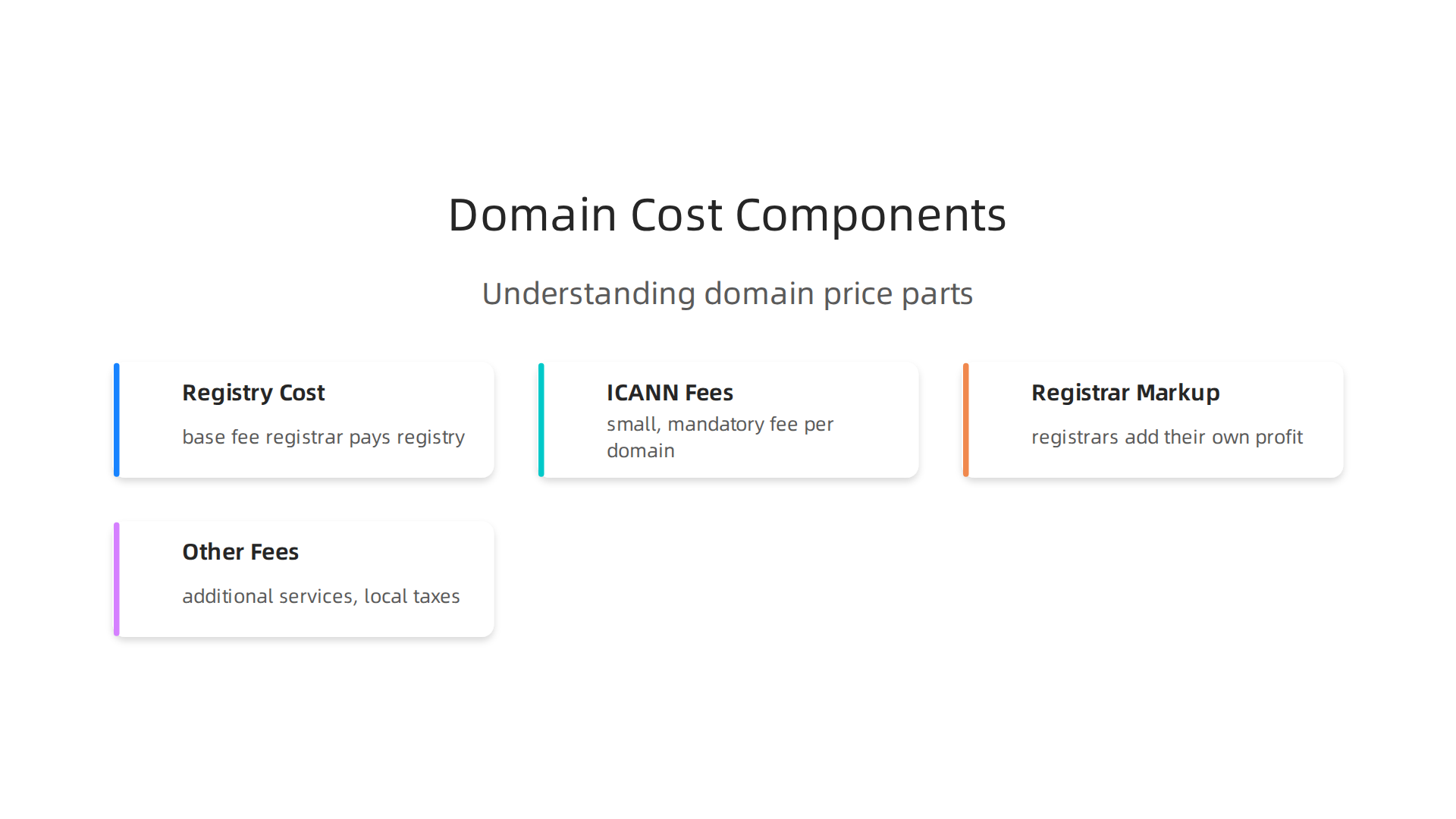
- Registry Wholesale Cost: This is the base fee the registrar pays to the registry for your chosen domain name. For a popular .com domain, the registry fee (paid to Verisign) is about $10.26 per year in 2026, plus a small fee to ICANN [^1].
- ICANN Fees: ICANN stands for the Internet Corporation for Assigned Names and Numbers. It’s a non-profit group that helps oversee the global internet’s naming system. They charge a small, mandatory fee of around $0.18 to $0.20 per domain per year, which is added to every domain registration and renewal [^2]. This fee helps support the work ICANN does.
- Registrar Markup: This is where registrars like GoDaddy and Hostinger add their own profit. On top of the wholesale registry cost and ICANN fee, registrars add a markup to cover their business costs and make money. This markup is why the
godaddy domain priceorhostinger pricingcan be different from one provider to another, even for the exact same domain. Some registrars might offer a low first-year price by lowering their markup, only to raise it for renewals. - Other Fees and Taxes: Sometimes, additional services are bundled in, or there are local taxes. Things like domain privacy protection, which hides your personal information from public databases, often cost extra.
How TLDs and Scarcity Affect Pricing
The type of domain extension you choose, also called a Top-Level Domain (TLD), plays a big part in its price.
- Legacy TLDs (like .com, .org, .net): These are the older, most well-known domain extensions. A .com domain is often seen as the standard, making good names quite sought after. While the base wholesale
cost to buy a domain namefor these might be somewhat stable, registry operators can and do raise their wholesale prices. For example, the wholesale price for .org domains is increasing from $9.93 to $11 per domain per year in 2026 [^3]. - New gTLDs (like .store, .app, .online): In recent years, many new TLDs have become available. These "generic Top-Level Domains" offer more choices. Their pricing can vary a lot, sometimes starting higher than traditional TLDs because they are newer or target specific industries. While there might be more names available under new gTLDs, their registries have different pricing policies, and some names might be considered "premium" and cost much more.
Understanding these different parts helps you do a better domain price comparison and find the best value for your online brand. You can learn more about how to evaluate what you’re truly paying for by checking our guide on the cost to buy a domain name 2026 price guide and hidden fees.
Now that you know who sets the prices, the next step is to actually do a smart domain price comparison. This means looking closely at what different companies charge for the same or similar domain names. It’s not just about the first price you see; many other things can add up to the total cost to buy a domain name.
How to Compare Domain Prices Like a Pro
To make sure you’re getting the best deal, follow these steps:
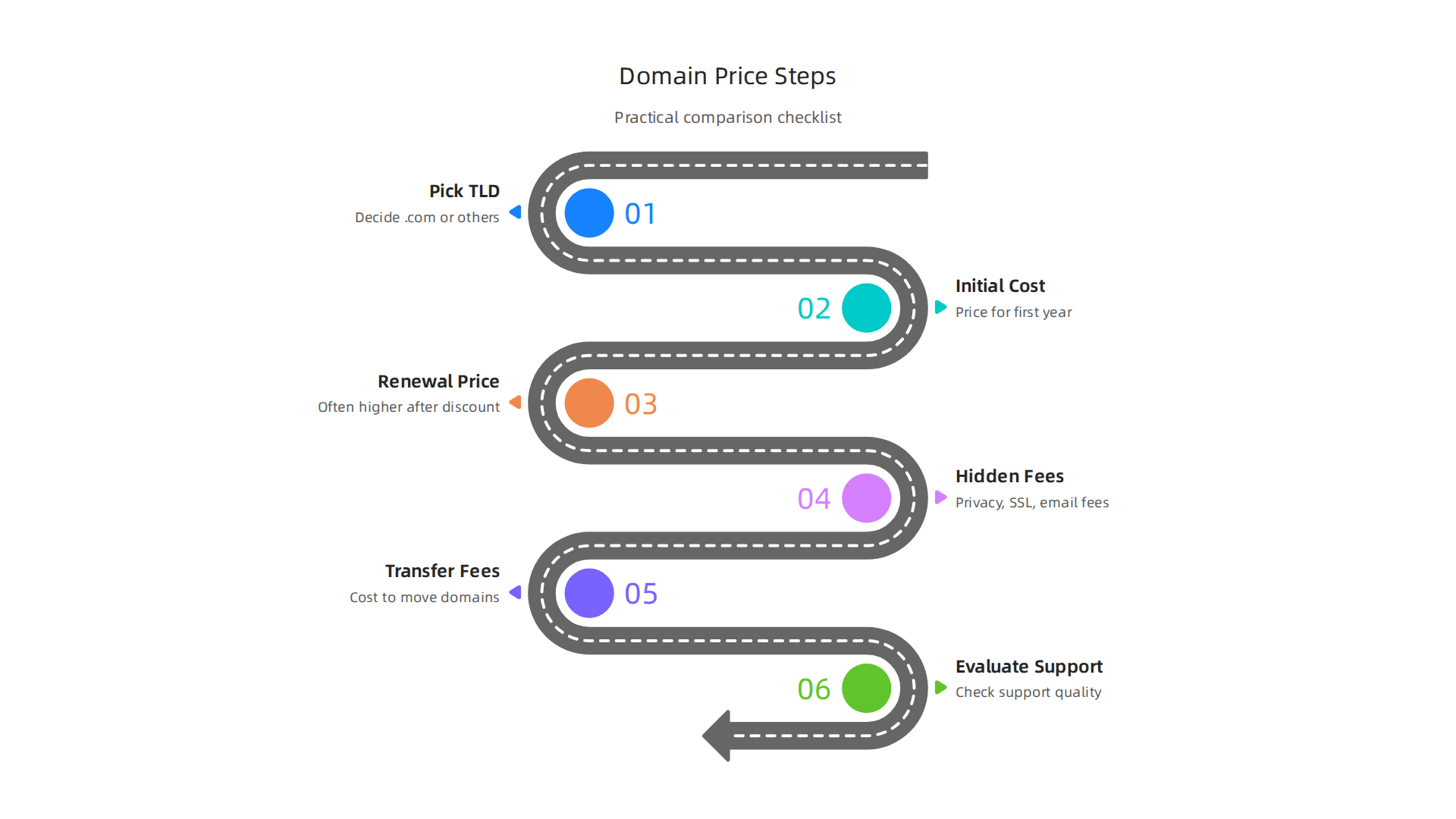
- Pick Your Top-Level Domain (TLD) First: Decide if you need a classic .com, a .org, or one of the newer options like .store or .online. Remember, different TLDs have different base prices from the registry. A .com might feel standard, but a specific new TLD could better fit your brand.
- Check the Initial Registration Cost: This is the price you pay for the first year. Many registrars, like GoDaddy or Hostinger, offer very low prices for your first year to attract new customers. You might see a
godaddy domain priceorhostinger pricingthat looks great, sometimes as low as $1 to $5 for the first year. - Find the Renewal Price: This is super important! The renewal price is often much higher than the first-year discount. For example, a .com domain that costs $5 in the first year might jump to $15 or even $20 to renew in its second year. This is where many businesses get caught off guard, as renewal costs in 2026 can range widely for a .com domain, from about $8 to $20 per year depending on the registrar [Source: blog.webhostmost.com/domain-renewal-cost/ (Domain Renewal Cost 2026: Why Prices Jump 300% After Year 1)]. Always look for the renewal price before you buy. You can learn more about these jumps by reading our guide on domain name renewal price comparison.
- Look for Hidden Fees and Add-ons:
- Domain Privacy Protection: This service hides your personal information from public databases. While it’s a good idea for privacy, it often costs extra, usually $5 to $15 per year. Some registrars offer it for free for the first year, then charge for it later.
- SSL Certificates: These make your website secure (you’ll see "https://" in the address). Many registrars offer a basic SSL for free, but premium ones cost money.
- Email Hosting: If you want an email address matching your domain (like you@yourbusiness.com), that’s often an extra service.
- Consider Transfer Fees: If you ever want to move your domain to a different registrar, there might be a transfer fee. While not a cost you pay right away, it’s good to know.
- Evaluate Customer Support: Good support is priceless when you run into problems. Some low-cost providers might have slower or less helpful support. This isn’t a direct
domain name registration cost, but it adds value.
Setting Up Your Comparison Table
A simple table can help you keep track of all these different prices. Here’s what it might look like:
| Registrar | TLD | Initial Cost (Year 1) | Renewal Cost (Year 2+) | Privacy Cost (Yearly) | Total 2-Year Cost | Notes |
|---|---|---|---|---|---|---|
| GoDaddy | .com | $1.99 | $21.99 | $9.99 | $43.97 | Often runs sales |
| Hostinger | .com | $9.99 | $14.99 | Free | $24.98 | Good for beginners |
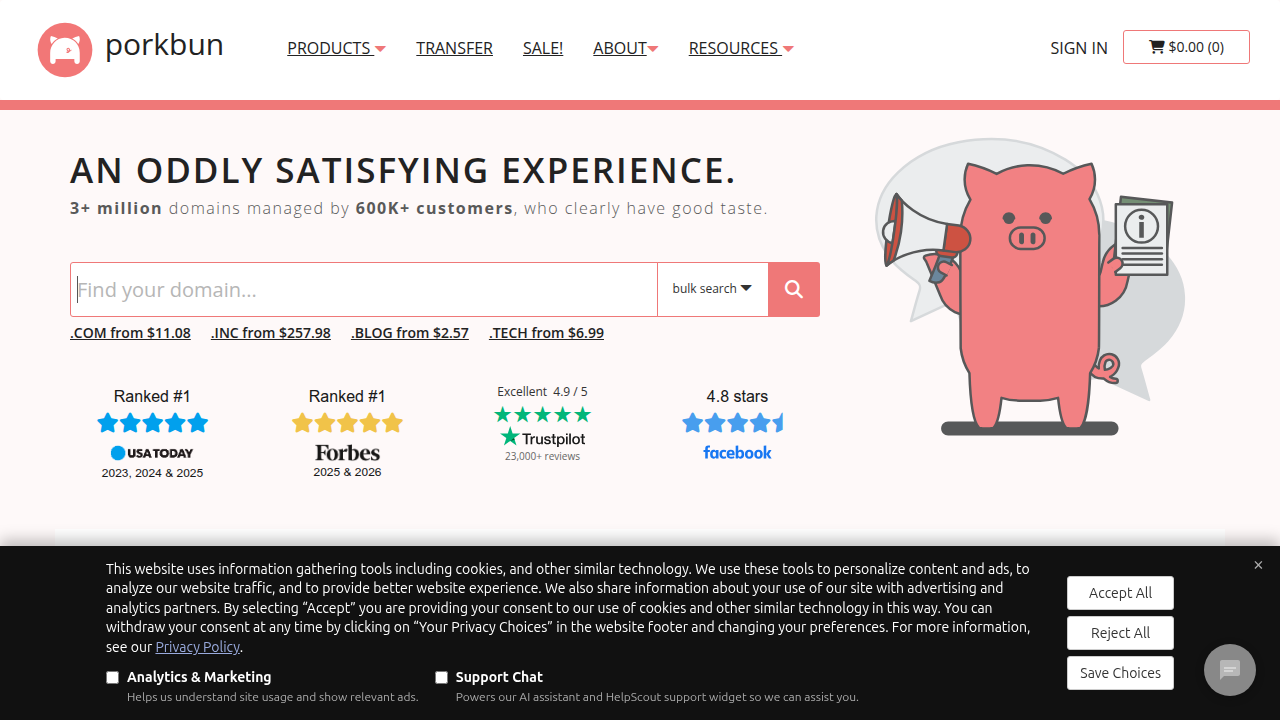
| Porkbun | .com | $10.67 | $10.67 | Free | $21.34 | Clear pricing |
(Prices are examples and can change.)
By using a table like this, you can quickly see the true domain name registration cost and avoid surprises later on. Comparing a few different registrars side-by-side helps you find reputable providers that offer transparent pricing and reliable service. You can also explore options from the best domain registrars in 2026 to assist in your decision.
One big thing to remember when you do a domain price comparison is that the first price you see might not be the real cost to buy a domain name. Many companies use special offers to get you to sign up.
Promotions, First-Year vs. Renewal Fees, and Hidden Costs to Watch
Companies like GoDaddy and Hostinger often show very low prices for the first year. You might see a godaddy domain price or hostinger pricing that looks super cheap. This is a common way to attract new customers, much like how businesses use promotional marketing to get people interested What Is Promotional Marketing? Your Guide to Getting …. They hope you will stay with them for a long time.
But here’s the catch: the price usually goes up a lot after that first year. This is called the renewal fee. What might cost you just a few dollars for the first year could jump to $15 or even $20 or more for the second year and beyond. This is why it’s super important to always look for the renewal price before you buy. Some registrars have clear and predictable pricing, but others use low starting prices that lead to much higher costs later on Domain Registrar Comparison: A Technical Guide for IT …. If you don’t check this, the true domain name registration cost can surprise you.
To get a real idea of the cost to buy a domain name, you need to calculate the price for at least two years. Add the first-year cost to the renewal cost for the second year. This gives you a much better picture. For example, a domain that’s $5 for the first year and $15 to renew for the second year actually costs $20 for two years, not just $5. Many hosting companies might even charge $20 to $30 yearly for a .com domain after a free first year, while dedicated domain registrars are often less expensive Why You Should (or Shouldn’t) Register Your Domain ….
Besides the renewal jump, watch out for these hidden costs and extra services:
- WHOIS Privacy: This keeps your personal information (like your name and address) private from public view. It’s often an extra fee, typically $5 to $15 per year, though some companies offer it free forever.
- SSL Certificates: These make your website secure, showing "https://" in the web address. Basic ones are often free, but advanced ones cost money.
- Email Hosting: If you want a custom email address like "yourname@yourwebsite.com", this is usually an extra service. Some providers bundle these services, but it’s often better to buy them separately to save money Is Bundled Hosting, Domain & Email Better Than Separate?.
- Transfer Fees: If you decide to move your domain to a different registrar, there might be a small fee.
- Domain Lock Changes: Some registrars might charge to unlock your domain if you want to move it, though this is less common now.
- Restoration Fees: If your domain name expires and you don’t renew it in time, bringing it back can cost a lot of money, sometimes hundreds of dollars.
- Taxes (VAT/GST): Depending on where you live, you might need to pay extra taxes on top of the listed price.
Understanding these details is key to a smart domain price comparison. It helps you pick the best provider for your needs, not just the one with the lowest initial price. To learn more about all the costs involved, take a look at our guide on the cost to buy a domain name 2026 price guide and hidden fees.
For robust, secure, and fast hosting that makes managing your website simple, consider Prism Web Host. We focus on giving businesses a smooth online experience without technical headaches.
When you think about the true cost to buy a domain name, it’s helpful to look at two main ways people get them. You can buy your domain from a company that only sells domains, called a dedicated registrar. Or, you can get it as part of a package deal with a web hosting company. Both ways have their good and bad points, especially when you are doing a domain price comparison.
Registrar vs Hosting-Bundled Domain: Pricing Trade-Offs and When to Bundle
Buying your domain from a special domain registrar like Namecheap or Porkbun is often the simpler choice. These companies focus just on domains. This means their prices for domain name registration cost can be very clear, often staying the same for years. For example, a .com domain might cost around $15 to $20 each year without big surprises. Some even offer free WHOIS privacy, which keeps your personal details hidden, and is a key security feature Domain Registrar Features Compared: Complete 2026 …. If you want to move your domain later, it is usually easy to do because they specialize in this.
Now, let’s look at getting a domain with your hosting. Many hosting companies offer a free domain name for the first year if you sign up for their hosting plan. This might sound like a great deal for a small business just starting out. It means you get your website address and the space to put your website all from one company. This can feel easier to set up at first, as everything is in one place Top 5 Reasons Domain with Hosting Package Wins.
However, there are some important things to watch out for with these bundled deals:
- Higher Renewal Costs: While the first year might be free or very cheap (like a low
godaddy domain priceorhostinger pricing), the renewal price often jumps up a lot. Hosting companies might charge $20 to $30 or more per year for a .com domain after the first year. This is often more than what a dedicated registrar charges for renewals. - Less Control and Portability: If your domain is tied to your hosting, it can be harder to move your website to a different hosting company later. This is called portability. If you ever want to change hosts for better prices or service, having your domain separate gives you more freedom.
- Customer Support: When you have problems, it might be unclear if you should contact the hosting side or the domain side of the company. Having them separate can sometimes mean clearer support lines.
- Extra Services: Sometimes, bundled deals might push extra services you don’t really need, making the overall
cost to buy a domain namehigher in the long run. Many experts actually suggest buying your domain and hosting from different companies to avoid these issues PSA: Don’t buy your domain through your web host.
Here’s a quick look at the main differences:
| Feature | Dedicated Domain Registrar | Hosting-Bundled Domain |
|---|---|---|
| Initial Price | Clear, standard annual fee | Often free or very cheap for first year |
| Renewal Price | Usually stable and predictable | Often much higher after first year |
| Control & Flexibility | High, easy to move domain | Lower, can be harder to move |
| Setup | You link domain to host yourself | Often automatically set up |
| Long-Term Cost | Often more budget-friendly | Can be more expensive overall |
| Focus | Domains only | Hosting is main focus, domain is extra |
For small businesses, it often makes more sense to keep your domain and hosting separate. This gives you better control and more transparent pricing over time. It allows you to shop for the best domain name registration cost and the best hosting separately.
If you’re looking to understand more about getting the most value when buying and renewing your domain name, make sure to read our guide on how to master your domain name registration cost and avoid hidden fees.
While comparing the cost to buy a domain name is important, the actual value you get isn’t just about the numbers you see.

Think about it: a very low godaddy domain price or hostinger pricing might look great at first. But what about important things like security, keeping your information private, and getting help when you need it? These non-price things really change the total value of your domain in the long run.
Security, privacy, and support: non-price factors that change total value
When you’re doing a domain price comparison, don’t forget to look at what’s included beyond just the yearly fee. Extra features like domain privacy and strong security can save you from big headaches and costs later.
Domain Privacy: Keeping Your Details Safe
When you register a domain, your name, address, email, and phone number are usually put into a public database called WHOIS. This means anyone can look up who owns your website. This can lead to unwanted spam, telemarketing calls, and even attempts to hack your website.
This is where domain privacy, sometimes called WHOIS privacy, comes in. It hides your personal information from the public eye, replacing it with the registrar’s details. Many good registrars offer this for free or at a small extra domain name registration cost. For example, GoDaddy now often includes free domain privacy for many eligible domains, helping protect your information and cut down on spam and scams Your domain’s complete security guide. It’s a small thing that makes a big difference for your peace of mind.
Strong Security Features: Stopping Bad Actors
Having a secure domain means more than just a strong password. Reputable domain registrars offer features that act like strong locks on your website’s address. Here are some key ones:
- Two-Factor Authentication (2FA): This adds an extra step to log in, like a code sent to your phone, even if someone knows your password Security Best Practices for Registrar Accounts. Many experts say using an app for 2FA is better than getting a text message Choosing a Secure Domain Registrar.
- Registrar Lock: This stops anyone from moving your domain to another company without your permission. It’s like putting a "do not transfer" sign on your domain Domain Security Checklist for Registrar and DNS.
- DNSSEC (Domain Name System Security Extensions): This helps protect your website from being sent to the wrong place by making sure the right address information is used. It stops hackers from sending your visitors to fake websites Domain Security Best Practices.
These security layers are crucial in 2026. Without them, your website could be at risk of being hijacked, which means someone else could take control of your domain.
The Importance of Good Support
Imagine your website suddenly stops working. Every minute it’s down, you could be losing customers and money. This is where good customer support from your domain registrar or hosting company becomes priceless. If your cost to buy a domain name doesn’t include easy-to-reach, knowledgeable support, that "cheap" domain could end up costing you a lot in lost business and stress.
When you’re choosing a registrar, look for companies known for great 24/7 support and clear ways to get help. This ensures that if something goes wrong, you can get it fixed fast.
The Real Cost of Poor Domain Management
A low domain name registration cost might seem appealing, but poor domain management can lead to much higher costs down the road. If your domain is hijacked or your website experiences long downtime because of bad security or slow support, it can damage your business’s reputation and lead to lost sales. The cost of recovering a hijacked domain, or moving your website because of a bad registrar, can be much higher than any savings you made on a cheap initial price. That’s why considering these non-price factors is a vital part of any true domain price comparison.
Want to learn more about picking the right company for your domain? Read our guide on how to find reputable domain name registrars that protect your business.
For a secure and reliable online presence, consider a host that prioritizes these aspects. Discover hosting solutions built for security and performance by visiting Prism Web Host.
When you are doing a domain price comparison, it’s easy to get caught up in the first number you see. But to truly pick the best home for your website, you need a clear way to compare more than just the price tag.
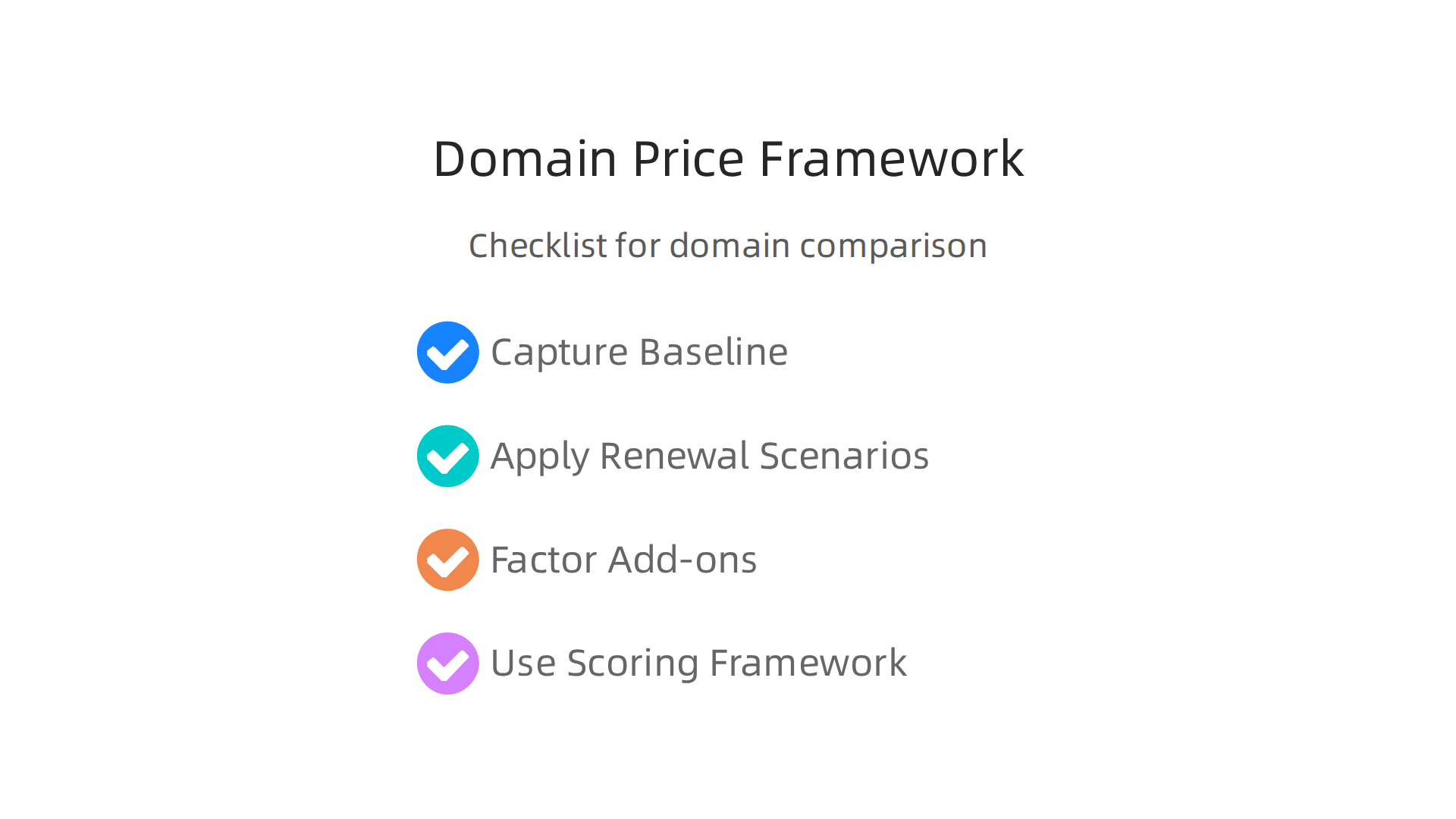

Here’s a simple checklist and a way to think about your choices, so you find a good deal without missing important things like security and support.
How to run a domain price comparison: checklist and decision framework
To really understand the true cost to buy a domain name, you need to look at a few things. It’s like buying a car; the sticker price is just the start.
Step 1: Capture Baseline Prices
First, list out a few domain registrars you are thinking about. These could be big names like GoDaddy or Hostinger, or others you’ve heard about. For each one, find out:
- Initial Registration Cost: What’s the cost for the first year? This is often a special "new customer" deal, so write it down clearly. This is your
domain name registration cost. - Renewal Cost: This is super important! The renewal price is usually much higher than the first-year price. Go to each registrar’s website and search for their domain renewal prices. Don’t skip this step, as it can change your
domain price comparisona lot. You might even find tools online that help you compare domain prices across registrars for different terms. - Transfer-In Cost: If you already have a domain and want to move it, check this cost.
- Required Term: Some registrars make you sign up for two years or more to get the best first-year deal. Make a note of this.
Step 2: Apply Realistic Renewal Scenarios
Now that you have the baseline prices, think about how long you plan to keep your domain. Most businesses keep their domain for many years.
- Calculate 2-Year Cost: Add the first-year cost to the second-year renewal cost. This gives you a more real
cost to buy a domain nameover time. - Calculate 5-Year Cost: Do the same for five years. This will show you how much the price can jump after those intro deals run out.
- Hidden Fees: Look for any extra fees like ICANN fees, which are small but can add up.
Many small businesses find themselves surprised by higher prices after the first year. To learn more about this, check out our guide on domain name renewal price comparison to stop overpaying.
Step 3: Factor in Add-ons and Support Needs
Remember, it’s not just about the numbers. The extra features and help you get make a big difference.
- Domain Privacy: Is it free or an extra cost? As discussed before, this protects your personal information.
- Security Features: Do they offer two-factor authentication (2FA), Registrar Lock, or DNSSEC for free? These are vital for keeping your website safe in 2026.
- Customer Support: How easy is it to get help? Is it 24/7? Is it through chat, phone, or email? Good support is priceless when things go wrong.
Step 4: Use a Simple Scoring Framework
After gathering all this info, it’s time to put it all together. A simple scoring framework can help you see which registrar offers the best total value. You can even use tools like a comparison chart maker to visualize your options.
Here’s a basic table you can use:
| Feature | Registrar A (e.g., GoDaddy) | Registrar B (e.g., Hostinger) | Registrar C (Other) |
|---|---|---|---|
| Initial Cost | $ (Score 3 for low, 1 for high) | $ (Score 3 for low, 1 for high) | $ (Score 3 for low, 1 for high) |
| Renewal Cost (Year 2) | $ (Score 3 for low, 1 for high) | $ (Score 3 for low, 1 for high) | $ (Score 3 for low, 1 for high) |
| Domain Privacy | Free (Score 3) / Extra (Score 1) | Free (Score 3) / Extra (Score 1) | Free (Score 3) / Extra (Score 1) |
| Security (2FA, DNSSEC) | Included (Score 3) / Some (Score 2) / None (Score 1) | Included (Score 3) / Some (Score 2) / None (Score 1) | Included (Score 3) / Some (Score 2) / None (Score 1) |
| Support (Quality/Speed) | Excellent (Score 3) / Good (Score 2) / Okay (Score 1) | Excellent (Score 3) / Good (Score 2) / Okay (Score 1) | Excellent (Score 3) / Good (Score 2) / Okay (Score 1) |
| Total Score | (Sum of scores) | (Sum of scores) | (Sum of scores) |
By using this kind of table, you can clearly see which provider gives you the best mix of low domain name registration cost and important features. This helps you choose a registrar that won’t give you headaches or unexpected costs later. Finding the cheapest domain hosting in 2026 means looking beyond just the upfront fees. It’s about getting real value for your money.
Summary
This article explains how to evaluate the true cost to buy a domain name so small businesses and brands avoid surprise bills. It covers who sets prices (registries, registrars, and ICANN), the parts that make up the final fee (wholesale registry cost, registrar markup, ICANN fees, taxes), and how TLD choice and scarcity affect pricing. The guide shows why first‑year promotional prices can be misleading, how renewal jumps and bundled services raise long‑term costs, and which hidden fees to watch (privacy, SSL, email, transfers, restorations). You’ll learn a practical comparison process: capture baseline prices, model 2‑ and 5‑year costs, factor add‑ons and support, and use a simple scoring table to pick the best value. After reading, you’ll be able to calculate the real multi‑year cost, compare registrars versus hosting bundles, and choose a provider that balances price, security, and support.
