




Master Your Domain Name Registration Cost and Avoid Hidden Fees
Article
Why domain name registration cost matters for your business
Getting your business online starts with a domain name. Think of it as your online address. In 2026, there are many domain names registered around the world, making it a busy online space [^1^].
It might seem like the cost to buy a domain name is a simple, one-time thing, but actually, there’s more to it. Understanding the full domain name registration cost is super important for any business owner, especially those running small or medium-sized businesses.

At first, a domain might look cheap. You might see a .com domain for just $10 to $20 for the first year [^1^]. But this is often just the starting price. The real domain name registration cost includes renewal fees, which can be much higher than the first year’s deal [^2^]. For example, renewing a .com domain in 2026 can cost anywhere from $8 to $22 each year, depending on where you bought it [^3^]. Plus, you might need extra services like privacy protection or a secure certificate, which add to your overall web hosting cost.
For a business, a good domain name is like gold. It helps people find you easily. If you don’t keep track of the full domain cost, you could lose your domain name. This could lead to your website going down, which means customers can’t find you. That’s called downtime, and it can really hurt your brand and business. Planning for these costs helps protect your brand and makes sure your website stays online. It also helps you budget for growth, so you know exactly what you’re spending on your online home each year.
To truly understand what goes into your web address, including how to pick the right one, you can learn more about the domain name meaning how to understand your web address and choose the right one.
Thinking about these longer-term expenses helps you avoid surprises and keeps your business running smoothly online.
[^1^]: Domain Name Statistics 2026: Registrations, Market Size …
[^2^]: 3. Namecheap
[^3^]: Domain Renewal Cost 2026: Why Prices Jump 300% After …
To avoid those surprises, let’s look closer at how domain name registration cost really works. There are a few different prices you’ll run into when you own a domain name.
Knowing these helps you plan your money better.
Different Kinds of Domain Costs
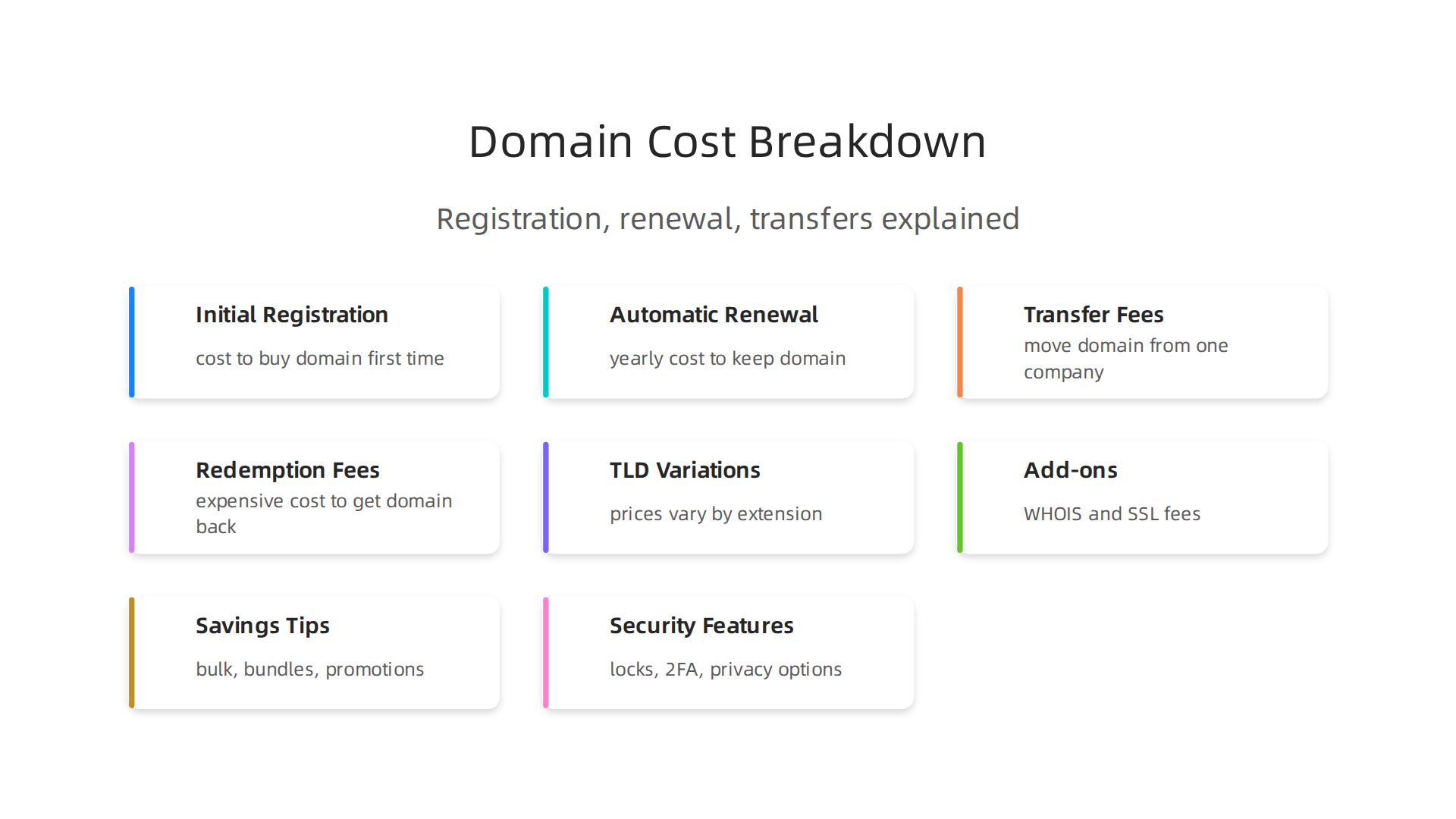
- Initial Registration: This is the
cost to buy a domain namefor the first time. It’s often cheap, like a special introductory offer. You might get a great deal for the first year, sometimes even for multiple years. This is a one-time charge for that first period. - Automatic Renewal: After your first registration period ends, the price usually goes up. This is your yearly
domain name registration costto keep owning your domain. It’s a recurring cost, meaning you pay it every year or every few years. Always check these renewal prices before you buy, as they can be much higher than the first-year price. You can find out more about how prices change with a domain name renewal price comparison. - Transfer Fees: Sometimes, you might want to move your domain name from one company (called a registrar) to another. This is called a transfer. Often, the transfer fee is about the same as a renewal fee, and it usually adds another year to your domain’s life. So, it’s not just a move, it’s also like a renewal with your new company.
- Redemption Fees: This is a cost you really want to avoid. If you forget to renew your domain name and it expires, it enters a "redemption period." During this time, you can still get your domain back, but it costs a lot more money. These fees can be very high, sometimes over $100. If you don’t get it back during this period, someone else can buy your domain, and you lose it forever. Keeping your domain secure is very important for your business, as highlighted in the Domain Security Report 2026 – CSC.
Most domain registrars set up your renewals to happen automatically. This is usually helpful so you don’t forget and lose your domain. But it means you need to keep an eye on the domain price comparison and your bank account. The web hosting cost for your website might include a "free" domain for the first year, but remember to look at the renewal price for both the domain and the hosting. Even for a simple WordPress domain cost, these different pricing events apply. Knowing these details helps you understand the full financial picture for your online home.
Now that we know about the different kinds of fees, let’s talk about how the type of domain name itself affects how much you pay. Not all domain names cost the same. The price often changes based on what the last part of your web address is, like ".com" or ".store."
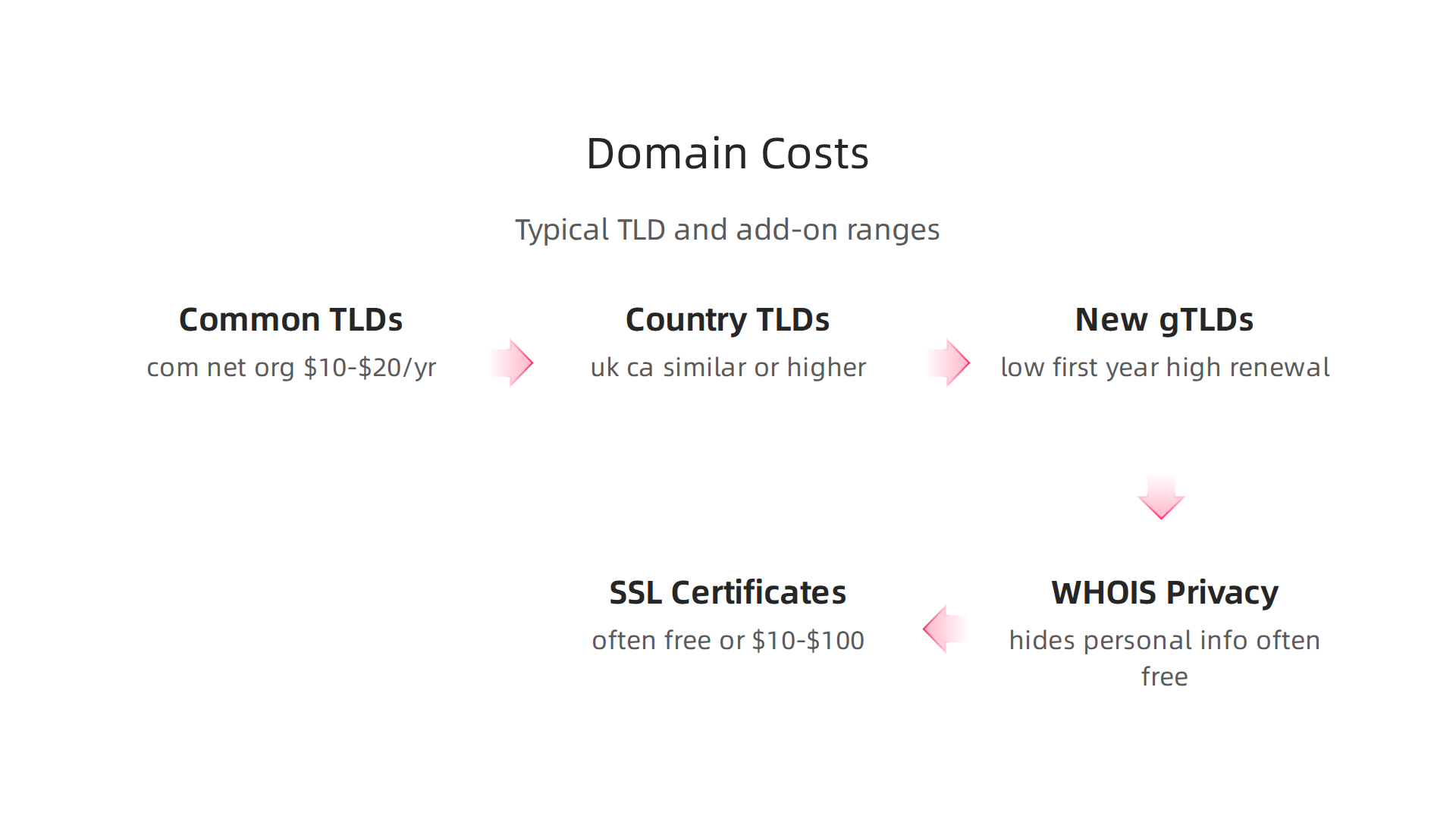
Typical costs by TLD and feature: common price ranges and examples
When you decide on a name for your website, the ending part, called a Top-Level Domain (TLD), makes a big difference in the domain name registration cost.
- Common TLDs (.com, .net, .org): These are the most well-known domain endings. For example, a ".com" domain is very popular. You can expect to pay around $10 to $20 per year for a new ".com" domain. The yearly renewal price for these is usually in a similar range, though some registrars might charge a little more for renewal than the first-year promo price. For instance, in 2026, many registrars list .com renewals between $14 and $18 per year, with some as low as $8.00 depending on the provider. These TLDs are considered "legacy gTLDs" and often have stable pricing compared to newer options, as mentioned in a gTLD Pricing Comparison. There are over 392.5 million domain names registered worldwide, with .com being the most common choice, according to Domain Name Statistics 2026.
- Country-Code TLDs (like .uk, .ca): These TLDs are specific to certain countries. Their
cost to buy a domain namecan be similar to .com, or sometimes higher. For example, a ".com.au" domain in Australia might cost around A$10-20 for the first year. - New gTLDs (like .online, .store, .tech): In recent years, many new TLDs have become available. These often come with very low first-year prices, sometimes just a few dollars. But be careful! Their renewal prices can be much, much higher. For example, a ".store" domain might be $1 to $4 for the first year but jump to $35 to $40 for renewal. This big price difference between the first year and renewal is a key thing to watch when looking at a
domain price comparisonfor new gTLDs. You can learn more about how to avoid these pricing surprises by checking out tips on cheapest domain extensions.
Beyond the domain itself, extra services can add to your domain name registration cost.
- WHOIS Privacy: This service hides your personal information (like your name and address) from public view. Many good registrars offer this for free. However, some might charge an extra $5 to $15 per year for it.
- SSL Certificates: An SSL certificate makes your website secure, showing a padlock icon in the browser. This is very important for any website, especially if you sell things or collect information. Many hosting companies include a basic SSL certificate for free with their
web hosting cost. But if you need a more advanced one, or if your host doesn’t offer it free, it could cost you an extra $10 to $100 per year. For example, you can learn more about specific costs for security features by looking into GoDaddy SSL certificate cost 2026.
When picking your domain and planning for your website, think about both the first-year price and the renewal costs for all these items. Even if you’re setting up a simple WordPress domain cost, these details apply. Prism Web Host offers a range of domain and hosting services to help you find the right fit for your budget. You can explore more at Prism Web Host – Domain & Hosting Services. Always check the total cost over several years to avoid surprises.
Beyond the main cost of your domain name, there are other services that registrars offer. These extras can make your website better or easier to manage. But they also add to your total domain name registration cost.
Registrar fees and add-ons to watch (WHOIS privacy, DNS management, transfers)
When you register a domain, you might see these extra services:
- Privacy Protection: We talked about this before. It keeps your personal details private. Many good companies give this for free, but some might charge you.
- Premium DNS: DNS helps people find your website when they type in your domain name. Premium DNS services are often faster and more reliable. This means your website loads quicker and is less likely to have issues. It can be a helpful add-on, though it increases your
cost to buy a domain name. - Email Forwarding: This lets you create a professional email address using your domain name, like "hello@yourwebsite.com". Messages sent to this address then go to your regular email, like your Gmail account. It’s a simple way to look more professional.
- Concierge Transfer Services: If you need to move your domain from one registrar to another, some companies offer a service to help you do it. They handle all the steps, which can be useful if you’re not tech-savvy. This convenience often comes with an extra fee.
Moving Your Domain (Transfers)
Sometimes, you might want to move your domain to a different company, maybe to get a better domain price comparison for renewal or better service. This is called a domain transfer.
- Transfer Fees: While moving a domain is often free or includes a year’s renewal at the new registrar, some registrars might charge a small fee. This adds to your
domain name registration costfor that year. - Transfer Locks: There are rules about when you can transfer a domain. After you first register a domain or move it to a new registrar, there’s usually a 60-day waiting period where you cannot transfer it again. This is called a transfer lock and is set by ICANN, the group that oversees domain names, to help keep your domain safe from being stolen. You can learn more about these rules in the FAQs for Registrants: Transferring Your Domain Name. Sometimes, a domain can also be locked if you change your contact information.
- Promotional Prices and Renewals: Many registrars offer very low prices for the first year to get you to sign up. This is great for your first
wordpress domain costor any website. But always check the renewal price! It can be much higher after the first year. Looking at the totalweb hosting costand domain renewal costs over a few years will help you avoid surprises. For example, you can compare different companies using a domain name renewal price comparison tool.
Choosing the right registrar and understanding all the potential costs, including any fees for add-ons or transfers, is important. It helps you find reliable service at a fair price and avoid unexpected bills down the road. To dive deeper into finding the right fit for your website needs, consider exploring resources on how to find reputable domain name registrars.
Choosing the right registrar helps you find good service at a fair price and avoid surprise bills. But you can also be smart about how you buy to save even more on your domain name registration cost. Here are some ways to keep your costs low:
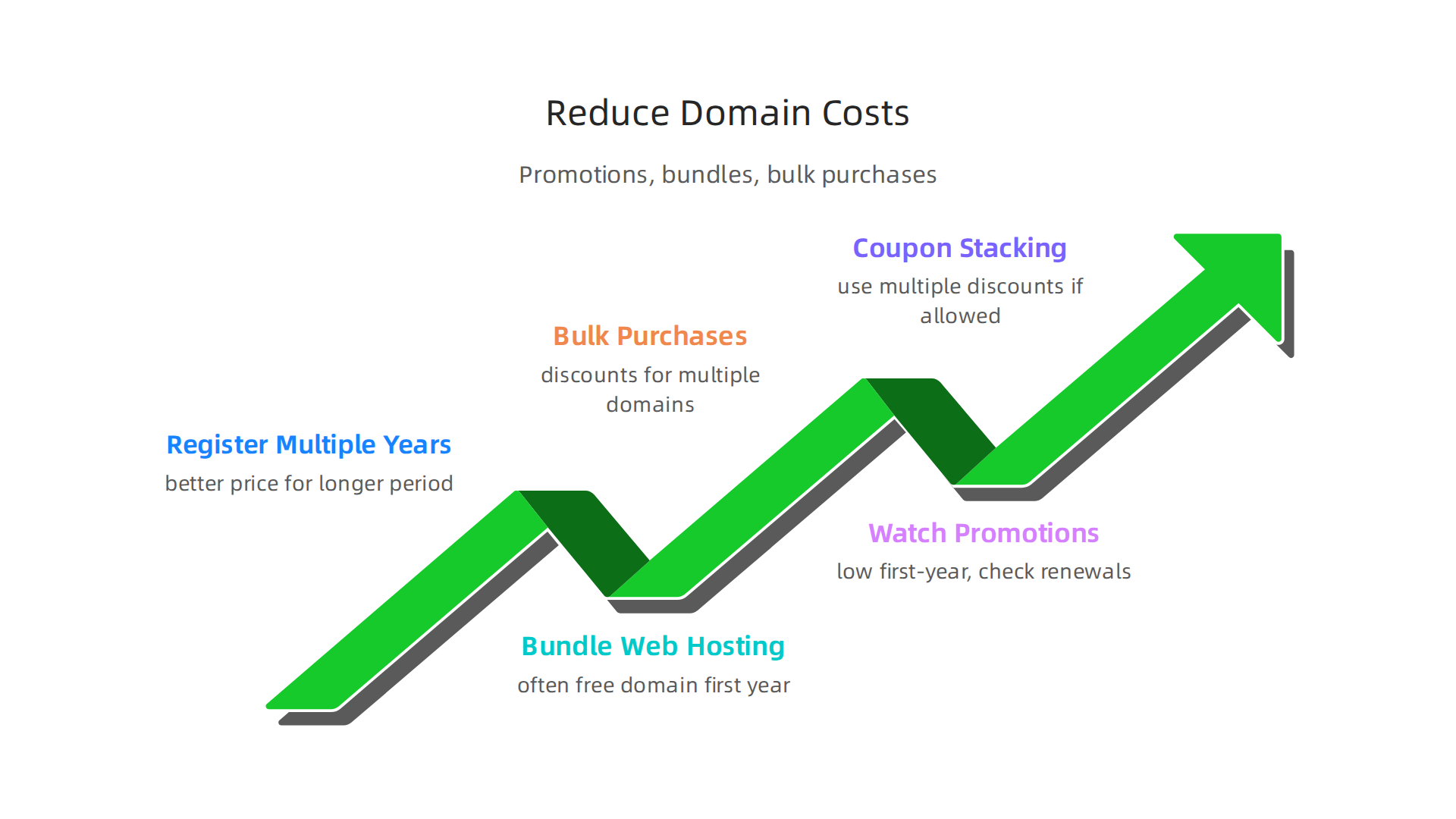
How to save on domain costs: promotions, bulk purchases, and bundles
Finding good deals can really help reduce the cost to buy a domain name. Here’s how to look for them:
-
Register for Multiple Years: Many registrars offer a better
domain price comparisonif you register your domain for more than one year at a time. Instead of paying yearly, you might save money by signing up for two, three, or even five years. This also protects your domain name for longer, so you don’t have to worry about renewing it as often. Just remember to check the total cost upfront to make sure it’s a real saving. -
Bundle with Web Hosting: A common way to save is to buy your domain name and web hosting together. Many hosting companies give you a free domain name for the first year when you sign up for their hosting plan. This can greatly lower your initial
wordpress domain costor any website’s cost. This is also a good way to save on your overallweb hosting cost. For instance, a reliable provider like Prism Webhost offers secure hosting environments that often include domain registration to help businesses launch easily. To get started with a hosting plan that covers all your bases, you can learn more about Hostinger Website Builder Review 2026 What SMBs Need to Know. -
Bulk Domain Purchases: If you need many domain names, perhaps for different projects or to protect your brand, buying them in bulk can save you money. Registrars often have special discounts for customers who register multiple domains at once. This reduces the
domain name registration costfor each individual domain. -
Watch for Promotions and Renewal Prices:
- Low First-Year Prices: You’ll often see very low prices, sometimes just a few dollars, for a domain’s first year. This is a common way for companies to attract new customers. While tempting, always look at the renewal price. Some domain types, especially newer ones called gTLDs, might have a very low first-year price but jump significantly when it’s time to renew. For example, some new gTLDs might cost less than $3 to register but over $30 to renew, as noted in domain pricing trends for 2026 TLD Price Comparison – First-Year and Renewal.
- Comparing TLD Prices: Popular domain endings like
.com,.net, and.orgtend to have more stable renewal prices, often around $10 to $15 per year, according to a gTLD Pricing Comparison. However, newer gTLDs like.onlineor.storemight have promotional first-year rates that are much lower, but their renewal costs can be quite high. The group that manages domain names, ICANN, does not put price limits on these newer gTLDs, which means their prices can change more often ICANN Renewal of Legacy TLD Contracts. Always compare both the starting and renewal costs to understand the truedomain cost per year. - Coupon Stacking: Some registrars let you use more than one discount at a time, which is called "coupon stacking." This isn’t common, but if you find a registrar that allows it, you can get even deeper discounts.
By using these tips, you can greatly reduce your overall domain name registration cost and avoid any unexpected bills, helping your website stay online for less.
While knowing how to find deals helps lower your upfront costs, it’s also important to understand the hidden fees and long-term expenses that can affect your overall domain name registration cost. Sometimes, the true cost to buy a domain name isn’t just the price you see when you first sign up.
Hidden Fees and Long-Term Cost Considerations
Many people get caught off guard by costs that pop up later.

Here’s what to look out for:
1. Redemption Fees After Expiration
What happens if you forget to renew your domain name? After your domain expires, there’s usually a short period where you can still renew it at the regular price. But if you miss that window, your domain goes into a "redemption period." During this time, you can still get your domain back, but it will cost you a lot more. This extra charge is called a redemption fee. These fees can range from $50 to hundreds of dollars, making the cost to get your domain back much higher than its yearly renewal price.
Losing your domain can be very bad for your business, especially if it’s tied to your website and email. Preventing this means keeping track of renewal dates and making sure your payment info is always up to date. Many registrars offer email reminders to help you avoid accidental lapses. For more details on what determines your annual domain expense, see our guide on domain cost per year.
2. Domain Backorder and Auction Costs
If your domain name isn’t renewed during the redemption period, it eventually becomes available for others to buy. This is where domain backorder services and auctions come into play. People or businesses who want your expired domain can "backorder" it, hoping to grab it the moment it becomes available. If more than one person wants it, it can go to auction.
Buying a domain through an auction can be expensive. While some domains might sell for a normal registration fee, popular or valuable domains can go for hundreds or even thousands of dollars. In 2026, the average sale price for domains in the aftermarket was about $2,345, with a typical transaction around $600, according to a 2026 Global Domain Report. This is another reason why keeping your domain renewed on time is so important, to avoid these high costs and the risk of losing your brand online.
3. Domain Parking: Monetization vs. Costs
Domain parking is when you register a domain name but don’t use it for a website or email right away. Instead, you "park" it, often displaying simple ads on it. Some people hope to earn money from these ads or sell the domain later for a profit. However, it’s rare to make much money from parked domains.
While parking a domain might seem like a way to cover the domain name registration cost, it often doesn’t. You still have to pay the yearly renewal fees, which typically range from $10 to $20 for common extensions like .com, as noted in 2026 domain statistics Domain Name Statistics 2026. The small amount of ad revenue you might get often doesn’t cover these costs. So, if you’re not planning to build a website, parking a domain mostly adds to your overall web hosting cost or domain cost without much return.
4. Premium Domain Renewal Spikes
As mentioned before, some newer domain endings (gTLDs) can have very low first-year prices. This can make the initial domain price comparison look great. But many of these come with much higher renewal fees later on. For example, a .online domain might have a cheap first-year price but a renewal cost of $30 to $40 per year Domain Extensions List: All TLDs & Domain Endings (2026). This is because the groups that manage these newer gTLDs are allowed to set their own prices without limits, leading to bigger price jumps over time. Always check the long-term renewal price to avoid a surprising increase in your domain name registration cost.
Understanding these hidden fees and long-term considerations helps you budget better and prevent unexpected expenses, keeping your website running smoothly without financial surprises.
Now that you know about the possible hidden costs and long-term expenses, it’s clear that the first price you see isn’t the only thing to think about when figuring out your domain name registration cost. Choosing the right place to buy your domain, called a registrar, is very important, especially for small to medium-sized businesses (SMBs). It’s a trade-off between the cheapest price and features that protect your business.
Choosing a Registrar for SMBs: Security, Support, and Performance Trade-Offs
When you pick a domain registrar, don’t just go for the lowest price. Think about how much security, good support, and strong performance your business needs. A very low domain price might seem good at first, but it can lead to bigger problems and costs later on.
Security Features You Must Have
Your domain name is like your online address. Keeping it safe is a big deal for your business.
Look for registrars that offer:
- WHOIS Privacy: This service hides your personal contact information from being publicly shown in the WHOIS database. Without it, anyone can easily find your name, address, and phone number, which can lead to spam or worse.
- Two-Factor Authentication (2FA): This adds an extra layer of safety to your account. Instead of just a password, you also need a code from your phone or another device to log in. This makes it much harder for hackers to get into your account. Many experts in 2026 agree that using multi-factor authentication is one of the best ways for SMBs to stay safe online Essential 2026 Security Controls for Every Growing SMB.
- Registrar Lock: This feature stops anyone from transferring your domain name away from you without your say-so. It’s a key step to prevent someone from stealing your domain. Turning on domain lock is a must-have for domain security, according to experts in 2026 Secure Your Domain 2026: Protection Tips & Best Practices.
Good Support and Strong Performance
Imagine your website goes down or you have trouble with your email. You need help fast. A good registrar will have:
- Reliable Customer Support: Can you reach them easily? Do they offer help 24/7? Good support means less stress and quicker fixes if something goes wrong.
- DNS Features: DNS (Domain Name System) is like the phonebook of the internet. Good DNS features mean your website loads quickly and reliably.
- Service Level Agreement (SLA) and Uptime: An SLA tells you what level of service you can expect, like how often your website will be online (uptime). Look for a high uptime guarantee, like 99.9% or more. This means your website is almost always working for your customers.
While a cheaper initial domain name registration cost might tempt you, choosing a registrar based on these important factors can save you from big headaches and extra web hosting cost in the long run. It’s about finding a balance that ensures your online business is safe, running well, and has the support it needs. For small businesses aiming for steady growth, looking beyond just the upfront domain price comparison is crucial.
If you are looking for reliable, secure, and high-performance website hosting with strong security features like DNSSEC and 99.99% uptime, consider checking out Prism Web Host. You can also learn more about how to find reputable domain name registrars that protect your business by reading our detailed guide on how to find reputable domain name registrars that protect your business.
Step-by-step cost comparison checklist (what to compare before checkout)
Since we know that choosing a good domain registrar means looking beyond just the first price, let’s create a simple checklist. This will help you compare different registrars and make a smart choice for your business.

It’s about finding the best value, not just the cheapest domain name registration cost.
Here’s what to compare before you buy:
- First-Year Price: This is the price you see advertised. It’s usually a low "introductory" rate to get you to sign up. Make sure to note this down.
- Renewal Price: This is super important. After your first year, the
domain name registration costoften goes up a lot. Some registrars might charge you $10 for the first year, but then $25 or even $50 to renew it for the second year. Always check the renewal price before you commit. You can learn more about how to avoid high renewal costs by reading our guide on domain name renewal price comparison. - Add-on Costs: Look for extra services that might add to your total
cost to buy a domain name.- WHOIS Privacy: We talked about this before. Some registrars offer it for free, while others charge a yearly fee.
- SSL Certificates: This helps keep your website safe and shows a padlock in the browser bar. Some registrars include a free basic SSL, others charge extra.
- Custom Email: Do you get a free email address like "yourname@yourdomain.com"? Or will that cost more?
- Web Hosting Cost: Sometimes, domain registrars will try to sell you hosting too. Make sure you know what you’re getting and how much it really costs, especially if you’re looking for
WordPress domain costsolutions that often come with hosting.
- Transfer Rules: What if you want to move your domain to a different registrar later? Most domains have a lock period. For example, you usually can’t transfer a domain within 60 days of buying it or moving it to a new registrar. This rule helps keep your domain safe from being stolen. Always check the terms, which are set by groups like ICANN, the main organization for domain names FAQs for Registrants: Transferring Your Domain Name.
- Support Hours: If you have a problem, can you get help quickly? Do they offer 24/7 support by phone, chat, or email? Good support can save you a lot of hassle.
- Security Features: As we mentioned, things like Two-Factor Authentication (2FA) and Registrar Lock are crucial for protecting your domain. Make sure these are offered and easy to turn on.
Building a Simple 1-3 Year Total Cost Spreadsheet
To make the best choice, create a simple spreadsheet. List each registrar you’re thinking about and break down the costs for 1 year, 2 years, and 3 years.
| Feature / Year | Registrar A (Example) | Registrar B (Example) | Registrar C (Example) |
|---|---|---|---|
| Year 1 Costs | |||
| Domain Price | $10 | $12 | $8 |
| WHOIS Privacy | $0 (Free) | $10 | $12 |
| Basic SSL | $0 (Free) | $0 (Free) | $40 |
| Total Year 1 | $10 | $22 | $60 |
| Year 2 Costs | |||
| Renewal Price | $25 | $30 | $28 |
| WHOIS Privacy | $0 (Free) | $10 | $12 |
| Basic SSL | $0 (Free) | $0 (Free) | $40 |
| Total Year 2 | $25 | $40 | $80 |
| Year 3 Costs | |||
| Renewal Price | $25 | $30 | $28 |
| WHOIS Privacy | $0 (Free) | $10 | $12 |
| Basic SSL | $0 (Free) | $0 (Free) | $40 |
| Total Year 3 | $25 | $40 | $80 |
| 3-Year Grand Total | $60 | $102 | $220 |
As you can see, the registrar that looked cheapest ($8 in Year 1) actually became the most expensive over three years! This simple domain price comparison helps you see the true domain name registration cost over time. This way, you can pick a registrar that truly offers good value and peace of mind for your small business, not just the lowest upfront cost to buy a domain name. Comparing these totals helps you avoid hidden fees and find truly cheapest domain hosting in 2026.
Summary
This article explains why understanding the full domain name registration cost matters for businesses and how the sticker price can hide bigger long-term bills. It covers the different types of fees you’ll meet—initial registration, renewals, transfers, redemption and premium auctions—and shows how TLD choice (.com vs new gTLDs vs country codes) strongly affects pricing. The guide also breaks down add-ons like WHOIS privacy, SSLs, premium DNS and transfer/concierge services, and why registrar features such as 2FA, registrar lock and reliable support are worth paying for. You’ll learn practical cost-saving tactics like multi-year registrations, bundling with hosting, bulk buys and watching renewal rates, plus a clear checklist to compare total cost of ownership. The article closes with a simple 1–3 year spreadsheet example so you can compare registrars by real lifetime cost, avoid hidden fees, and protect your brand online.
