




Find Winning Domain Name Ideas for Your Business in 2026
Article
Having the right website address, also known as your domain name, is a very big deal for any business or brand online in 2026. Think of it like the front door to your shop in the digital world. A good domain name helps people find you easily, remember you, and trust what you offer. It’s more than just an address; it’s a key part of your online identity and how well you do business.

When people search for things online, a clear and memorable domain name can make them want to click on your site. This is like a domain bias in web search, where people trust certain websites more because of their names. A strong domain can also help your website show up higher in search results, giving you a better domain rating and bringing more visitors to your site. This is a big part of why learning about good domain name ideas is so important. If you want to know more about what is a website domain, we have a guide for that.
Choosing a domain name, however, can be tricky. You might find yourself asking:
- Is the name I want even available?
- Does it truly fit my brand and help people know what I do?
- Will I run into legal problems, like using a name that someone else has already trademarked? You need to do a Domain Trademark Check: Screen Before You Buy (2026) to be safe.
- Can my domain name work well with the technical parts of my website?
This guide is here to help you through all these challenges. We’ll show you how to find great domain name ideas that are free to use, fit your brand, and are safe from legal issues. We’ll also help you understand your domain name value and even look at tools like unlock your domain value with GoDaddy Domain Appraisal. By the end, you’ll feel confident in picking the perfect domain name for your business, helping you stand out online and reach more customers.
Choosing a good domain name is a bit like naming a baby; you want it to be perfect, easy to remember, and fit who they are. Before you start listing all the cool domain name ideas, it’s really smart to first think about what your business is all about and what you want that name to achieve.

This helps you pick a name that truly works for you.
Understand Your Business and Who You’re Talking To
First, take a moment to define what makes your business special. What are your main values? Do you want to seem friendly, professional, modern, or trustworthy? Your domain name should give people a little hint about this.
Next, think about your customers. Who are they?
- Are they young people looking for fun products?
- Are they businesses needing serious services?
- Are they local folks in your town, or people all over the world?
Knowing your audience helps you choose words and styles that speak to them. For example, a local bakery might use its town’s name, while a global tech company would want a name that sounds good everywhere.
Set Clear Goals for Your Domain Name
Once you know your brand and audience, you can set specific goals for your domain name.
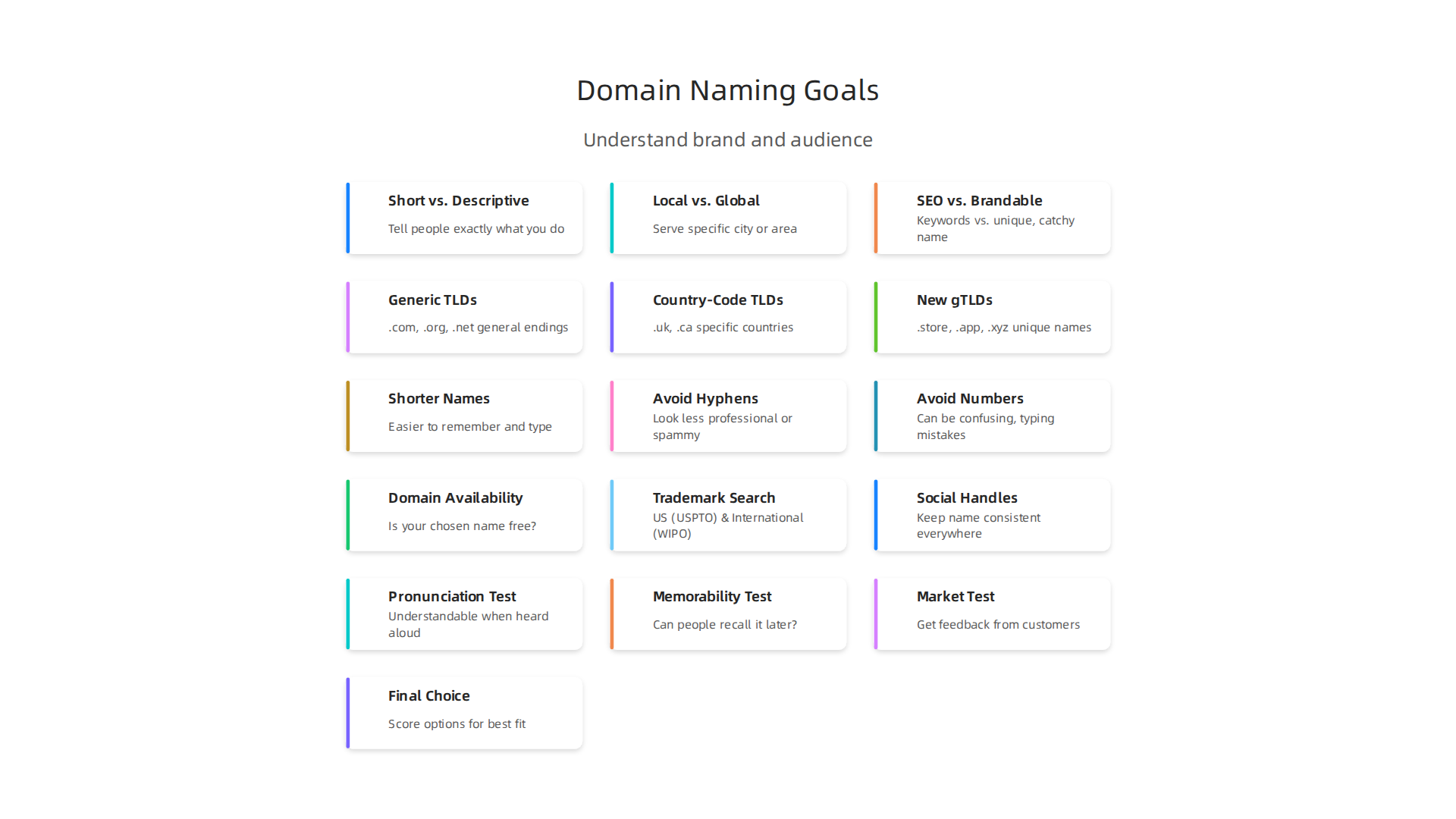
This will help you narrow down your choices and pick the best one.
-
Short vs. Descriptive:
- Short names are often easier for people to remember and type. They can be good for big brands that want to create their own unique word, like "Google" or "Zoom."
- Descriptive names tell people exactly what you do. For example, if you sell "fresh organic vegetables," your domain name might include those words. This can help new customers quickly understand your business.
-
Local vs. Global:
- If your business serves only a specific city or area, adding your location to the domain can be very helpful. Think "DenverCoffee.com."
- If you plan to serve people everywhere, a more general name is better, so it doesn’t sound like you’re only in one spot.
-
SEO vs. Brandable:
- SEO (Search Engine Optimization) focused names include keywords that people search for. If you sell "eco-friendly toys," a domain like "EcoFriendlyToysOnline.com" could help you show up in search results.
- Brandable names are unique, catchy, and easy to say. They might not contain exact keywords, but they help you build a strong, memorable identity. Think "Apple" or "Nike." These names often stick in people’s minds, which is super important for building a strong presence. It’s smart to test how easy a name is to say and remember. For example, you can try the "phone test" where you tell someone your domain name and ask them to type it without seeing it written down to see if they get it right. Some tools can even help evaluate how easy your domain is to remember based on common language and how clear it sounds 2. You want a name that people can recall even after a short time, as this makes your brand much stronger online How to Choose a Brandable Domain Name for Your Startup.
By thinking about these points first, you’ll be ready to brainstorm domain name ideas that truly fit your business and help it grow in 2026. This groundwork ensures you don’t just pick any name, but the right name.
After laying the groundwork from our previous discussion, it’s time to generate lots of domain name ideas. This is where the creative process really begins. We can use both classic brainstorming methods and modern digital tools to find the perfect name.
One good way to start is by making seed-word lists. Think about all the words that describe your business, what you offer, or how you want customers to feel. For instance, if you’re a local bakery, your seed words might be "bake," "bread," "sweet," "fresh," "neighborhood." Once you have these core words, use a thesaurus to find similar words or related concepts. "Fresh" could become "crisp" or "new." This helps you quickly grow your list of possible words.
Another useful trick is compounding. This means putting two or more words together to make a new one. You might combine "bread" and "house" to get "BreadHouse." You can also play with linguistic tricks, like adding common word endings or beginnings, or even slightly changing a word to make it unique and memorable. Sometimes, creating a completely new, made-up word can lead to a very strong brand name.
In 2026, we’re lucky to have powerful AI domain name generators to help us. These smart tools take your seed words and other ideas, then suggest many more domain name ideas. They can also check if those names are actually available to buy. Tools like Instant Domain Search, Nametastic, and Appy Pie are highly rated for helping businesses brainstorm great names and check their availability quickly Best Domain Name Generators in 2026. These generators are often free and can give you a wide range of creative options, making the process much faster.
The smartest approach is to mix these old-school and new-tech methods. Begin by brainstorming your own seed words and ideas. Then, take those words and enter them into a few different AI domain name generators. This way, you get the benefit of human creativity combined with the speed and vast suggestions a computer can offer. As you review the generated names, keep thinking about what is a website domain that truly represents your business. Don’t forget that a strong domain name value can be a big asset. If you ever want to know what a domain name might be worth, you can look into a service like GoDaddy domain appraisal to get an estimate. Plus, having a good domain rating can help your website rank better in search results over time.
After you have a list of possible domain name ideas, the next step is to make sure they are both good for search engines (SEO) and easy for people to remember (brandability). It’s like finding the sweet spot between being found easily online and sounding unique and special.

When to include keywords and when to prioritize brandability
Sometimes, including keywords in your domain name ideas can be very helpful. Keywords are words people type into search engines like Google to find things. For example, if you sell "tasty cookies online," having "tastycookies" or "cookiesonline" in your domain name might help your site show up when someone searches for those words. This is good for SEO, which helps search engines understand what your website is about. However, a name that is too long or just a string of keywords can sound boring and be hard to remember.
On the other hand, a branded domain name focuses on being catchy and unique, even if it doesn’t have a direct keyword. Think of names like "Google" or "Apple." They don’t tell you exactly what the company does, but they are easy to remember and say. These names help you build a strong brand identity. A good brand name makes your business stand out from others. When choosing a name, you’re looking for domain name meaning that connects with your audience.
The best choice often balances both. A domain name that includes a relevant keyword but also sounds unique and professional can work wonders. For instance, instead of "bestonlinecookiesforsale.com," you might choose "SweetCookieBite.com." This name hints at what you offer ("Cookie") but also has a memorable, branded feel ("SweetBite"). Many of the tools we talked about, like the ones highlighted in lists of Best AI Domain Name Generators, Tested & Ranked, can help you find creative combinations.
How search intent and audience expectations shape keyword decisions for domains
Think about why someone is searching. This is called "search intent."
- If people are looking for something very specific, like "emergency plumber in Miami," a domain name like "MiamiEmergencyPlumber.com" might be very effective. Their intent is clear, and the keywords match.
- If people are searching for ideas, new products, or a solution to a problem, they might be more open to a branded name. For example, if they’re looking for "creative gifts," a unique domain name like "SparkleFinds.com" could catch their eye more than "CreativeGiftIdeasOnline.com."
Your audience’s expectations also play a big part.
- If your audience is looking for a trustworthy local service, a domain that clearly states the service and location can build trust.
- If your business is trendy or creative, a more abstract and branded name might be expected and preferred.
The goal is to pick a domain name that makes sense to your ideal customers and helps them find you, whether they’re searching for keywords or trying to remember your brand. It’s about helping them connect with what you offer as a business.
When you are thinking about domain name ideas, it’s also important to understand the different parts of a domain and what makes a good one. It’s like choosing the right type of car for your journey; the style and make matter a lot.
Domain formats explained: TLDs, brandable names, hyphens, numbers, and length
Every website address has two main parts you see most often: the name itself (like "Google") and the ending part (like ".com").
That ending part is called a Top-Level Domain, or TLD. Knowing about different TLDs and how your chosen name looks can really change how people see your business online.
Top-Level Domains (TLDs) explained
TLDs are the letters after the last dot in a web address. The most common one is .com. There are a few kinds of TLDs:
- Generic TLDs (gTLDs): These are general endings like .com, .org, or .net. They are widely used and often feel trustworthy. For many businesses, .com is still the most popular choice. Google treats all generic TLDs, like .com, .site, or .app, equally in how they rank websites, meaning having keywords in the TLD itself does not give you a special boost in search results in 2026.
- Country-Code TLDs (ccTLDs): These TLDs are for specific countries, like .uk for the United Kingdom or .ca for Canada. If your business only serves people in one country, a ccTLD can make your website look more local and trusted by those customers.
- New gTLDs: Over the past few years, many new TLDs have become available, like .store, .app, .studio, or .xyz. These can be good for showing what your business is about or for finding a unique name if your first choices are taken. However, people might not trust them as much as a .com domain because they are newer. Some new TLDs like .ai are growing fast for tech companies, according to 2026 domain trends.
How length, hyphens, and numbers affect your domain name
The look of your domain name ideas can greatly impact how easy it is for people to remember, type, and trust.
- Length: Shorter domain names are usually better. They are easier for people to remember and type correctly. Experts suggest aiming for around 6 to 14 characters, not including the TLD. Long names can lead to more typing mistakes, which means people might not find your site.
- Hyphens: It’s generally a good idea to stay away from hyphens (like "my-business.com"). While Google doesn’t punish hyphens in terms of SEO, they can make your website look less professional or even spammy to people. A study in 2024 showed that many people (35%) feel less trust when they see hyphens in a website address, and they can also increase typing errors. If you use one hyphen to separate two clear words, it might be okay for readability, but using two or more often looks bad.
- Numbers: Like hyphens, numbers in your domain name (like "beststore247.com") can be confusing. When you tell someone your website address out loud, they might not know if "2" means the number 2 or the word "two." This also makes it easier to type the wrong address. Many sources say to avoid numbers completely to keep your domain name easy to say, remember, and type without mistakes. Using numbers or hyphens can reduce how much people trust your site.
Choosing a clean, simple, and memorable domain name is key to building trust and helping people find your business easily. It helps improve your online visibility and overall what is a website domain identity. You want a domain name that clearly represents your brand and avoids anything that might make it hard for customers to connect with you. If you are struggling with deciding on a domain name, you might consider evaluating its potential to understand its value. You can even check out services that offer GoDaddy domain appraisal for some of your domain name ideas.
Now that you have some good domain name ideas in mind, the next big step is to make sure they are actually free to use and won’t cause problems later. It’s like finding a perfect house, then needing to check if it’s for sale and if anyone else already owns a part of it. This part is super important for your business online.
Practical checks before you commit: availability, trademark, and social handles
Choosing a domain name is more than just liking the sound of it. You need to do some quick checks to make sure your choice is truly yours.
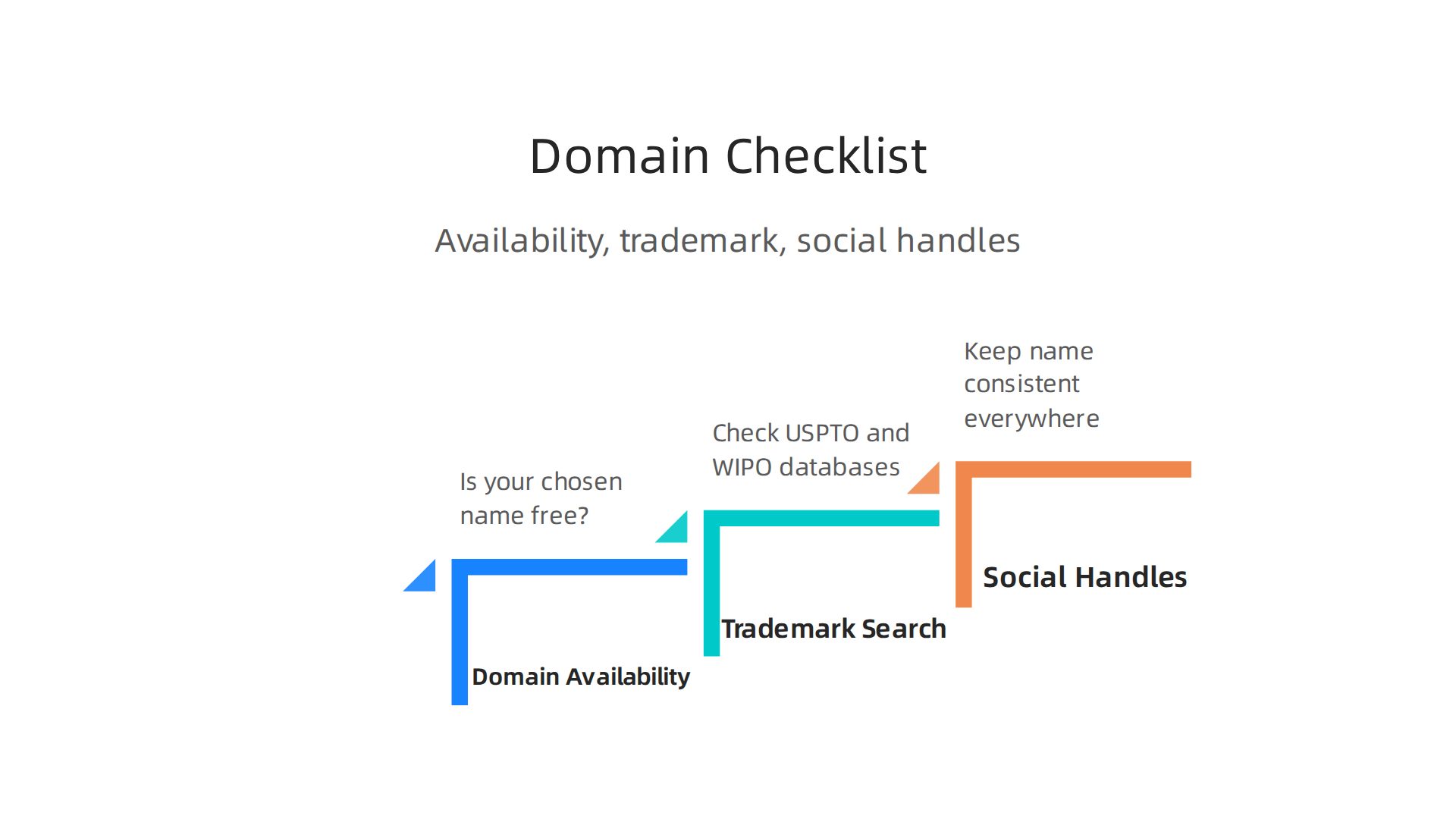
These checks help protect your brand and make it easier for customers to find you.
1. Is your domain name available?
The first and easiest check is to see if your chosen domain name is actually free. This means no one else has bought it yet. You can do this on any domain registrar’s website, like Prism Web Host. You just type in your desired name, and it tells you if it’s taken or not. If it is, don’t worry! Try different TLDs (like .net instead of .com) or slight variations of your domain name ideas. Checking for availability is the start of understanding your potential domain name value.
2. Check for trademarks: Protect your brand
This step is critical. A trademark is a special protection for words, names, symbols, or designs that identify your business and its goods or services. If someone else already has a trademark for a name similar to your chosen domain, especially in the same business area, you could face legal trouble.
To avoid problems:
- Search for US trademarks: If you plan to do business in the United States, you should check the U.S. Patent and Trademark Office (USPTO) database. You’ll look for names that are exactly the same or very similar to your domain name ideas. This check helps you find any "live" marks that might conflict with your brand.
- Search for international trademarks: If your business will reach customers outside the US, it’s wise to check international trademark databases, like the World Intellectual Property Organization (WIPO). This helps you see if your name is protected in other countries. You should check the official registries to avoid costly legal issues down the road, as highlighted in guides like Domain Trademark Check: Screen Before You Buy (2026). Running a Trademark Clearance Search is a smart move before you fully commit.
Finding a good domain name means picking one that is clear and not already trademarked by another company. This helps ensure your domain name meaning is unique to you.
3. Social media handles: Keep it consistent
In 2026, having a consistent name across all your online platforms is super important. When people search for your business, they expect to find you easily on social media like Facebook, Instagram, or X (formerly Twitter).
- Check popular platforms: Before you buy your domain, quickly check if the same name is available as a username or handle on the main social media sites your business will use.
- Why it matters: If your domain is "mygreatbusiness.com" but your social media is "mygreatbiz_official," it can confuse customers. Matching names make your brand look more professional and trustworthy. It also makes it easier for people to tag you and share your content, which can help improve your website’s overall domain rating over time by building brand recognition.
Taking these practical steps will save you a lot of headaches later. It helps you pick strong domain name ideas that are truly yours and set your business up for success online.
Once you have brilliant domain name ideas and have checked their availability and trademarks, the journey isn’t over. Next, you need to think about the technical side of things. This involves how your domain name actually works online, connecting to your website, and staying safe. It’s like making sure your new house not only looks great but also has good electricity, water, and strong locks.
Technical considerations: DNS, SSL, hosting, performance and security
Connecting your chosen domain name to your actual website involves a few important technical parts. Understanding these helps make sure your site is fast, always online, and safe for everyone who visits.
1. DNS configuration: The internet’s phone book
DNS stands for Domain Name System. Think of it as the internet’s phone book. When someone types your domain name, like "yourbusiness.com," into their browser, DNS helps translate that name into a special number (an IP address) that tells their computer exactly where your website lives on a server.
- How it works: Your domain registrar manages your DNS settings. You’ll set up "DNS records" to point your domain to your web host. If these settings are wrong, people won’t be able to find your website. You can use tools to verify SSL certificates and DNS configuration for any domain to ensure everything is set up correctly. Good domain registrars offer strong uptime rates for DNS resolution, meaning your website stays findable without issues, as noted by experts comparing Best Domain Registrars 2026 Q1.
- Why it matters: Fast and correct DNS setup is key for your website to load quickly. It’s an important part of what is a website domain and how it connects to the wider internet.
2. SSL: Secure your site with a lock
SSL (Secure Sockets Layer) is a security layer that encrypts the information sent between your website and its visitors. You’ve seen it as the "HTTPS" at the start of a website address and the little padlock icon in your browser.
- Importance: An SSL certificate keeps customer data safe, like passwords and credit card numbers. Google and other search engines also prefer secure websites and may even rank them higher. Many good hosting plans, like those mentioned in a Step-by-Step Domain Registration & Hosting Setup (2026 Tutorial), include a free SSL certificate. It’s a must-have in 2026 for any business website. You can also monitor your SSL certificate monitoring to make sure it is always active.
3. Hosting: Where your website lives
Your web host is the company that stores your website files and makes them available to visitors online. The quality of your hosting directly affects your site’s speed, reliability, and security.
- Key features to look for:
- Reliable uptime: This means your website is almost always online. A good web host promises high uptime, often 99.9% or higher, so your site is always there for customers Domain Registrar Comparison: Pricing, Security, and ….
- Fast load speeds: How quickly your pages appear. This is critical for keeping visitors happy and for good SEO. Look for hosts using fast technology like NVMe SSD storage and LiteSpeed servers.
- Strong security: Protection against online threats. This includes things like firewalls and DDoS (Distributed Denial of Service) protection.
- Choosing wisely: Picking the right web host is as important as choosing your domain name. It directly impacts your online success. Learn more about web hosting meaning explained for business owners.
4. Performance and security: Keeping your site healthy
Beyond the initial setup, you need to keep an eye on your website’s performance and security over time.
- Website performance: Regularly check your website’s speed. Slow sites make people leave. Tools can help you audit your website’s health and check performance, including how fast your DNS resolves.
- Security measures: Protecting your domain and website from bad actors is ongoing. This includes strong DNS security, monitoring for malware, and using security headers. High-quality web hosts offer enterprise-grade security features, DDoS protection, and isolated hosting environments to keep your site safe. Even free website audits can check for security, integrity, content and performance reports.
By taking these technical points seriously, you’re not just buying a domain; you’re building a strong, secure, and fast online home for your business.
Okay, you’ve handled the tough technical stuff. But even with a perfect setup, a bad domain name can still hurt your business. Now it’s time to make sure your chosen domain name ideas actually work well for people. We need to test how easy they are to understand, remember, and if they feel right to your future customers.
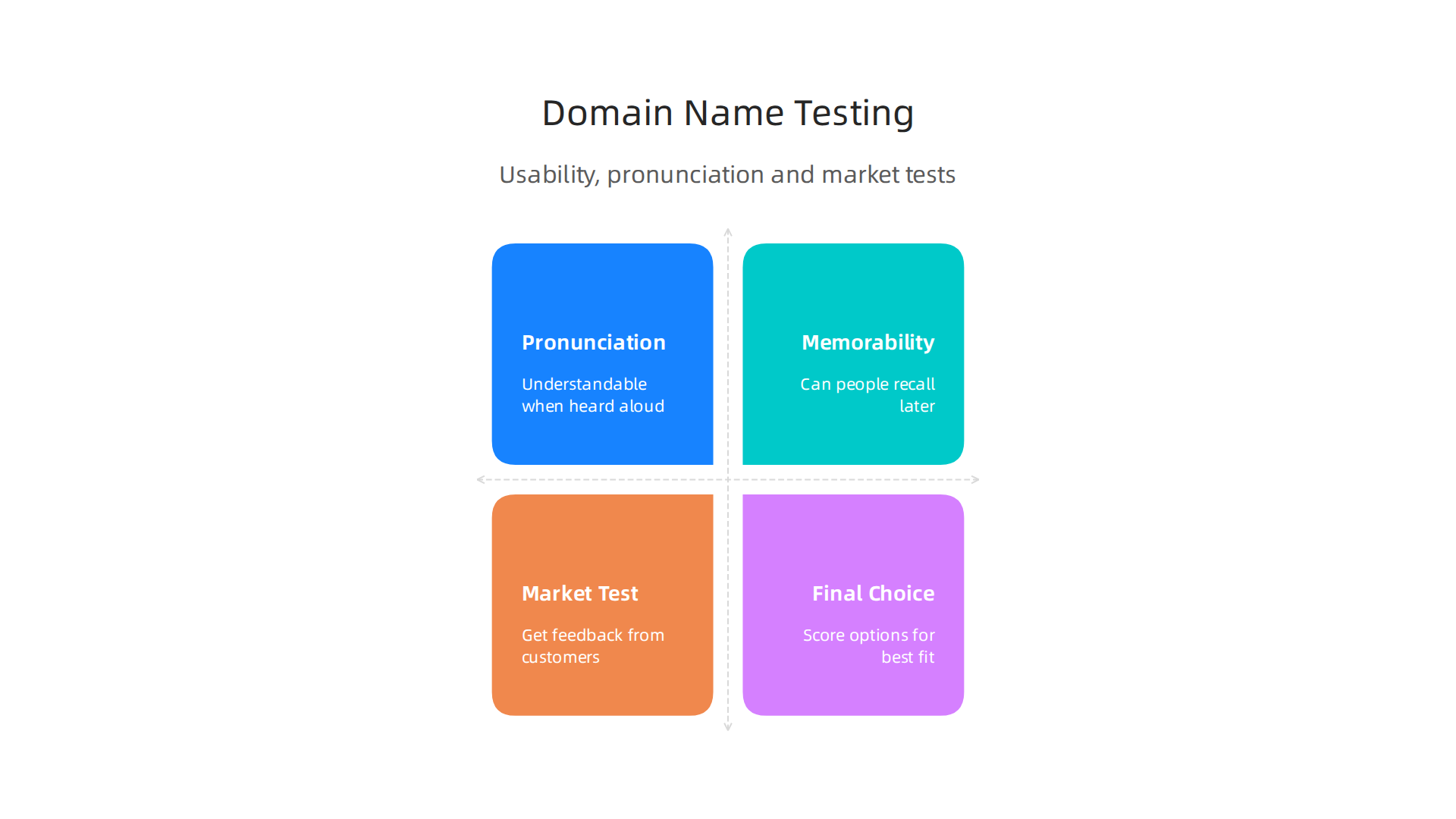
This means putting your best domain name ideas through some quick, real-world checks.
Testing, narrowing and choosing: usability, pronunciation and market tests
Finding the right domain name is like finding the perfect name for a new friend. It needs to be easy to say, easy to remember, and feel friendly. After you have a few good domain name ideas, it’s smart to test them out. Don’t just pick the one you like best yourself. Real people need to like it too!
1. The Pronunciation Test (The "Radio Test")
Imagine someone hears your domain name on the radio or in a loud place. Could they understand it and type it correctly without seeing it written down? This is often called the "radio test."
- How to do it: Say your domain name aloud to a friend or family member. Don’t show them how it’s spelled. Then, ask them to write it down. If they struggle to spell it or get it wrong, that’s a sign it might be too tricky. A good domain name should be clear and easy to say, even over the phone The Radio Test: Is Your Domain Easy to Say? (2025 Guide).
- Why it matters: If people can’t easily say or spell your domain, they might never find your website. It’s a key part of your online identity.
2. The Memorability Test
Can someone remember your domain name after a little while? A memorable name means people will come back to your site more often.
- How to do it: Tell a few different people your domain name. Then, after about ten minutes of talking about other things, ask them to recall the name. How many remember it correctly? Some experts suggest that if fewer than four out of five people can recall it after two days, you should think about other options How to Choose a Brandable Domain Name for Your Startup. Tools can even analyze how easy your domain is to remember based on common language patterns Domain Memorability Analyzer.
- Why it matters: You want your business name to stick in people’s minds. A strong, easy-to-remember domain helps your brand grow.
3. Market Tests and User Feedback
The best way to know if your domain name ideas are good is to ask the people who will actually use them: your potential customers.

- How to do it: Make a small list of your top 3-5 domain name ideas. Then, show or tell these names to about 10-15 people who are like your target customers. Ask them simple questions:
- Which name do they like best?
- What do they think your business does based on the name?
- Does the name sound professional or fun?
- Would they type it the way you said it?
This kind of feedback is very helpful. You can even do a "recall test" where you tell them the name, talk for a bit, then ask them to type it without seeing it Domain Name for Startup: Complete 2025 Framework – Names.Center.
- Why it matters: Your customers’ opinions are gold. They will tell you if your domain name ideas make sense to them, helping you decide on the very best one.
4. Making Your Final Choice
After all the tests, you should have a clearer picture of which domain name ideas shine. Now, it’s about making the final decision.
- Narrowing your shortlist: Look at the feedback from your tests. Which names were easy to say, easy to remember, and got good reactions from your test group? Cross off the ones that didn’t do so well. You should be left with a few strong choices.
- Decision framework: You can create a simple scoring system. Give points for things like:
- Ease of pronunciation
- Memorability
- Relevance to your business
- Availability of the .com (or other key extension)
- How well it stands out
This helps you pick the best one in a fair way The Complete Guide to Choosing a Domain Name for Your Startup.
- Consider its value: Think about the long-term potential of your chosen name. A great domain name can increase your online value over time. If you’re curious about how much a domain name might be worth, you can even explore options like a GoDaddy domain appraisal. Understanding your domain name meaning and importance will guide you.
By doing these checks, you’re not just picking a name; you’re choosing a powerful tool that will help your business connect with people and grow online.
Summary
This article walks business owners through choosing the right domain name in 2026, explaining why a clear, memorable domain is essential for discovery, trust, and SEO. It starts with defining your brand and audience, then shows practical goal-setting—short versus descriptive names, local versus global focus, and the SEO vs brandability trade-off. You’ll learn brainstorming methods that combine seed-word lists, compounding tricks, and AI domain generators, plus how to evaluate TLDs, length, hyphens, and numbers. The guide covers must-do checks: availability, trademark searches, and matching social handles, and it explains the technical steps to connect and secure your site via DNS, SSL, and hosting. Finally, it offers usability tests—pronunciation, memorability, and market feedback—to help you narrow choices and confidently buy a domain that protects your brand and supports growth.
