




Vercel Hosting Pricing Demystified for Small Business Budgets
Article
Why Vercel pricing matters for small businesses and online brands
Small businesses and online brands always look for ways to grow without spending too much money. When it comes to putting your website or app online, understanding the cost is super important. That’s where figuring out the vercel hosting pricing comes in. It’s not always as simple as a single monthly fee.
You see, many web hosting services have simple monthly prices. But with Vercel, the vercel hosting cost can be a mix of a set fee and what you actually use. This means your bill might change each month depending on how many people visit your site, how much data they use, and other things. For small businesses, this can be tricky. You want to know exactly what you’ll pay so you can plan your budget, right?

The big challenge is finding a balance. You need good performance and strong security for your website. But you also need costs that you can count on. If your website suddenly gets popular, you don’t want a huge surprise bill. This is why it’s so important to really look at how Vercel prices its services and what you get for your money. Actually, Vercel uses a hybrid model that combines fixed plans with extra charges based on usage.
In this article, we’re going to dive deep into Vercel’s pricing plans. We’ll look at the different levels they offer, like Hobby, Pro, and Enterprise, and what each one includes. For example, the Hobby plan is free for personal projects, while the Pro plan starts at $20 per month per user Vercel Pricing: Hobby, Pro, and Enterprise plans. We will also explain what usage-based costs mean for things like data transfer and server use. We will talk about how performance and security features fit into the different pricing levels. And we will even touch on other options you might consider, such as cloudflare hosting pricing, cloudflare pages pricing, or even firebase hosting pricing, so you can make the best choice for your business. Understanding how to compare pricing models and avoid hidden fees is key to smart hosting decisions.
How Vercel’s pricing model is structured (plans, billing cycles, and key terms)
To really understand vercel hosting pricing, you need to know how Vercel sets up its costs. It’s not just one simple price. Vercel uses different plans and charges you based on what you actually use. This is called a "hybrid model." Let’s break it down into easy parts.
First, Vercel has a few main plans. These plans decide your starting point and what’s included:
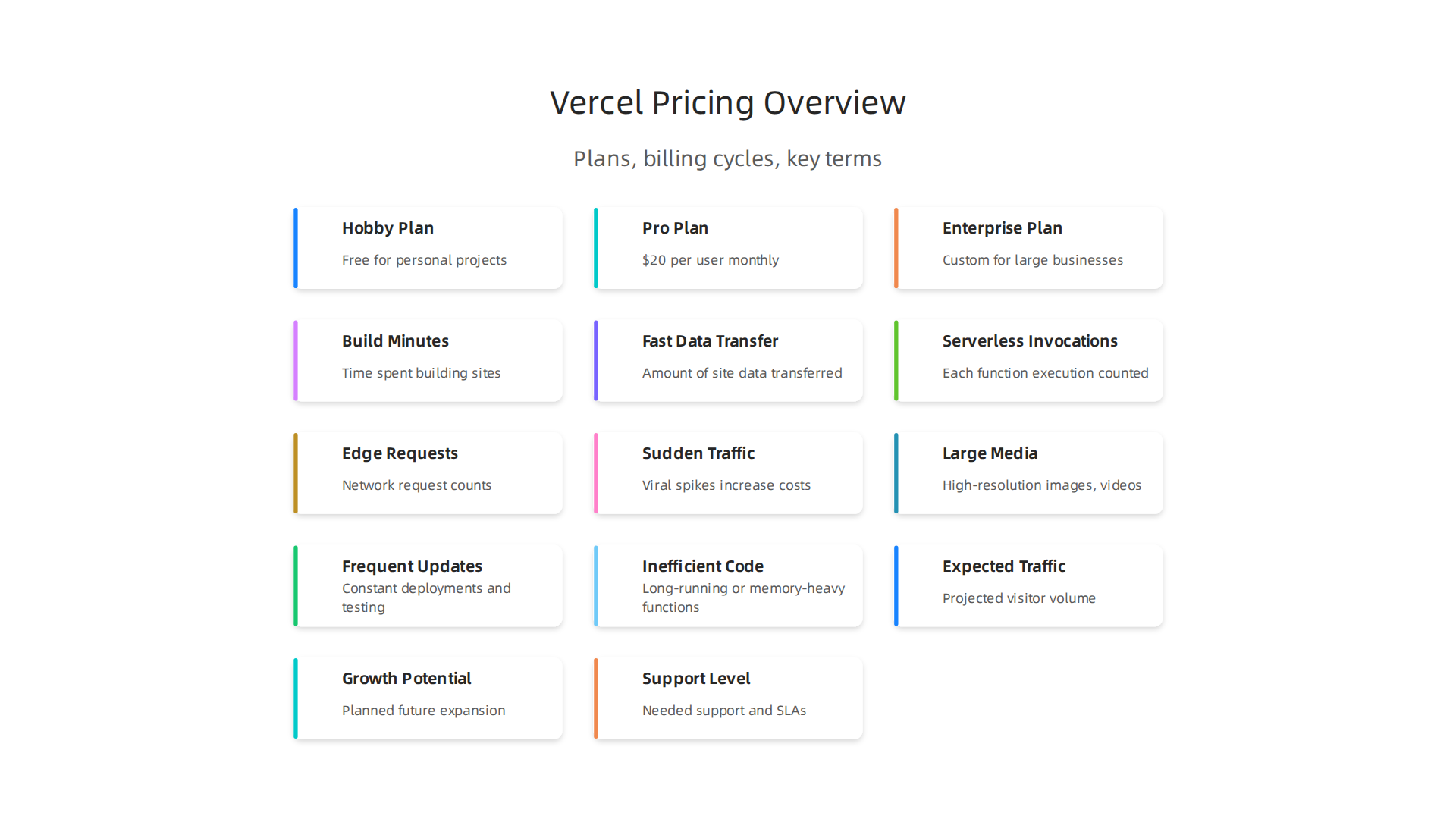
- Hobby Plan: This plan is free. It’s great for personal projects, learning, or trying things out. But it has limits. If your site gets too popular, it might stop working until the next month, or you’ll need to upgrade. For example, the Hobby plan includes 1 million Edge Requests and 100 GB of bandwidth each month in 2026 Vercel Pricing 2026: Plans, Limits & Costs – Temps.
- Pro Plan: This plan starts at $20 per user each month. It’s for teams and businesses that need more power and features. It comes with much higher included usage for things like data transfer and server use. This is where most small businesses or growing online brands usually start. You get more features, but you also need to watch your usage, as costs can go up if you use more than what’s included Vercel Pricing 2026: Hobby, Pro, Enterprise and Hidden Costs.
- Enterprise Plan: This plan is for very large businesses with special needs. The pricing is custom, meaning you talk to Vercel to figure out a plan that fits your exact business. It offers the best security, performance, and support.
What do "Included" and "Metered" mean?
When you look at Vercel’s plans, you’ll see "included" items and "metered" items.
- Included means you get a certain amount of a service for free within your plan’s monthly price. For example, the Pro plan includes 1 TB of Fast Data Transfer and 10 million Edge Requests per month Vercel Pro Plan.
- Metered means that once you use up your "included" amount, Vercel starts charging you extra for every bit more you use. This is why your
vercel hosting costcan change each month. If your website suddenly gets a lot more visitors, your metered costs will go up.
Important words for your Vercel bill
Here are some key terms you’ll see on your Vercel bill:
- Build Minutes: This is the time Vercel spends building your website or app code. Every time you make changes and push them live, Vercel builds your project. This uses "build minutes," and you get a certain amount included.
- Fast Data Transfer (Bandwidth): This is how much data your website sends to visitors. Think of it like water flowing through a pipe. The more people visit your site and download images or videos, the more data transfer you use.
- Serverless Invocations (Function Invocations): Many modern websites use small pieces of code called "serverless functions" that run only when needed. Each time one of these functions runs, it’s called an "invocation." You get a number of these included, then pay per extra use. For instance, the Hobby plan has a limit of 1 million function invocations per month Limits – Vercel.
- Edge Requests: This counts how many times people ask Vercel’s network to show parts of your website. The more requests, the higher this number.
- Active CPU Hours / Provisioned Memory GB-hours: These are terms related to the computer power and memory your serverless functions use when they run.
How Vercel bills you and what to watch out for
Vercel usually bills you every month. At the start of your billing cycle, you get your "included" amounts for all services. As you use your website or app, Vercel tracks how much of these services you use. If you go over your included limits, those extra uses become "overage" charges. These overage charges are added to your monthly bill. This means your vercel hosting pricing can be different each month, depending on how busy your website is.
It’s super important for small businesses to keep an eye on their usage. Vercel provides tools to help you see how much you’re using. Being aware of these numbers can help you avoid surprise bills and keep your vercel hosting cost predictable. Understanding these details can really help you calculate your true web hosting cost and avoid hidden fees in 2026. If you’re using a custom domain with Vercel, knowing these billing details can also help you set up a Vercel custom domain and avoid surprise bills.
The way your vercel hosting pricing adds up each month depends on many small parts. These parts are like ingredients in a recipe. If you use more of one ingredient, the total cost goes up. Let’s look closely at these cost parts and what makes them change.
How your Vercel bill grows with usage
Vercel’s billing is mostly about how much you "consume." This means the more popular or complex your website is, the more you will likely pay.
- Build Minutes: Imagine you’re building a toy car. Each time you make a change, you spend time building it again. For websites, "build minutes" are the time Vercel’s computers spend putting your website together when you update it. If you or your team updates your website many times a day, or if your website is very big and takes a long time to build, these minutes add up. This is especially true for websites that change often or use advanced Continuous Integration (CI) tools. The more changes you push, the more build minutes you use. This directly impacts your
vercel hosting cost. - Fast Data Transfer (Bandwidth): This is how much information your website sends to its visitors. If your site has lots of pictures, videos, or files, or if many people visit your site, you will use more bandwidth. Think of it like water flowing through a hose. The more people drink, the more water flows out. When many visitors from all over the world access your site, Vercel uses its global network (a Content Delivery Network, or CDN) to deliver content fast. For example, a CDN can help deliver content quickly, with providers like Cloudflare showing a median Time to First Byte (TTFB) of 28ms for cached content in 2026 Cloudflare vs CloudFront 2026: 20% TTFB Gap and … – Tech Insider. High traffic or large files can quickly make your bandwidth costs climb, making your
vercel hosting pricinghigher. If you’re comparing this withcloudflare hosting pricingorfirebase hosting pricing, you’ll find bandwidth is a key cost across all platforms. - Serverless Functions (Invocations, Active CPU Hours, Provisioned Memory GB-hours): Many websites today use small pieces of code that only run when needed. These are called "serverless functions." Each time one of these functions does its job (like processing a form, searching a database, or handling a user login), it uses an "invocation." The more people use the dynamic parts of your website, the more these functions run, and the more Vercel charges for their use. This also includes the computer power (CPU hours) and memory they need. This is a common part of cloud pricing models, sometimes seen in details of
cloudflare pages pricingtoo.
Variable vs. Fixed Costs on Vercel
When you look at your vercel hosting cost, you’ll see two main kinds of costs:
- Fixed Costs: These are usually your base plan price. For example, the Pro Plan costs $20 per user each month. This amount stays the same no matter how much you use your website, up to your included limits.
- Variable Costs: These are all the "metered" items. They change from month to month based on how much you actually use beyond your plan’s included amounts. Bandwidth, build minutes, and serverless invocations are all variable costs. If your website is busy one month and quiet the next, your variable costs will go up and down.
What causes big jumps in your Vercel bill?
Understanding these variable costs is key to avoiding surprise bills. Here are some common things that can cause your vercel hosting pricing to spike:
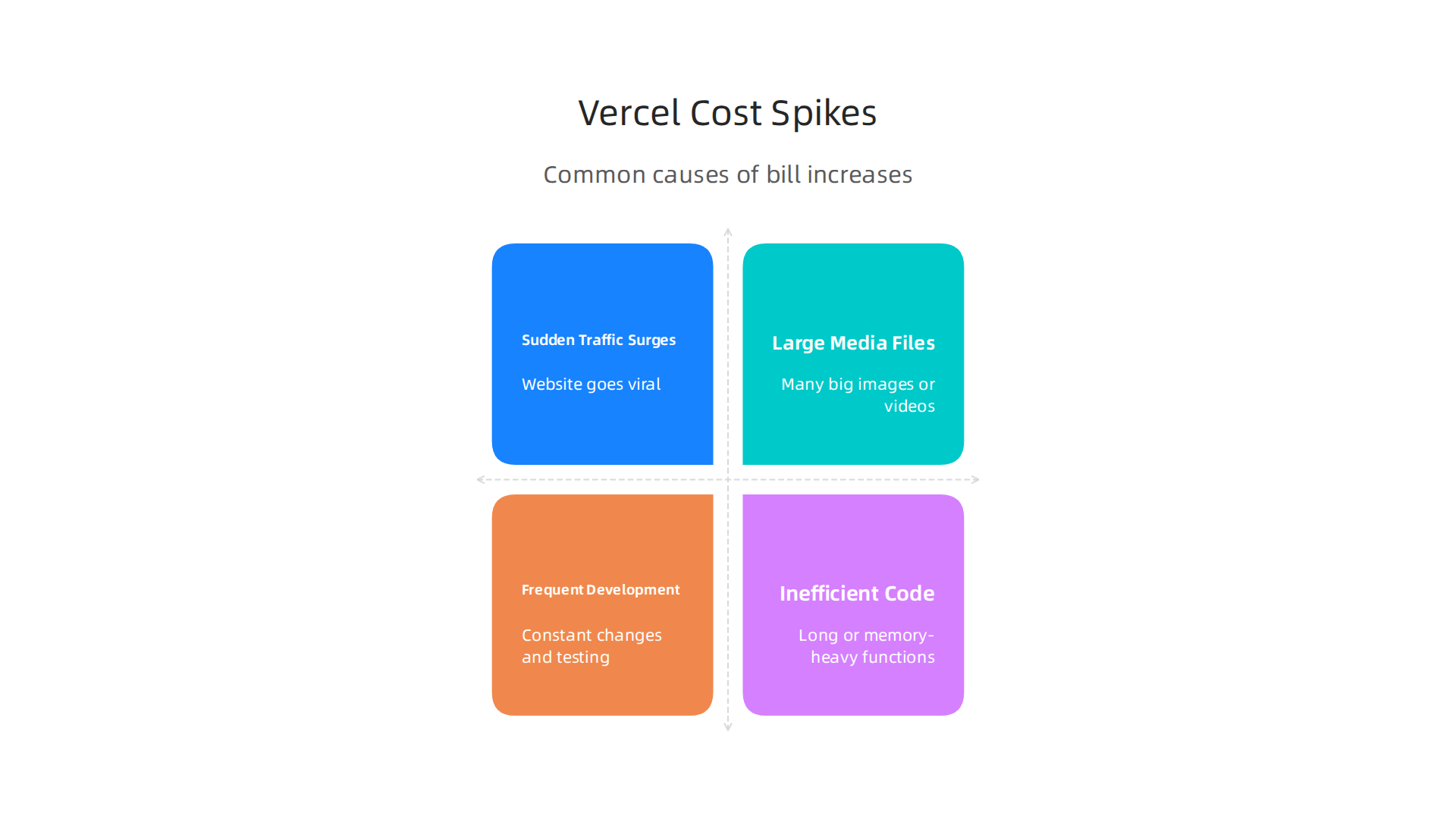
- Sudden Traffic Surges: If your website goes viral, gets a lot of news attention, or has a very successful marketing campaign, many more people will visit it. This means much higher data transfer, more edge requests, and more serverless function runs.
- Large Media Files: If you host many big images, high-quality videos, or downloadable files directly on Vercel and they are accessed often, your bandwidth costs can quickly become very high.
- Frequent Development and Testing: For teams that are constantly changing and testing their website, the "build minutes" can add up fast. Each new test or deployment uses up more of these minutes.
- Inefficient Code: If your serverless functions are not written well and take a long time to run or use a lot of memory, they will consume more "Active CPU Hours" and "Provisioned Memory GB-hours," pushing up your costs.
By keeping an eye on these parts of your Vercel bill, you can better control your overall vercel hosting cost. It’s important to keep track of your usage and how different factors influence your spending. If you’re exploring different hosting options and want to truly understand what you’ll pay, check out this guide to master your web hosting cost in 2026: compare pricing and avoid hidden fees.
When planning your hosting, consider all these elements. For businesses looking for reliable hosting with clear costs and strong security, Prism Web Host – Web Hosting & Services offers solutions designed to help you avoid common pitfalls and ensure your website performs well without unexpected charges.
Understanding your vercel hosting cost isn’t just about the money you spend. It’s also about what that money buys you in terms of how well your website works. The paid features on Vercel play a big role in making your site fast and easy for users, no matter where they are. This affects everything from how quickly your pages load to how happy your visitors are.

How Vercel’s Paid Features Boost Speed and User Experience
Vercel offers special features that make your website very quick. These features are often part of the vercel hosting pricing plans and directly improve speed and latency, which is how fast your site responds.
- Edge Network and Global CDN: Vercel uses a global network of servers, called a Content Delivery Network (CDN). Imagine having many small copies of your website stored all over the world. When someone visits your site, they get the content from the server closest to them. This "edge network" makes pages load much faster. For example, using a CDN can make the Time to First Byte (TTFB) much quicker. Studies show that websites using a CDN can have a global TTFB average of 154ms, compared to 478ms for those without a CDN, a big difference in speed WordPress Hosting Benchmarks 2026: 24/7, 365 Days Tested. This speed is key for a good user experience and can affect your
cloudflare hosting pricingcomparisons too. - Edge Functions: These are like small pieces of code that run closer to your users, right on the "edge" of the network, instead of far away in a central data center. This means dynamic parts of your website (like a login process or a personalized feed) can respond faster. While serverless functions were mentioned before as a variable cost, when they run at the edge, they are often quicker for users. This helps lower latency, meaning less waiting time for your visitors.
Smart Choices: Higher Plans vs. Optimizing Your Site
When you look at your vercel hosting pricing, you might wonder if you should pay for a higher plan or try to make your website use fewer resources.
- Higher Tier Benefits: Moving to a higher Vercel plan often gives you more included bandwidth, build minutes, and serverless function runs. It can also unlock advanced features like a better Service Level Agreement (SLA), which means Vercel promises your site will be up and running a certain percentage of the time, often 99.99% for Enterprise plans Enterprise Service Level Agreement. This can simplify things, as you won’t worry as much about going over limits.
- Optimizing Your Website: Instead of just paying more, you can work on making your website more efficient. This means making images smaller, writing leaner code for your serverless functions, and making sure your content is cached well. Good caching stores copies of your content so it doesn’t need to be rebuilt or fetched from far away every time. This can lower your billable usage, keeping your
vercel hosting costdown without sacrificing speed. Many businesses also consider how other platforms likecloudflare pages pricingorfirebase hosting pricingstructure these trade-offs.
Important Numbers to Watch for Your Business
To make sure your vercel hosting pricing is giving you good value, you should track some key performance numbers:
- Load Time: This is how long it takes for your entire website page to show up for a user. Faster load times mean happier visitors and better rankings on search engines.
- Time to First Byte (TTFB): This measures how long it takes for your browser to get the very first piece of information from the server. A lower TTFB means your server is responding quickly. Different CDN providers show varied TTFB performance, with some like Cloudflare achieving a median 28ms for cached content in 2026 Common Cdn Pitfalls & How To….
- Caching Effectiveness: How much of your website content is being served from the fast CDN edge servers instead of the main server? High caching effectiveness means your site is using its distributed network well, saving you money on data transfer from the origin and making your site faster.
By watching these numbers, you can see how your spending on Vercel connects to how well your website works for your customers. This helps you make smart choices about your vercel hosting cost and how to get the best performance for your business. If you are comparing Vercel with other services, understanding how to manage settings for a custom domain can also be important for performance and cost. Learn more about how to set up your Notion custom domain with Vercel.
Which Vercel plan is right for your business: decision framework for SMBs and e-commerce
Making smart choices about your vercel hosting cost also means picking the right plan for your business.

It’s not just about today, but also thinking about where your business will go in the future. Here’s a simple way to decide which Vercel plan fits you best.
A Checklist for Choosing Your Vercel Plan
When looking at Vercel’s plans, think about these points:
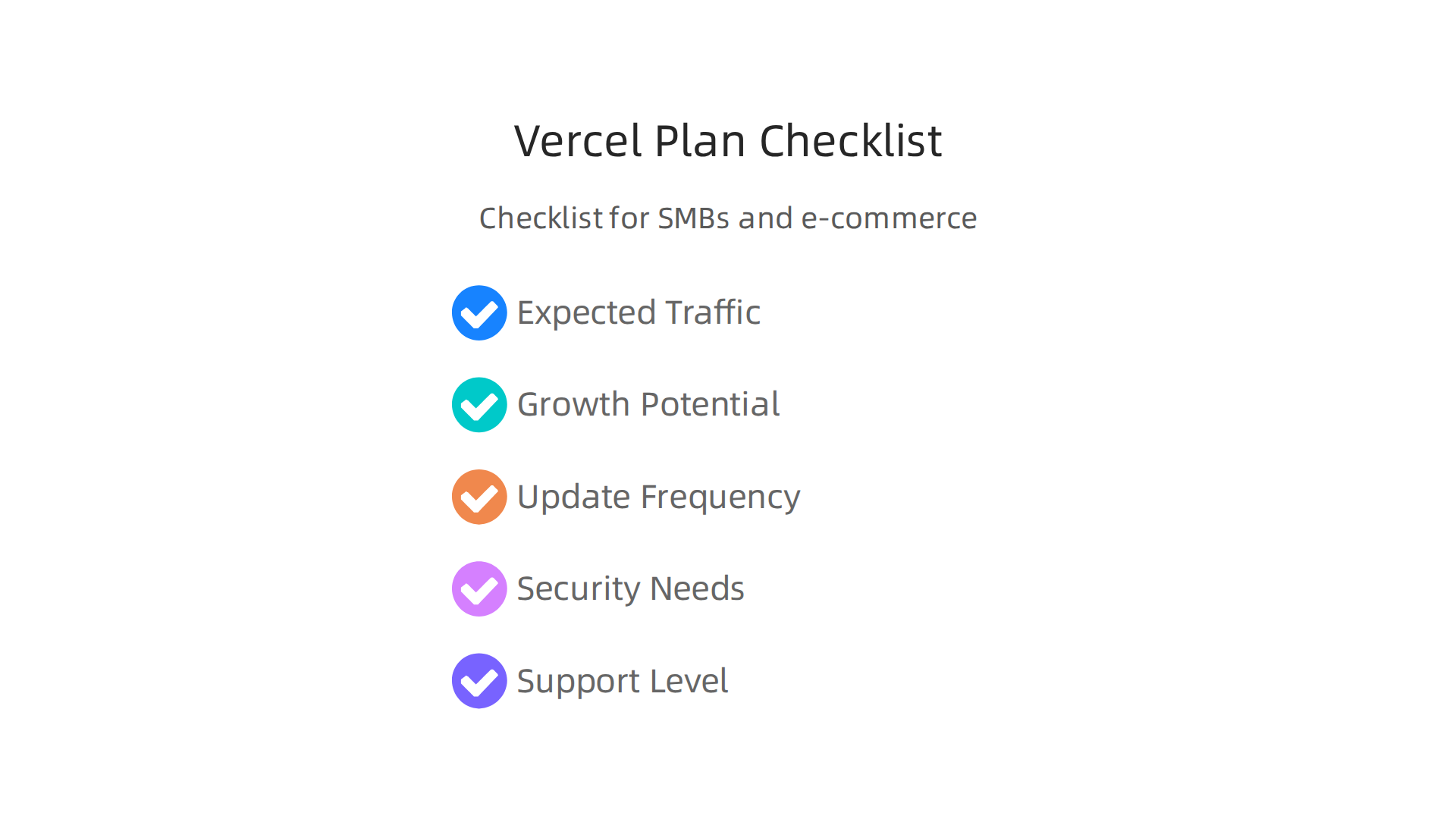
- How much traffic do you expect? If you have a small blog or a new personal project, you won’t need as much as a big online store. Vercel’s Hobby plan is free and gives you 100GB of bandwidth and 1 million Edge Requests each month, which is great for starting out Vercel Pricing and Free Tier Limits Explained (2026).
- How much do you expect to grow? If your website is getting more popular fast, you’ll need a plan that can handle more visitors and data without slowing down or costing too much extra.
- How often do you update your site? Each time you build or deploy changes, Vercel uses "build minutes." If you update daily, you’ll use more build minutes than someone who updates once a month.
- Do you need top-level security and uptime? For businesses where every second of downtime costs money, features like a strong Service Level Agreement (SLA) are very important.
- What kind of support do you need? If you’re new to hosting, you might want more help from Vercel’s team. Higher plans usually offer faster and more dedicated support.
Plans for Different Business Needs
Let’s look at how different businesses might choose a plan:
- For the Solo Entrepreneur or Small Project: The Vercel Hobby plan is perfect if you are just starting. It’s free and designed for personal projects or experiments. However, it has limits, and if your app gets too popular or uses too many resources, it might pause.
- For the Small Storefront or Growing E-commerce Site: The Vercel Pro plan is usually the next step. It costs $20 per user per month and includes much more, like 1 TB of Fast Data Transfer and 10 million Edge Requests each month. This plan is built for teams and commercial apps. It gives you more room to grow without worrying about hitting limits right away Vercel Pro Plan.
- For the Large E-commerce Site or Enterprise: If you have a very big website with lots of traffic, special security needs, or need custom solutions, the Enterprise plan is what you’d look at. This plan has custom pricing and offers the highest levels of performance, security, and support.
When comparing hosting services, it’s always good to understand all the potential fees. You can learn how to calculate your true web hosting cost and avoid hidden fees in 2026 to make sure you’re getting the best deal.
How to Estimate Your Monthly Costs
To guess your vercel hosting cost, you need to think about your expected usage:
- Look at your traffic: How many visitors do you expect? How much data will they download (Fast Data Transfer)?
- Check your functions: If your site uses Edge Functions or serverless functions, how often will they run (invocations) and for how long (CPU hours, memory)?
- Count your builds: How often will you push updates that trigger a new build?
Vercel’s pricing works on a "hybrid model" where you pay a base fee for your plan (like $20/month for Pro) plus extra if you go over the included usage for things like bandwidth or function calls. Knowing these numbers helps you choose the right plan and avoid surprise bills.
If you are exploring other hosting options to compare with vercel hosting pricing, consider looking into Prism Web Host – Web Hosting & Services for secure and high-performance solutions. Choosing the right web hosting for your small business is a big decision, and it’s good to explore all your options.
When thinking about your vercel hosting cost, it is very important to look beyond just the basic monthly fee. Things like strong security, guaranteed uptime, and good customer support can change the real value of a Vercel plan for your business. These are often like hidden costs or benefits that help you avoid problems later.

Security Features: Staying Safe Online
Having a secure website is super important in 2026. Higher-priced Vercel plans give you better security tools to keep your site and your customers safe.
- DDoS Protection: Vercel already helps protect all plans from DDoS attacks, which are like many computers trying to crash your site at once. They have an automatic system for this Vercel security overview. But if you have a very big business, the Enterprise plan offers even stronger, custom DDoS protection Enterprise – Vercel.
- Advanced Protection: For important sites, Vercel’s Enterprise plan can also give you things like a special firewall (WAF) to block bad traffic, ways to limit how many requests a bad actor can make (rate limiting), and secure ways to connect to your databases (VPC peering) Vercel Review 2026: Best AI Web Deployment Tool. These features are like having a tougher bodyguard for your website.
Why does this matter for vercel hosting pricing? Well, cyberattacks can cost small and medium businesses a lot of money. The average cost for a business after a security problem can be very high, sometimes over $149,000 Small Business Cybersecurity Statistics 2026: Threats, Costs. Investing in good security is like buying insurance for your online business.
Uptime and Reliability: Your Site Always On
Uptime means how often your website is working and available for visitors. If your website is down, you can lose sales and trust.
- Service Level Agreement (SLA): For businesses where every minute counts, an SLA is key. This is a promise from the hosting company about how much uptime they will provide. Vercel’s Enterprise plan offers a 99.99% uptime SLA, meaning your site will almost always be online Enterprise Service Level Agreement. For smaller plans, while Vercel is generally reliable, you might not have the same formal guarantee. This higher level of uptime commitment is a big factor in
vercel hosting costfor critical operations.
Support: Getting Help When You Need It
When something goes wrong, or you have questions, good support can save you a lot of time and stress.
- Support Models: With Vercel’s Hobby or Pro plans, you get access to help through their community or standard channels. This is usually good for most issues. However, the Enterprise plan comes with dedicated support, meaning you have a team ready to help you faster and with more specialized knowledge Support Terms. For a big company, having this fast, expert help can prevent long downtimes or solve tricky problems quickly, which affects the true
vercel hosting pricing.
Thinking about all these security, uptime, and support features helps you understand the full vercel hosting cost. It’s not just the sticker price, but also the value you get from avoiding risks and having peace of mind. When picking a plan, always ask yourself what level of safety and help your business truly needs.
If you are thinking about how to protect your website and want reliable, secure hosting options, it’s wise to compare providers. Learn more about how secure and reliable hosting can benefit your business by exploring how to choose a web hosting company a business guide to speed and security.
Don’t let technical issues or security worries slow your business down. Discover Prism Webhost’s reliable and secure hosting plans to ensure your website always performs its best.
After looking at what Vercel offers, it’s also smart to check out other options. Many businesses wonder about the best vercel hosting pricing when they compare it to similar services. This means looking at other platforms that do similar things and thinking about the full cost of moving your website.
Thinking About Other Hosting Choices
Vercel is great for certain kinds of websites, especially those built with modern tools. But it’s not the only player in town. Other hosting providers have their own strengths and vercel hosting pricing models.
- Netlify: Like Vercel, Netlify is very popular for building and hosting modern websites quickly. Their pricing is often similar to Vercel’s, with free tiers for small projects and paid plans that go up based on how much you use. Some comparisons show that for certain workloads, Netlify might be a bit cheaper than Vercel, or vice versa, depending on your needs Vercel vs Netlify Pricing Comparison (2026).
- Render: Render is another strong option, especially if you need to run more complex applications or databases. Many users find Render’s flat-rate pricing for services more predictable than Vercel’s usage-based model for full-stack apps Web Hosting Comparison 2026 – Vercel vs Netlify vs Cloudflare vs …. This can make
vercel hosting costfeel different when you compare the two directly for larger projects. - Cloudflare Pages: If your website is mostly static (meaning it doesn’t change much), Cloudflare Pages can be a very cost-effective choice. They are known for their strong free tier and competitive pricing for their Pro plans, which include a lot of features for fast delivery and security. You can dive deeper into how their costs break down by exploring Cloudflare Pages pricing unveiled real costs no hidden fees.
- Firebase Hosting: For apps built with Google’s Firebase tools, Firebase Hosting is a natural fit. It offers a generous free tier for smaller projects and can be very scalable. However, understanding
firebase hosting pricingmeans watching out for costs as your app grows, especially with database usage and storage.
When comparing these, remember that cloudflare hosting pricing and others are not just about the monthly bill. It’s about what you get for that money in terms of speed, security, and how easy it is to use.
The True Cost of Moving Your Website
If you’re already on one platform and thinking about switching to another, like from Vercel to Netlify, or vice versa, there’s more to consider than just the new monthly fee. This is called the "total cost of ownership," and it includes migration costs.
- Developer Time: Moving a website means your team will spend hours, days, or even weeks changing code, setting up new systems, and making sure everything works right. This time costs money.
- Testing and Rework: After moving, you need to test everything carefully. Sometimes, things don’t work the same way, and your team might need to fix or "rework" parts of your website. This also adds to the
vercel hosting costof switching. - Learning Curve: Your team will need to learn how the new platform works. This learning takes time and can slow down other important work.
These hidden costs are a big part of why you should think carefully before making a move. They can make the total cost of ownership much higher than you first think Cloud Migration: The True Total Cost of Ownership Beyond Lift ….
How to Compare Costs Properly
To really understand what platform is best for your business, you need to do a careful comparison.
- Look at your current usage: Get a clear picture of how much bandwidth, compute time, and other resources your website uses right now.
- Estimate future needs: Think about how much your website might grow in the next year or two.
- Use pricing calculators: Most platforms have tools that help you estimate costs based on your usage.
- Run a small test: If possible, try running a small part of your website or a new project on the platform you are thinking of. This "pilot" can show you the real
vercel hosting pricingor other platform costs before you commit fully.
By doing this, you can make sure you’re comparing "apples to apples" and getting the best value for your money. Remember, the cheapest option upfront might not be the most affordable in the long run if it lacks important features or becomes costly to manage. Understanding the full picture of your web hosting cost in 2026 helps your business make smart decisions.
Summary
This article explains how Vercel’s hybrid hosting pricing works and why it matters for small businesses and online brands that need predictable costs and strong performance. It breaks down Vercel’s main plans—Hobby (free), Pro (starting at $20/user/month) and Enterprise (custom)—and clarifies the difference between included allowances and metered usage like build minutes, bandwidth, edge requests and serverless invocations. You’ll learn what drives variable charges (traffic spikes, large media, frequent builds, inefficient functions), which metrics to watch (TTFB, load time, caching effectiveness), and practical ways to cut costs through optimization and caching. The guide also covers security, uptime guarantees, and support levels so you can weigh value beyond the sticker price, plus a simple decision framework for picking the right plan and estimating true monthly bills. Finally, it compares Vercel to alternatives and highlights migration and total cost-of-ownership considerations so you can choose the best hosting path for growth without surprises.
