




Master Your Vercel Hosting Cost Avoid Hidden Fees and Overages
Article
Why understanding Vercel hosting cost matters for SMBs and entrepreneurs
Small businesses and new entrepreneurs often worry about how much it costs to run their websites. Modern hosting services like Vercel can be tricky. You might get a bill that is bigger than you thought. This happens a lot when your website starts to get more visitors. You want your website to grow, but you also need to keep track of your money. This is why understanding the real vercel hosting cost is so important. Unexpected bills or scaling costs can catch many off guard, making it hard to plan your budget.

This guide is here to help you understand Vercel’s pricing clearly. We will look at the different plans Vercel offers, like the free Hobby plan and the Pro plan, and how they bill you. For example, the Hobby plan gives you 100GB of bandwidth and 1 million edge requests for free, which is great for starting out Vercel Pricing 2026: Plans, Limits & Costs – Temps. However, for commercial projects and teams, the Pro plan is needed, which starts at $20 per seat per month and includes some usage credits, but can also have extra charges for things like bandwidth or function use Vercel Pricing: Hobby, Pro, and Enterprise plans. We’ll talk about what could lead to unexpected charges, often called "hidden costs." If you want to dive deeper into how Vercel’s pricing works for smaller budgets, you can read our guide on Vercel hosting pricing demystified for small business budgets. We will also compare Vercel’s pricing to other options like cloudflare hosting pricing, cloudflare pages pricing, and even firebase hosting pricing. Most importantly, we’ll share smart ways to save money so your vercel hosting pricing stays friendly to your budget.
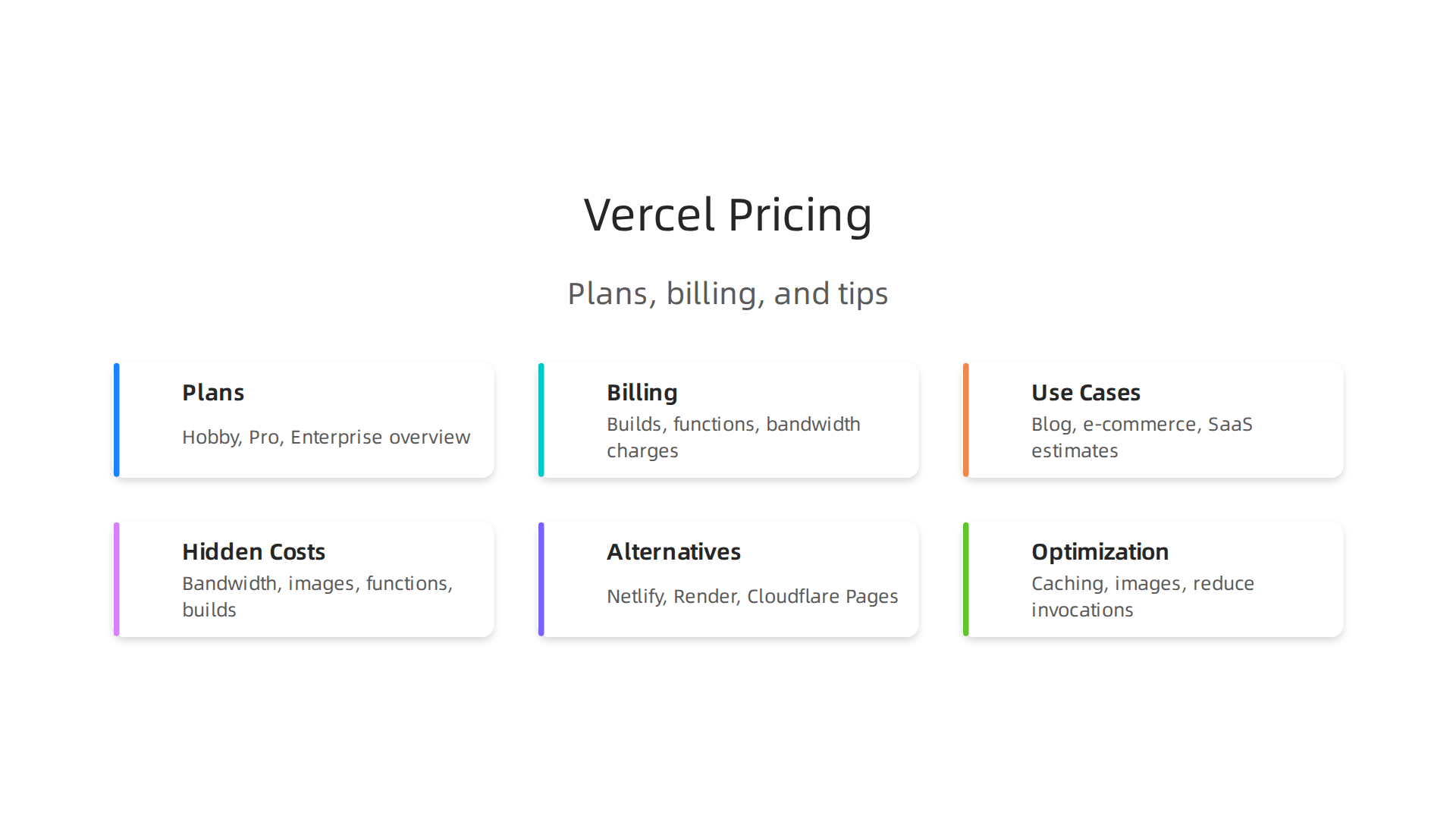
Vercel offers different plans to fit many kinds of projects, from small personal websites to big business applications. Understanding these plans is key to managing your vercel hosting cost and making sure you do not get surprised by your bill. Vercel uses a system where you pay for what you use, combining a base plan with extra charges if you go over certain limits in 2026.
Here is a simple look at Vercel’s main plans:
Hobby Plan (Free)
This plan is perfect if you are just starting out, working on personal projects, or building a small web app for fun. It is free forever and lets one person work on the project.
The Hobby plan comes with a set amount of resources:
- You get 100 GB of data transfer per month. This is like the amount of data your website can send to visitors [Vercel pricing, quotas, and features · Staxly].
- You can have 1 million requests from the "edge network," which helps your site load fast for people all over the world.
- You also get 1 million serverless function calls or 100 GB-hours of function use. These "functions" are small bits of code that run when needed, like when someone fills out a form on your site.
- For building your website, you can make 100 deployments (updates to your site) each day, but only one can happen at a time [Vercel Pricing 2026: Plans, Limits & Costs – Temps].
The important thing about the Hobby plan is that it has "hard caps." This means if you go over these limits, your site might stop working until the next month, instead of charging you more. This helps you avoid unexpectedvercel hosting pricing.
Pro Plan ($20/month per user)
The Pro plan is for teams and businesses that need to scale their projects.

It starts at $20 for each team member every month [Vercel Pricing 2026: Hobby, Pro, Enterprise and Hidden Costs]. This plan gives you more power and flexibility.
With the Pro plan, you get:
- A larger amount of data transfer, usually up to 1 TB per month [Your Vercel Bill at Scale: What the Pricing Page Omits].
- More capacity for serverless functions, around 1,000 GB-hours of execution, and unlimited requests.
- The ability for multiple team members to work together easily, with options for free "viewer" seats for those who just need to see progress [Vercel Pro Plan].
- You can also build your site faster with multiple builds happening at the same time.
The main difference with the Pro plan is that if your website uses more resources than what is included, you will pay extra for those "overages." This is where yourvercel hosting costcan go up if you are not careful. For example, Vercel charges for things like extra build time at about $0.0035 per CPU Minute [Pricing on Vercel].
Enterprise Plan (Custom Pricing)
This plan is for very large companies and organizations with special needs. It offers custom pricing and comes with top-level security, high performance, and dedicated support. Businesses choosing this plan usually need special agreements and help with complex setups. The cost for an Enterprise plan can be around $45,000 each year, but this varies a lot [How Much Does Vercel Cost in 2026? Full Breakdown – Temps].
What Makes Your Vercel Bill Go Up?
As your website grows, certain things can make your vercel hosting cost increase quickly:
- Builds: The more often you update your website, or the bigger your website is, the more "build minutes" it uses. On the Pro plan, going over included build minutes will cost you more.
- Serverless Functions: If your website uses many functions, like for forms, user logins, or custom data work, running these functions can add to your bill once you pass the included amount.
- Bandwidth: This is the data your website sends to visitors. If your website gets very popular or uses a lot of images and videos, you will use more bandwidth. Exceeding the free limits on both Hobby and Pro plans will lead to higher charges on the Pro plan.
When looking at vercel hosting pricing, it is smart to also think about other hosting options. For example, some businesses compare it with cloudflare hosting pricing or cloudflare pages pricing because these services also offer good performance for websites. If you’re running a business and need reliable, secure, and high-performance hosting without complex technical hurdles, check out our offerings at Prism Web Host for scalable web hosting. For those curious about how Vercel works with custom domain setups, we have a helpful guide on how to set up your Notion custom domain with Vercel.
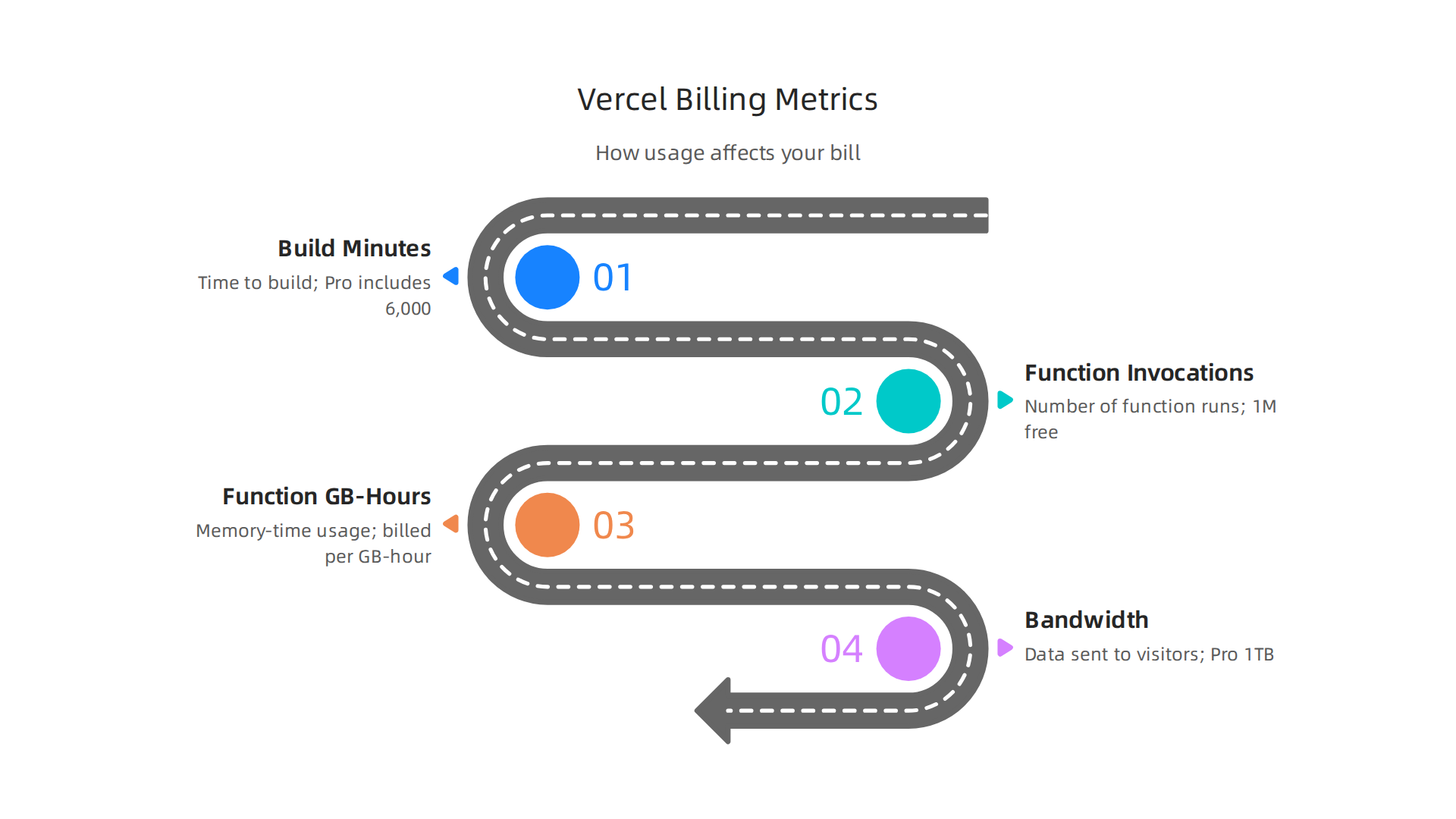
Understanding how Vercel measures your website’s activity is important for keeping track of your vercel hosting cost. Vercel looks at specific things like how much data your site uses, how often your special code functions run, and how long it takes to update your site. These are called "usage metrics," and they directly affect your bill, especially if you are on a Pro plan.
Here is how Vercel figures out your usage and what you might pay:
Build Minutes
When you make changes to your website and send them live, Vercel "builds" your site. This process takes time, measured in "build minutes" or "CPU minutes."
- What you get: On the Pro plan, you usually get around 6,000 build minutes each month included [Vercel Software Pricing & Plans 2026: See Your Cost].
- Overage charges: If your project needs more time to build than what is included, you will pay extra. Vercel charges for these extra build minutes. For example, it might cost around $0.0035 per CPU Minute [Limits – Vercel], but rates can go up depending on the type of machine used for building [Vercel Pricing in 2026: Plans, Credits, and What You’ll Actually Pay]. Some sources show overage rates going from $0.06 to $0.08 per minute in 2026 [Vercel Raised Prices in 2026: What Changed and What to Do]. This is why keeping your build times short can save you money.
Serverless Function Usage
Many websites today use "serverless functions" for tasks like sending emails, handling form submissions, or connecting to databases. Vercel charges for two main parts of these functions:
- Invocations: This is simply how many times your functions run. On both Hobby and Pro plans, you typically get 1 million function invocations for free each month [Vercel Pricing: Hobby, Pro, and Enterprise plans].
- Overage charges: If your functions are called more than 1 million times, you will pay extra. This can cost around $0.60 for every additional 1 million invocations [Vercel pricing explained: the seat, the meter, and the rule …]. This can be a big part of your
vercel hosting pricingif your site is very active.
- Overage charges: If your functions are called more than 1 million times, you will pay extra. This can cost around $0.60 for every additional 1 million invocations [Vercel pricing explained: the seat, the meter, and the rule …]. This can be a big part of your
- GB-Hours: This measures how much computer power (memory) your functions use and for how long.
- Overage charges: If your functions use more memory or run for longer than the included amount, you will pay for these "GB-hours." The cost can start at about $0.0106 per GB-hour [Vercel Pricing: Hobby, Pro, Enterprise & the Fluid Compute …].
Bandwidth (Fast Data Transfer)
Bandwidth is the total amount of data your website sends to its visitors. This includes things like images, videos, text, and files.
- What you get: The Hobby plan includes 100 GB of bandwidth, while the Pro plan offers a generous 1 TB per month [Vercel Pricing 2026: Cost Breakdown & Competitor].
- Overage charges: If your website becomes very popular or serves many large files, you might go over these limits. When that happens, Vercel charges for the extra data transfer. This often costs about $0.15 per GB, though it can vary by region [Vercel Pricing 2026: Plans, Costs & Is It Really Worth It?]. Managing your images and videos can help lower your
vercel hosting costhere.
Understanding Billing Cycles and Overage Charges
Vercel usually bills you every month. The base price for your plan (like the $20 per user for the Pro plan) is fixed, but the extra charges for overages can change based on your usage in that month. If you exceed the free limits on a Pro plan, these overage charges are added to your monthly bill. This means your vercel hosting cost can go up if your project grows quickly without careful monitoring.
If you are trying to keep a close eye on your website budget, it helps to understand how different hosting providers handle costs. Comparing options like firebase hosting pricing could give you a better idea of what fits your needs. To truly master your web hosting budget and avoid unexpected bills, it is a good idea to learn how to calculate your true web hosting cost and avoid hidden fees in 2026. This can help you make smart choices for your website.
When planning your website’s budget, knowing these details about vercel hosting pricing is key. It lets you estimate costs better and choose the right plan for your project’s growth.
When planning your website’s budget, knowing these details about vercel hosting pricing is key. It lets you estimate costs better and choose the right plan for your project’s growth.
Estimating Monthly Cost for Common Use Cases (Blog, Portfolio, Small E‑commerce, SaaS)
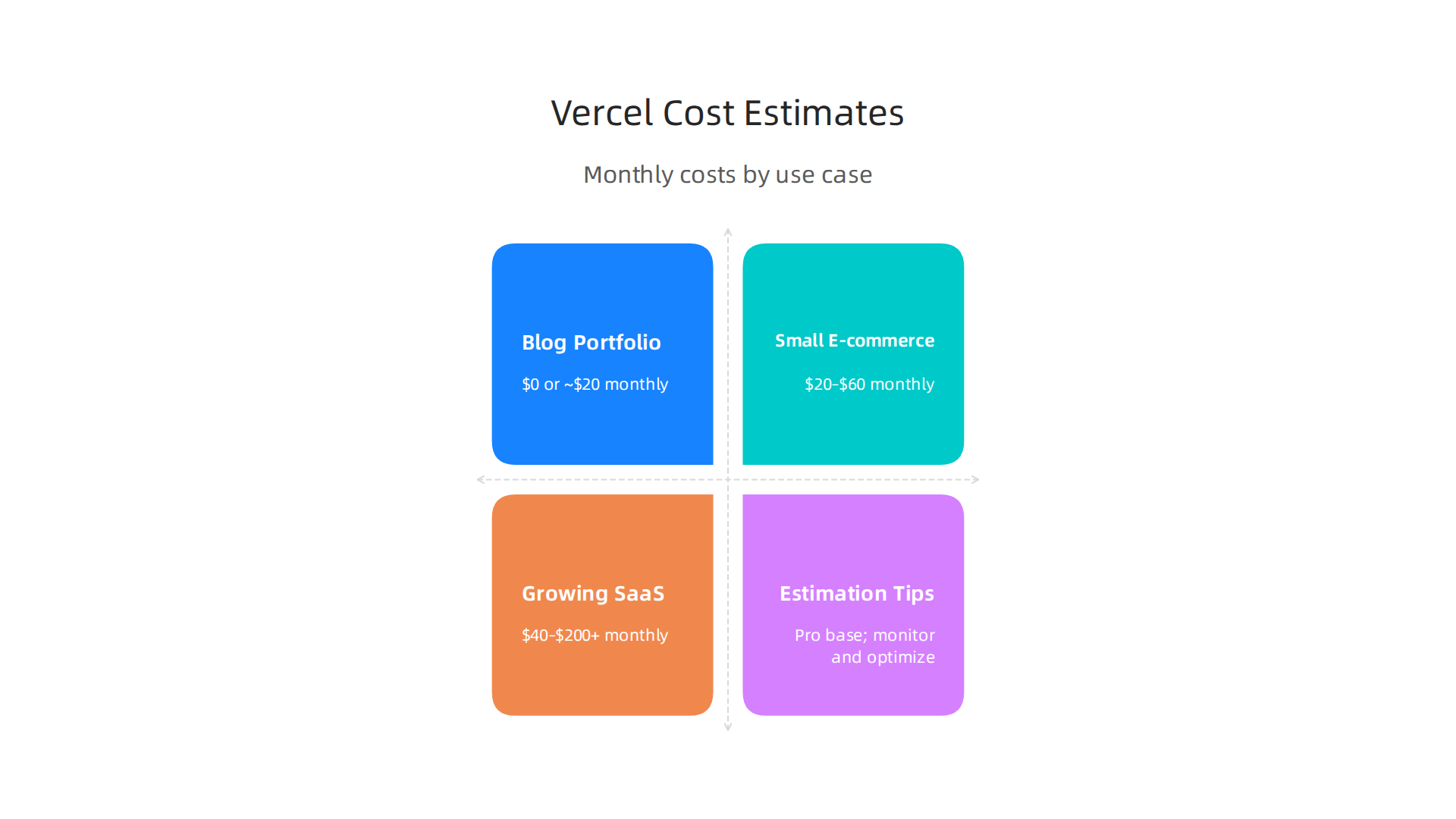
Figuring out your exact vercel hosting cost can seem tricky, but it helps to think about how different types of websites use Vercel’s services. Your monthly bill will depend on how much traffic you get, how many files your site sends out, and how often your special code runs. Let’s look at some common examples.
1. Simple Blog or Online Portfolio (Low Traffic)
For a personal blog or online portfolio that doesn’t get a lot of visitors, your vercel hosting cost will likely be very low.
- Traffic: Imagine you have up to 10,000 visitors a month.
- Data Usage: Your site uses about 10 GB of data (bandwidth).
- Builds: You update your site once or twice a month, using minimal build minutes.
- Functions: You might use a simple contact form, so serverless functions run only a few hundred times.
In this case, if you’re using the Hobby plan, your cost is usually $0. If you are on a Pro plan with one user, your base cost is $20 a month, and you would likely stay within the included limits, keeping your bill around this base price. Many small teams can keep their costs under $100 per month on Vercel’s Pro plan, even with more traffic included [How to Lower Vercel Hosting Costs by 35% in 2026].
2. Small E-commerce Store or Marketing Site (Medium Traffic)
A small online store or a company marketing website with moderate traffic will have higher usage.
- Traffic: Maybe 50,000 to 80,000 unique visitors a month.
- Data Usage: Your site has many images and product pages, using around 100-200 GB of bandwidth.
- Builds: You update products or content often, leading to more build minutes.
- Functions: You have features like customer reviews, search, or order processing that use serverless functions regularly.
For a website like this, especially one with a lot of images, careful management is needed. Setting rules to store images longer in the cache can help reduce costs [Managing Usage & Costs]. With a single Pro user, your base would be $20, but overage for bandwidth or serverless functions might add to that. Some small businesses with less than 100GB of traffic might pay $20-$50 per month, while a Next.js marketing site with 80,000 visitors could see costs closer to $40-$60 per month depending on how images are handled [Vercel pricing 2026: what you actually pay for a real Next.js …].
3. Growing SaaS Application (Higher Traffic and Function Use)
A Software as a Service (SaaS) application will likely have the highest vercel hosting pricing due to more users and complex features.
- Traffic: Your app serves 100,000 to 250,000 visitors or more each month.
- Data Usage: Lots of data is moved for app functions and content.
- Builds: Teams build and deploy updates frequently.
- Functions: User logins, data processing, notifications, and other app logic cause serverless functions to run millions of times.
For a scaling SaaS, your costs will depend heavily on serverless function invocations and GB-hours, as well as bandwidth. An early-stage SaaS with 1-3 team members and around 50,000 visitors might see costs around $40-$60 per month if usage of builds and functions is kept low [Vercel Pricing Breakdown (2026)]. However, a larger SaaS application with high traffic could easily reach hundreds or even thousands of dollars per month due to overage charges for these services [Your Vercel Bill at Scale: What the Pricing Page Omits]. A solo developer running a simple SaaS might pay about $20 a month, while a five-person startup could pay around $200 a month [Vercel pricing 2026: the real 30-day bill].
Key Points for Estimating Your Bill:
- Pro Plan Base: Remember the Pro plan starts at $20 per user per month. This is your fixed cost before any extra usage.
- Know Your Limits: Keep track of your free limits for bandwidth, build minutes, and serverless functions.
- Monitor Usage: Vercel gives you tools to see how much you are using. Check these often.
- Optimize Everything: Compressing images and making your code efficient can lower your overage charges. You can look into ways to optimize Vercel cost in 2026 to ensure you are not overpaying.
To better understand all the parts that make up your bill, and to compare Vercel’s costs with other options, it helps to learn more about Vercel hosting pricing demystified for small business budgets. When you’re looking for hosting that can grow with you and offers strong security, Prism Web Host – Scalable Web Hosting is a good place to learn more about reliable options.
Even with careful planning and monitoring your usage, there are often vercel hosting cost elements that can sneak up on you. These are the "hidden" charges or add-ons that aren’t always clear when you first look at vercel hosting pricing. Understanding them helps you avoid unwelcome surprises on your monthly bill.
Hidden Costs & Add-Ons: What Can Push Your Bill Higher
While Vercel’s pricing model is generally straightforward, some services and activities can lead to extra charges beyond the basic plan fees.
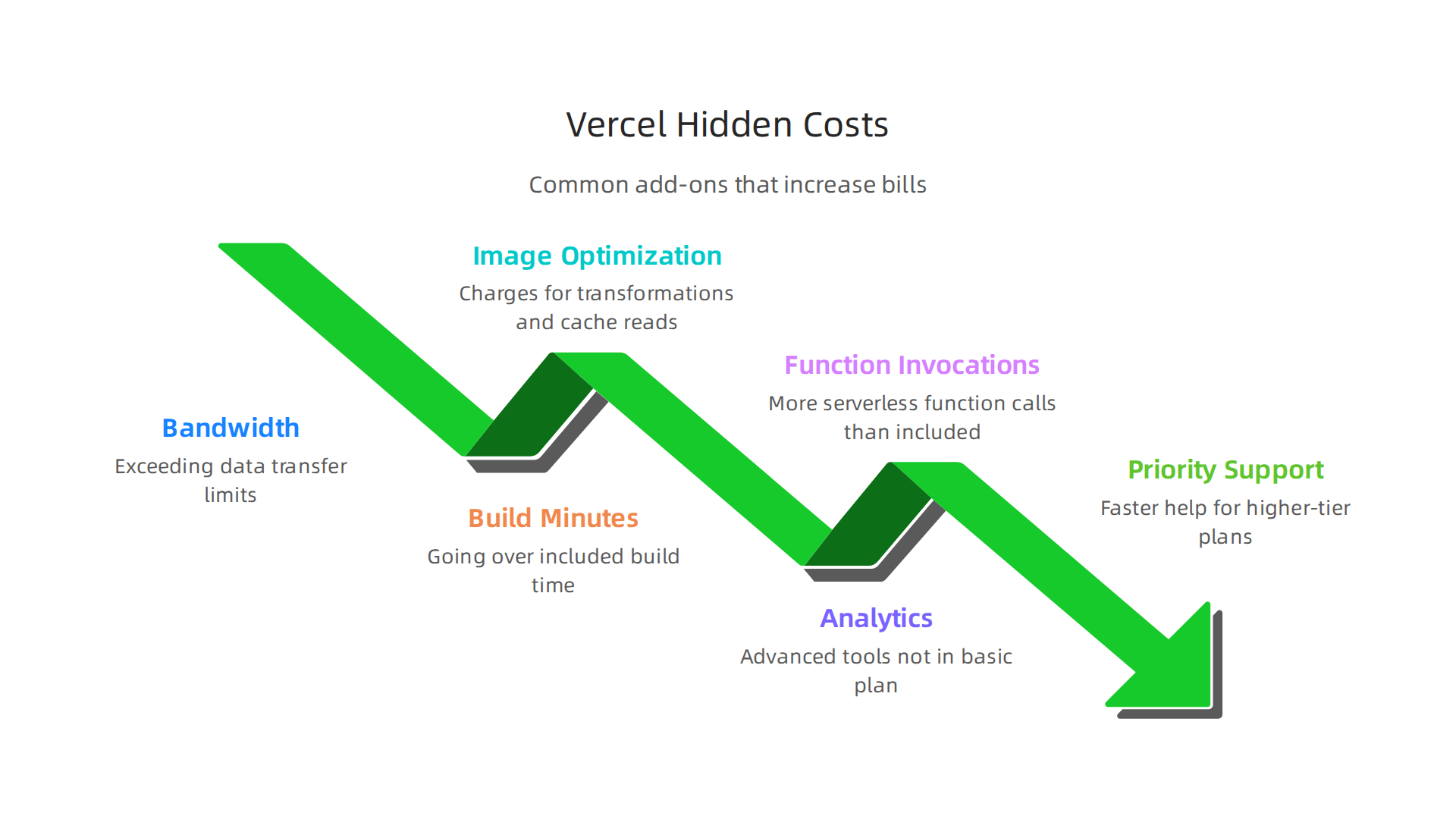
These are often related to exceeding included limits or using advanced features.
1. External Bandwidth Overages
We talked about bandwidth before, but it’s one of the biggest reasons for higher bills. When your website or app sends out more data than your plan includes, you pay extra for that "fast data transfer." This means if many people download files, stream videos, or simply load large pages with many images, your bill can go up. For instance, after your Pro plan’s included bandwidth, overage rates can vary, but generally, you’ll pay per gigabyte Vercel Software Pricing & Plans 2026: See Your Cost.
2. Image and Video Optimization
If your site uses many images, Vercel offers an Image Optimization feature. It makes images smaller and faster for users. While useful, this service also has its own costs. You get a certain number of free image transformations and cache reads each month. But if your site is popular and processes or serves many images, you’ll pay for extra transformations and cache actions. For example, after 5,000 transformations, you might start paying around $0.05 for every 1,000 extra transformations Limits and Pricing for Image Optimization. This can add up quickly for image-heavy sites like e-commerce stores or portfolios.
3. More Build Minutes and Function Invocations
Even if you’re not a SaaS app, you might find your vercel hosting pricing higher due to exceeding build minutes or serverless function invocations. Every time you update your site and Vercel builds it, that uses "build minutes." Pro plans usually include 6,000 minutes per month, but going over this means extra charges, sometimes up to $0.014 per minute for standard machine types Vercel Pricing review: when does it become expensive.
Serverless functions, used for things like API calls or dynamic content, also have limits. After about 1 million free invocations per month on Pro plans, you pay about $0.60 for every extra million calls Vercel Pricing: Hobby, Pro, Enterprise & the Fluid Compute …. If your website has interactive features or processes a lot of user data, these costs can rise quickly.
4. Analytics, Monitoring, and Third-Party Integrations
Vercel offers tools to see how your site is doing. If you use advanced analytics or monitoring tools that are not included in your basic plan, these can be extra. Also, if you connect your Vercel project to many other services (like databases, content management systems, or external APIs), these third-party tools might have their own costs that add to your overall web hosting expenses.
5. Priority Support
For larger businesses or those needing faster help, priority support options can increase your vercel hosting cost. While standard support is included, dedicated support teams or faster response times are often part of higher-tier or enterprise plans.
6. Enterprise-Only Features
For very large companies, Vercel offers Enterprise plans with custom pricing. These plans come with special features not found in Hobby or Pro plans. These might include:
- Custom Service Level Agreements (SLAs): Promises about uptime and performance that are tailored to your business.
- Advanced DDoS Protection: Extra security against large-scale attacks that aim to take your site offline.
- Private Networking: Secure connections for your applications, away from the public internet.
These features are usually part of a custom agreement and can significantly add to the overall vercel hosting pricing. Companies can sometimes negotiate terms for these advanced features directly with Vercel.
Keeping an eye on these potential extra costs is important for managing your overall website budget. Comparing different hosting options and understanding all the fine print can help you make a good choice for your business. To learn more about how hosting costs work in general, check out our guide on web hosting cost in 2026.
After looking at Vercel’s potential hidden costs, it’s wise to compare its pricing to other hosting options. Different platforms offer different ways to pay, and understanding these can help you pick the best one for your project. Vercel is known for its "serverless-first" approach, meaning you often pay for what you use, especially for fast-growing apps. But this model isn’t always the cheapest, especially if your app has steady, high usage.
Comparing Vercel to Alternatives: Pricing Models vs Netlify, Render, and VPS
When thinking about vercel hosting cost, it’s helpful to see how it stacks up against other popular choices like Netlify, Render, or even a Virtual Private Server (VPS). Each has its own way of charging and works better for different kinds of websites.
Vercel vs. Netlify: Similar Serverless Paths
Vercel and Netlify are quite similar. Both are great for modern web apps, especially those built with frameworks like Next.js or React. They both use a serverless-first model where you get a free tier (Hobby plan for Vercel, Starter for Netlify) and then move to Pro plans that charge per user seat plus usage Vercel Pricing 2026: Cost Breakdown & Competitor.
For instance, Vercel’s Pro plan starts at $20 per user per month, including a usage credit. Netlify’s Pro plan is also around $19 to $20 per user per month. The actual vercel hosting pricing or Netlify cost often comes down to how much bandwidth, build minutes, and serverless functions your site uses beyond the included limits. For many teams, Netlify can sometimes be a more cost-effective Vercel alternative, especially for simpler static sites, because their included limits or overage rates might differ slightly How Much Does Vercel Cost in 2026? Full Breakdown – Temps.
Vercel vs. Render: Services vs. Serverless
Render offers a different kind of platform. While Vercel focuses heavily on serverless functions and automatic scaling, Render lets you host many types of services, like web servers, databases, and background workers, often using a container-based approach. You usually pay for dedicated resources for each service.
Render can be a good choice if your project needs a specific server setup or a database that runs all the time. Its pricing often starts around $7 per month for basic web services or PostgreSQL databases Vercel vs Render vs Netlify: A Developer’s Guide to Choosing …. This model can be cheaper than Vercel’s serverless usage for applications with consistent, predictable traffic that need continuous processing. However, if you have many small services or very spiky, unpredictable traffic, Vercel’s pay-as-you-go serverless model might be more efficient.
Vercel vs. Virtual Private Server (VPS): Control vs. Convenience
A Virtual Private Server (VPS) is like owning a slice of a physical server. You get a set amount of CPU, memory, and storage, and you manage everything yourself. This means more work for you but also more control over costs and performance.
The biggest difference is cost predictability. With a VPS, you pay a fixed monthly fee, which can be much cheaper for websites with high, steady traffic compared to Vercel’s usage-based model where costs can climb with heavy use. For example, a basic VPS might start from just a few dollars a month. However, you’ll need technical skills to set it up, keep it secure, and manage updates. This setup is often called "self-hosting" and can be a good option for businesses with technical staff looking to save on vercel hosting cost in the long run. If you want to explore more about cheaper hosting options that give you more control, check out our guide on cheap VPS hosting in 2026.
Other Serverless-Like Options: Cloudflare Pages and Firebase Hosting
Other platforms also offer similar serverless deployment options. Cloudflare Pages is excellent for static sites and provides very generous free tiers for bandwidth and builds, often making it a very strong competitor to Vercel and Netlify, especially for projects focused on front-end delivery. If you are comparing cloudflare hosting pricing, you’ll find it can be very competitive. Firebase Hosting, part of Google’s Firebase platform, is another option, especially if you’re already using Firebase for your backend services. Their firebase hosting pricing is also usage-based, similar to Vercel, making it flexible for apps with varying traffic. For more details, you can look into Cloudflare Pages pricing unveiled.
Ultimately, choosing between Vercel and these alternatives depends on your project’s needs.

If you need top-notch performance for modern, dynamic apps with easy setup and don’t mind usage-based pricing for high scalability, Vercel is a strong contender. For simpler static sites, Netlify or Cloudflare Pages might offer similar benefits at a potentially lower vercel hosting cost at scale. And for full control and fixed costs for predictable workloads, a VPS could be your best bet.
Now that we’ve looked at how Vercel stacks up against other hosting choices, let’s talk about how you can keep your Vercel costs low if you decide to use it. Knowing these tips can help you avoid surprise bills and make your vercel hosting cost more predictable.
Practical Tips to Optimize Vercel Costs and Scale Efficiently
To make sure your Vercel bill stays manageable as your website grows, there are several smart moves you can make.

These actions focus on how your site uses resources and how you manage your team.
Smart Ways to Lower Your Vercel Bill
- Use Caching: Caching means storing copies of your website’s files so they don’t have to be freshly created every time someone visits. This saves a lot on
vercel hosting pricing. For example, settingCache-Controlheaders for images and static files can tell Vercel to store them for a long time. This greatly reduces how many times Vercel needs to process requests, cutting down on bandwidth and function use How to Optimize Vercel Cost in 2026.- For content that changes sometimes, you can use something called Incremental Static Regeneration (ISR). This rebuilds pages in the background only when needed, instead of every single time someone visits How can I reduce my Vercel Functions usage on Vercel?.
- Optimize Your Images: Images often use up the most bandwidth. Vercel has a built-in image optimization feature that makes pictures smaller and faster to load. Make sure this is set up correctly. You can tell Vercel how long to cache these optimized images, like setting a
minimumCacheTTLfor up to 31 days. This stops Vercel from transforming the same image over and over again Managing Usage & Costs. Also, avoid putting very large images directly in your public folders, as this can increase bandwidth costs quickly How to Reduce Vercel Costs by Optimizing Your Next.js App. - Reduce Serverless Invocations: Every time your Vercel application has to do a specific task, like running a server-side function or an API call, it’s called an "invocation." These add to your
vercel hosting cost. To cut down on these:- Static Generation: Build as many of your pages as possible ahead of time (static generation). These pages don’t need a serverless function to run for each visit.
- Efficient Code: Make sure your serverless functions do their work quickly and don’t get called more often than needed. Each page view or API call can count as an invocation The Vercel Bill No One Warned You About.
- Limit Build Frequency: If you deploy your website many times a day, those build minutes add up. Try to group your changes and deploy less often, especially if you have a large project.
- Manage Team Seats: Vercel’s Pro plan often charges per user seat. If your team changes, make sure you remove anyone who no longer needs access to your Vercel account to avoid extra charges Vercel Pricing in 2026: Plans, Credits, and What You’ll Actually Pay.
Smart Operational Practices
- Monitor Usage and Set Alerts: Vercel provides a dashboard where you can see exactly how much bandwidth, build minutes, and serverless functions you are using. Check this often! Many users find that keeping an eye on these numbers helps prevent large bills. You can even set up alerts to warn you if your usage is getting too high Understand the Cost Impact of Function Invocations.
- Use Staging Plans Wisely: For testing new features or changes, use a separate, lower-cost staging environment if possible. This keeps experimental traffic from racking up costs on your main production site.
- Consider Enterprise for Big Needs: If your project grows very large and has massive traffic, Vercel offers custom Enterprise plans. These plans can be more cost-effective for big companies with specific needs, as you can negotiate terms directly. For a smaller scale, companies can expect costs ranging from $20 to $50 per month for a small business on a Pro plan Vercel Pricing 2026: $0-$3,500/mo (Hobby, Pro, Official).
By following these practical tips, you can take better control of your vercel hosting cost and make sure your website scales efficiently without breaking the bank. For businesses looking for reliable, secure, and high-performance hosting solutions beyond Vercel, consider exploring what a dedicated provider can offer. Learn more about various hosting products and services designed for business growth at Prism Web Host – Scalable Web Hosting. If you’re looking to understand more about overall web hosting costs, you might find our guide on calculate your true web hosting cost and avoid hidden fees in 2026 very helpful.
Summary
This article explains Vercel hosting cost in clear, practical terms for small businesses and entrepreneurs so you can avoid surprise bills as your site grows. It breaks down Vercel’s main plans—Hobby (free), Pro ($20/seat/month) and Enterprise (custom)—and details how usage metrics like build minutes, serverless invocations, GB‑hours, bandwidth and image transforms affect your monthly bill. You’ll learn typical overage rates, which activities drive costs, and example monthly estimates for blogs, small e‑commerce sites and SaaS apps. The guide compares Vercel to alternatives such as Cloudflare Pages, Netlify, Render and VPS hosting to show when serverless pay‑as‑you‑go is worth it. It also lists hidden fees to watch for and gives concrete ways to lower costs—caching, image optimization, fewer builds, and fewer function invocations. After reading, you’ll be able to estimate likely bills, spot where overages come from, and apply practical steps to keep Vercel hosting pricing predictable and affordable.
