




Firebase Hosting Pricing Uncover True Costs and Save Your Budget
Article
Why Firebase Hosting Pricing Matters for Your Business
For many small businesses and online brands, putting your website on the internet can feel a bit like a guessing game. You want your site to be fast, safe, and always online, but you also worry about how much it will really cost. It’s common to hear stories of unexpected bills, complicated ways to grow your site, or having to choose between good security and quick speeds. This can make picking the right web hosting a big headache.

That’s where understanding how services like Firebase Hosting work becomes super important. Many people are looking at options beyond traditional hosting or other cloud services like Vercel or AWS. In 2026, finding clear answers about [firebase hosting pricing] can save you a lot of worry and money. It’s not just about the starting price; it’s about what you actually pay as your business grows.
In this guide, we’re going to break down everything about [firebase hosting pricing]. You’ll learn exactly how it works and what things make your bill go up or down, like how much space your website takes up and how much data visitors use when they look at your site. For instance, Firebase Hosting starts with free limits for storage and data transfer, which can be great for small sites to begin with, offering 10 GB of storage and up to 10 GiB of data transfer each month at no cost when you start, as Google explains Firebase Pricing. Knowing these limits helps you understand when you might start paying more.
We’ll also look at how Firebase compares to other services, so you can think about potential [vercel hosting pricing] or even the typical [aws hosting cost]. Our goal is to give you practical ways to guess your future expenses and keep your costs under control. This way, you can focus on running your business without constantly checking your hosting bill. If you’re comparing different options to understand your full costs, you might find our guide on how to calculate your true web hosting cost and avoid hidden fees in 2026 very helpful.
Overview: How Firebase Hosting Pricing Is Structured
When you choose Firebase Hosting, it’s important to know there are two main ways you pay for it: the free plan and the "pay-as-you-go" plan. These are called the Spark plan and the Blaze plan.
The Spark plan is free and gives you good starting limits, which is great for small websites or when you are just getting started. If your site grows bigger, you’ll move to the Blaze plan, which means you only pay for what you use beyond those free limits.
Let’s look closer at how Firebase Hosting pricing works. It mainly looks at two things:
- Hosting Storage: This is how much space your website files take up. Think of it like the size of your website’s folder on a computer. Under the Spark plan, you get up to 10 GB of storage for free. If you use more than that, the Blaze plan will charge you for the extra space, usually around $0.026 per GB, as noted in a guide on Firebase pricing Spark vs Blaze: The Firebase Pricing Guide I Wish I’d Read.
- Data Transfer (Bandwidth): This is the amount of data visitors use when they look at your website. Every time someone loads a page or downloads an image from your site, it counts as data transfer. Firebase Hosting gives you 10 GB of data transfer per month for free. After that, you’ll pay based on how much data leaves Firebase’s servers, which can be around $0.15 per GB, depending on if the data is cached or not Firebase Pricing – Google.
A great thing about Firebase Hosting is that it includes many useful features at no extra charge, even on the free Spark plan. For instance, you get a custom domain, a global Content Delivery Network (CDN), and an SSL certificate. The CDN makes your website load faster for people all over the world by storing copies of your site closer to them. The SSL certificate keeps your website secure, which is super important for your visitors. These features are often extra costs with other hosting services. You can learn more about managing your content delivery and caching behavior directly from Firebase Hosting.
When we talk about serving static versus dynamic content, it means how your website delivers information. Static content is like a plain webpage or a picture that doesn’t change often. Firebase Hosting is very good and cost-effective for static content because it uses the CDN efficiently. Dynamic content, however, is information that changes for each visitor, like a personalized shopping cart or live updates. While Firebase Hosting can help deliver dynamic content, the costs for these might come from other Firebase services, such as Cloud Functions or Firestore databases, which have their own pricing rules. Understanding these details can help you better manage your overall web costs. If you want to dive deeper into all the ways to keep your hosting budget in check, you might find our guide on how to Master your web hosting cost in 2026 compare pricing and avoid hidden fees quite useful.
Building on the basic structure of Firebase Hosting pricing, let’s look closer at the free options and what might cause you to pay more. The free Spark plan is quite generous for getting started, but it has specific limits, or "quotas," you need to know about.
For hosting, the Spark plan gives you 10 GB of storage for your website files and 10 GB of data transfer each month. This data transfer is also known as "egress" and it’s the amount of data visitors download from your site. A helpful detail here is that Firebase also sets a daily limit of about 360 MB for data transfer. If your website goes over these limits, your project automatically switches to the Blaze plan, where you start paying for the extra usage Learn about usage levels, quotas, and pricing for Hosting.
Hidden Charges to Watch For
While Firebase Hosting pricing for static files and simple websites is clear, "hidden" costs usually come from other Firebase services that your website uses.

Many modern web apps, even those hosted on Firebase, often connect to these other services, and they have their own pricing rules.
Here are some common areas where costs can add up:
- Cloud Functions: If your website uses special server-side code to do things like send emails or process payments, these are often run by Firebase Cloud Functions. You get a certain number of free "invocations" (how many times your code runs) and a certain amount of "compute time" (how long your code runs) each month. Go over these free limits, and you’ll pay for each extra invocation and the time it takes Understand App Hosting costs – Firebase.
- Firestore or Realtime Database: If your website stores user data, like comments or product lists, in a database like Firestore, you’ll be charged for "reads," "writes," and "deletes." These are how many times your website asks for, changes, or removes data from the database. There are free tiers for these too, but a popular app can quickly go past them.
- Cloud Storage (beyond Hosting): Firebase Hosting storage is specifically for your website’s static files. If you store other kinds of files, like user-uploaded pictures or videos, in Firebase Cloud Storage, that’s a separate cost. It often has a smaller free tier than hosting storage.
- Usage Spikes: A sudden rush of visitors to your website, sometimes called a "usage spike," can quickly push you over your free limits for data transfer, function invocations, or database operations. This means a higher bill than you might expect, even if it’s just for a short time.
Understanding these details is key to managing your overall Firebase hosting pricing. It’s important to keep an eye on your usage in the Firebase console so you don’t get surprised by unexpected charges.

This is also why many businesses compare different options, looking at Vercel hosting pricing or even AWS hosting cost to see what fits best for their needs. If you’re looking for hosting that helps you keep these costs predictable and your site always running, consider exploring a service that clearly outlines its offerings. You can find out more about reliable solutions that focus on performance and security by visiting Prism Web Host — Hosting for Firebase Sites.
When thinking about different hosting choices, it’s good to compare. For example, knowing how to Master your Vercel hosting cost avoid hidden fees and overages can give you ideas on what to look for in other services too.
Now, let’s talk about the main things Firebase Hosting charges for: bandwidth and egress. These terms might sound fancy, but they are quite simple.
Bandwidth, Egress and Limits: Measuring What Matters
When you host a website, "bandwidth" is like the size of the pipe connecting your website to your visitors. "Egress" is the actual data that flows through that pipe from your website to your visitors, like when they load a page, view a picture, or download a file. Firebase mainly charges you for this "egress" data transfer, which is measured in gigabytes (GB) each month.
Firebase Hosting is pretty kind when you’re just starting. The free Spark plan gives you 10 GB of storage for your website’s files and 10 GB of data transfer (egress) every month. There’s also a daily limit of about 360 MB for data transfer. If your website goes over these limits, you’ll start paying for the extra usage on the Blaze plan Firebase Pricing – Google. For example, after the free tier, outgoing bandwidth for cached content typically costs around $0.15 per GB, while uncached content can be a bit more Spark vs Blaze: The Firebase Pricing Guide I Wish I’d Read ….
It’s important to know that these limits usually apply to your whole Firebase project, not just one small website within it. So, if you have multiple websites under one project, they all share these free amounts. Firebase uses a global Content Delivery Network (CDN) to make your website fast for everyone, no matter where they are. While prices for some services can change slightly based on different regions, the main cost for hosting data transfer stays quite consistent after your free usage.
To keep track of your overall Firebase hosting pricing, it’s a good idea to set up alerts. You can create "budget alerts" in the Google Cloud Console. These alerts will send you a message if your spending reaches a certain point, helping you avoid any big surprises on your bill Avoid surprise bills | Firebase Documentation – Google. Monitoring your usage dashboard in the Firebase console is also key.
Understanding how bandwidth and egress are metered is crucial for forecasting your website’s costs. Comparing how these factors are handled by other providers, such as looking into vercel hosting pricing or aws hosting cost, can help you choose the best fit for your needs. For a deeper dive into controlling your expenses, especially if you’re exploring alternatives, you might want to learn how to calculate your true web hosting cost and avoid hidden fees in 2026. This kind of careful planning helps ensure your website runs smoothly without unexpected bills.
Understanding how bandwidth and egress are metered is crucial for forecasting your website’s costs. Comparing how these factors are handled by other providers, such as looking into vercel hosting pricing or aws hosting cost, can help you choose the best fit for your needs. For a deeper dive into controlling your expenses, especially if you’re exploring alternatives, you might want to learn how to calculate your true web hosting cost and avoid hidden fees in 2026. This kind of careful planning helps ensure your website runs smoothly without unexpected bills.
Scaling, Performance and CDN: Cost vs. Speed Tradeoffs
When thinking about firebase hosting pricing, it’s not just about how much data you send out. It’s also about how well your website performs and how it grows.

Firebase Hosting is built to make your website fast and handle many visitors without you doing much extra work. It does this using a global network called a Content Delivery Network, or CDN for short.
A CDN is like having many copies of your website all over the world. When someone visits your site, the CDN sends the website from the server closest to them. This makes your site load much faster. Firebase Hosting uses a global CDN to deliver your static files (like pictures and code) quickly to users everywhere Firebase Hosting – Google. This is a big plus for performance and is included in the base firebase hosting pricing.
For sites with simple, unchanging content, this CDN setup means great speed and often lower costs because cached content is cheaper to deliver. However, for more complex websites that serve dynamic content (like user-specific information or changing data), Firebase Hosting can work with other services like Cloud Functions or Cloud Run. These services let your website do more advanced things, like running code on the server. When you use these, the way your site scales can impact your firebase hosting pricing.
For example, when a dynamic part of your site hasn’t been used for a while, it might "cold start." This means it takes a little longer to wake up and respond to the first visitor. If you have many such "cold starts" or a lot of visitors, these extra services can add to your bill. To keep costs down and speed up your site, you might look at ways to improve caching or pre-render parts of your site that don’t change often.
Thinking about performance tradeoffs and costs is key. While Firebase Hosting offers great performance right out of the box, understanding how your website’s dynamic needs affect overall firebase hosting pricing is important. For businesses looking into other options, comparing things like vercel hosting cost or render web hosting can help you see different ways to balance speed and expense. If you’re comparing different hosting options, it can be helpful to know what is web hosting services and what each provider specializes in.
Ultimately, Firebase Hosting aims to give you a fast and reliable website. By understanding how CDN, scaling, and dynamic content delivery play into the costs, you can make smart choices for your website’s budget and performance.
After thinking about how fast your website is and how it grows, another big part of your firebase hosting pricing is security and support. You want your website to be safe from bad guys and to get help when you need it.
Security Features You Get
When you use Firebase Hosting, some important security tools are already built in. This means you don’t have to pay extra for them right away.
- Free SSL Certificates: These are like a digital lock for your website. They keep information safe when people visit your site. Firebase Hosting gives you these for free and sets them up automatically for your custom domains. This is a key part of getting a fast, secure hosting for static websites.
- DDoS Protection: This helps protect your site from attacks that try to flood it with too much traffic and make it crash. Firebase Hosting includes protections that help keep your site running smoothly even when under attack. For tips on keeping your whole project safe, check out the Firebase security checklist.
These features are often included in the base firebase hosting pricing. They help make sure your website is safe without you having to be a security expert. For those considering security costs with other providers, knowing the GoDaddy SSL Certificate Cost 2026 can offer a useful comparison point.
Service Guarantees and Support
Beyond security, what else does firebase hosting pricing cover? It also includes promises about how well your service will work and what kind of help you can get.
- Service Level Agreements (SLAs): An SLA is a promise from the hosting company about how much of the time your website will be up and running. Firebase Hosting has an SLA that helps ensure your site is reliable. If they don’t meet this promise, you might get some money back as service credits, as detailed in their Service Level Agreement for Hosting and Realtime Database. This guarantee is a part of the value you get for your hosting cost.
- Support Options: For many, Firebase offers great community support through forums and documentation. This is often free. However, if you need more direct, one-on-one help, especially for bigger problems or complex setups, you might need to look into paid support plans available through Google Cloud. These higher levels of support can add to your overall
firebase hosting pricing, but they offer peace of mind for businesses that need quick, expert help.
When you look at different hosting options, like vercel hosting pricing or aws hosting cost, it’s smart to compare their security and support as well. These things add to the real value of your hosting. They are important factors when you try to understand your full web hosting cost in 2026 and choose the best fit for your needs.
After looking at how security and support fit into your Firebase Hosting costs, it’s also smart to compare the actual prices and features with other choices. Understanding firebase hosting pricing means looking at how it measures up against common alternatives.
Comparing Firebase Hosting with Other Options
Firebase Hosting is great for websites that are static, meaning they don’t change much, or apps built on Firebase. It offers a free plan called Spark and a "pay-as-you-go" plan called Blaze. The Blaze plan charges you based on how much space your website uses (storage) and how much data it sends out to visitors (data transfer) each month. For example, after 10 GB of storage and 10 GB of monthly transfer, you start paying about $0.026 per GB for storage and $0.15 per GB for transfer Firebase Pricing (2026): What $0 Really Includes. You can find more details on general Firebase pricing on the Firebase Pricing – Google page.
Here’s how Firebase Hosting stands next to other popular options:
- Static Site Hosts (like Vercel and Render): These are similar to Firebase Hosting.
- Vercel Hosting Pricing: Vercel also has a free plan. Their paid plans, like the "Pro" plan, might start around $19 per month and offer more bandwidth for bigger needs Vercel vs Netlify vs AWS Amplify for Next.js in 2026. If you’re comparing, you might want to learn more about Master your Vercel Hosting Cost.
- Render Web Hosting: Render is another choice for hosting web apps and static sites. It often comes with a free tier too, then moves to paid plans based on usage or fixed rates for certain services.
- Many providers, including Firebase, Vercel, and Render, offer free tiers for static websites Static Website Hosting: Providers Compared (2026).
- Cloud Platforms (like AWS): AWS (Amazon Web Services) offers a huge range of services, including hosting. Its
aws hosting costcan be very low for simple static sites using services like S3, but it can get very complex and expensive for bigger, more custom setups. - Managed Hosting: These are more traditional hosting services that often come with fixed monthly fees. They take care of server management for you. While they might seem simpler, their costs can add up, especially if you need many extra services or specialized support. If you want to dive deeper into web hosting choices, check out our guide on choosing a web hosting company.
Real-World Examples of Monthly Costs
To make sense of firebase hosting pricing, let’s look at a few examples for small and medium-sized businesses (SMBs) in 2026:
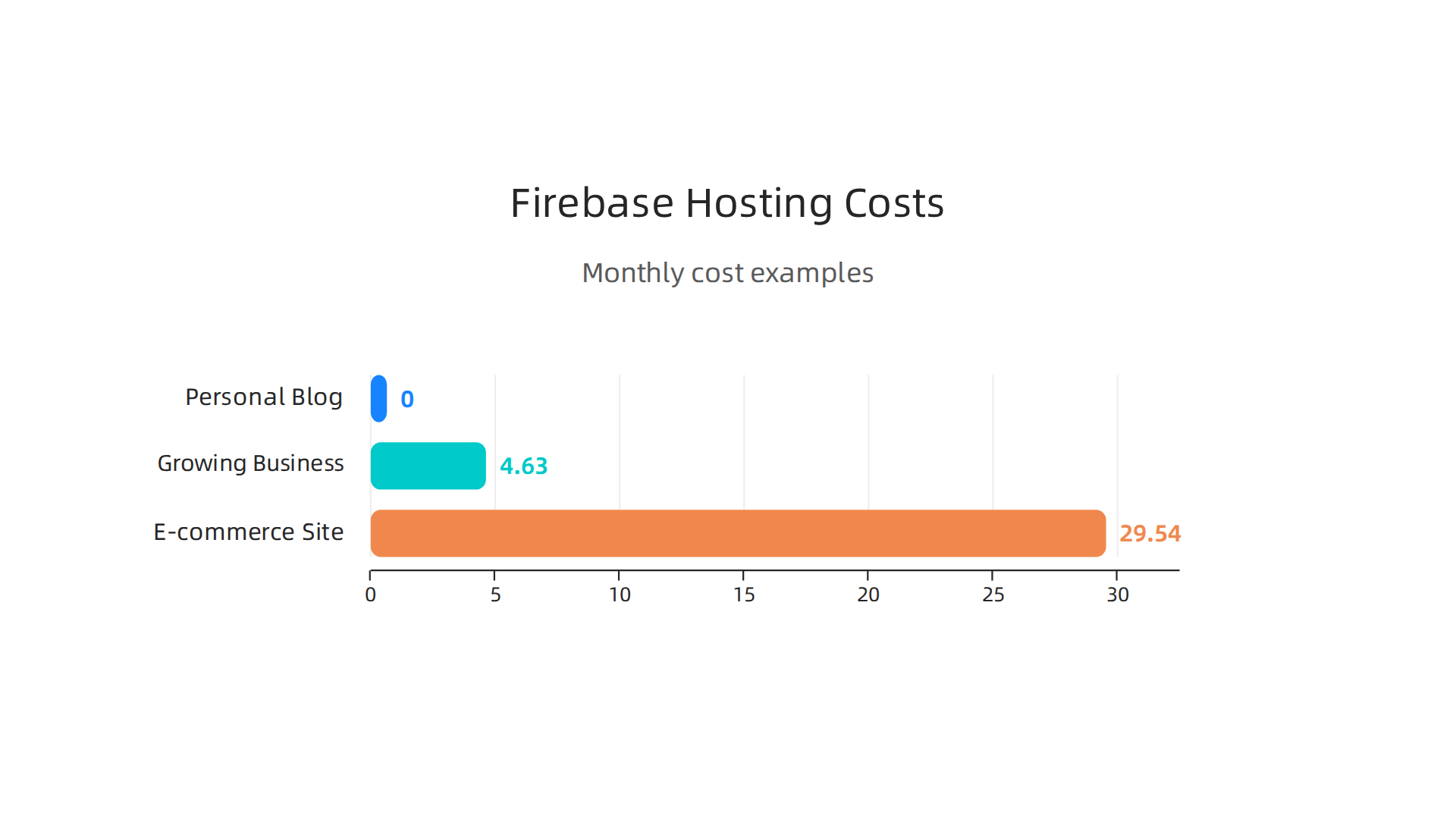
- Small Personal Blog or Portfolio (Low Traffic): If you have a simple website with a few pages and not many visitors, Firebase’s free "Spark" plan is usually enough. You get 10 GB of storage and 10 GB of data transfer each month for free. This means your monthly
firebase hosting pricingwould likely be $0. - Growing Small Business Website (Medium Traffic, Basic Features): For a business website with more content, product images, and a decent number of visitors, you might go over the free limits. Let’s say your site uses 15 GB of storage and transfers 40 GB of data per month.
- Storage: (15 GB – 10 GB free) * $0.026/GB = $0.13
- Transfer: (40 GB – 10 GB free) * $0.15/GB = $4.50
- Total monthly cost: Around $4.63. This is still very affordable.
- E-commerce Site or Active Blog (High Traffic, Many Images/Videos): If your website has lots of users, many images, or even videos, your usage will be higher. Let’s imagine you need 50 GB of storage and 200 GB of data transfer monthly.
- Storage: (50 GB – 10 GB free) * $0.026/GB = $1.04
- Transfer: (200 GB – 10 GB free) * $0.15/GB = $28.50
- Total monthly cost: Around $29.54. Even for a busy site,
firebase hosting pricingcan be very competitive.
These examples show that Firebase Hosting often starts free and scales up based on what you actually use. This can be a very cost-effective way to host your website, especially if you can keep your content light and use good caching practices to reduce data transfer.
If you are looking for reliable, secure, and high-performance website hosting infrastructure tailored for businesses, consider exploring Prism Web Host — Hosting for Firebase Sites.
To keep your Firebase Hosting costs low, even for busy websites, it’s smart to do more than just compare prices. You can actively lower your monthly bill with a few simple steps.
Use Smart Caching
One of the best ways to save money on firebase hosting pricing is through caching. Firebase Hosting uses a global network that stores copies of your website’s files closer to your visitors. This means less data needs to travel far each time someone visits your site, which lowers your data transfer costs.
You can tell web browsers and this network how long to save your content. This is done by setting "Cache-Control" rules. For example, images might be saved for a long time, while text that changes often might be saved for a shorter time. When content is cached, it doesn’t need to be loaded again from the main server, cutting down on costs. You can learn how to set these rules to manage cache behavior directly.
Make Your Website Lighter
Large files, especially pictures and videos, use a lot of data. This directly affects your firebase hosting pricing. Here’s what you can do:
- Optimize Images: Make sure your pictures are the right size for different screens (like phones or computers) and compressed to be smaller without looking bad. You can even use smart tools that automatically resize images when they are uploaded, which helps a lot with costs. Taking steps to optimize Cloud Functions can help here.
- Lazy Loading: Don’t load images or videos until a visitor actually scrolls down to see them. This saves data transfer for content that might never be viewed.
- Remove Unused Files: Go through your website files and delete anything old or not needed. Every little bit of storage adds up.
Keep an Eye on Your Spending
To avoid any surprise bills, it’s very important to keep track of your usage. Firebase gives you tools to see exactly how much storage and data transfer your site is using. This helps you understand your firebase hosting pricing in real time. Knowing your usage helps you make changes before costs get too high. Firebase offers details on usage levels, quotas, and pricing for Hosting.
Your Cost-Saving Checklist for Firebase Hosting
Here’s a simple checklist to help you forecast and avoid unexpected charges:
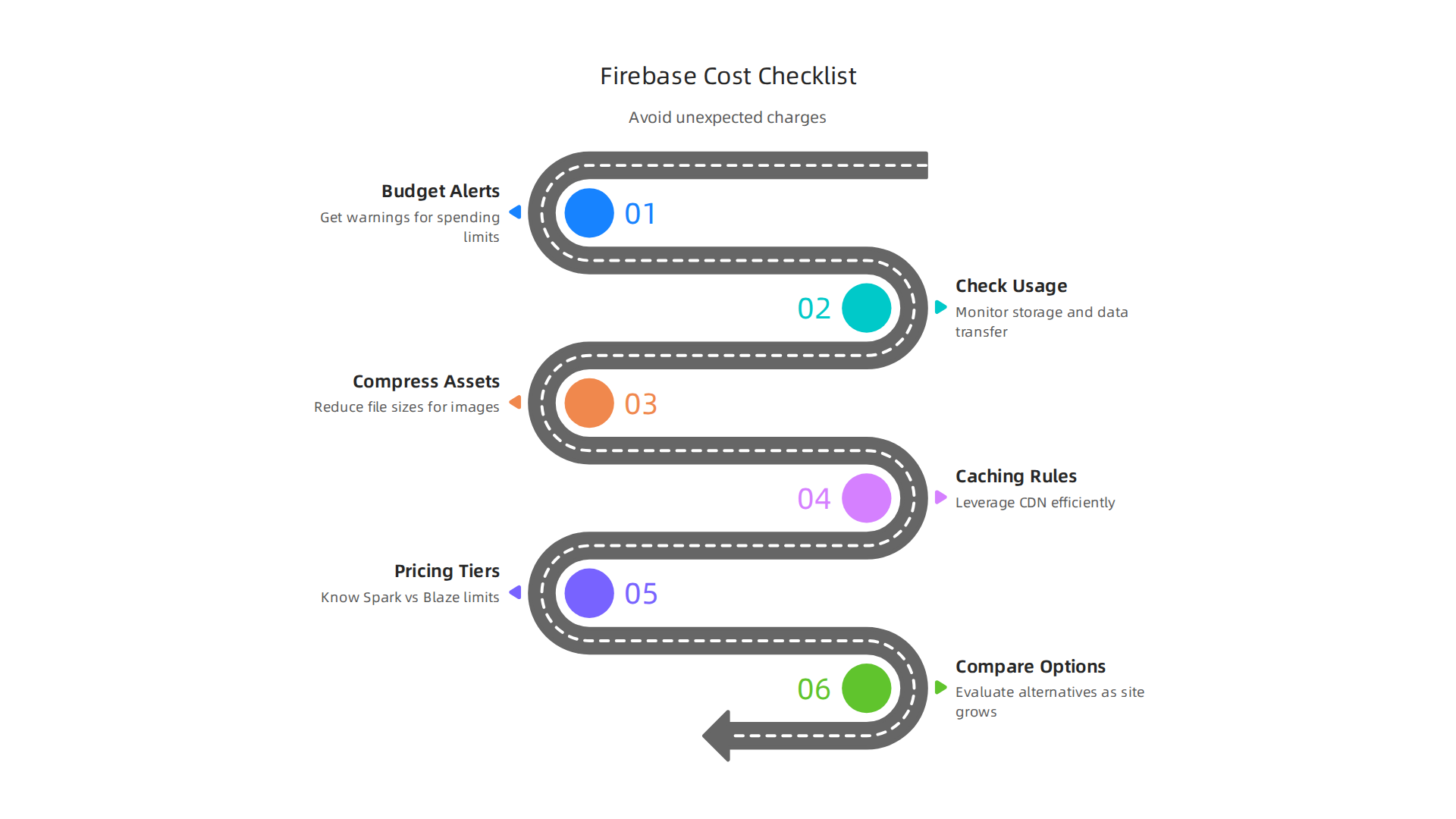
- Set Up Budget Alerts: Turn on alerts in your Firebase account. These will send you a warning if your spending goes above a certain amount you set.
- Check Usage Regularly: Log into your Firebase console every week or two to look at your storage and data transfer numbers.
- Compress All Assets: Always make sure images, videos, and other files are as small as possible.
- Use Caching Rules: Set good "Cache-Control" headers for your website content. This helps browsers and the CDN work smarter.
- Understand Pricing Tiers: Be clear on when Firebase’s free "Spark" plan limits end and when the "Blaze" (pay-as-you-go) plan starts charging for storage and data transfer.
- Compare When Needed: Keep an eye on how your
firebase hosting pricingcompares to other options likevercel hosting pricingoraws hosting costas your site grows. This ensures you always have the best deal. - Review your Overall Hosting Cost: For a deeper dive into understanding and cutting down your website expenses, check out how to master your web hosting cost in 2026.
By following these simple tips, you can enjoy the benefits of Firebase Hosting without worrying about your budget.

Summary
This article explains Firebase Hosting pricing in clear terms so business owners and developers can forecast real costs and avoid surprises. It covers the two main plans (free Spark and pay-as-you-go Blaze), what Firebase measures—storage and data transfer (egress)—and common limits such as the 10 GB monthly free tier and a roughly 360 MB daily egress cap. The guide also highlights hidden charges that come from related services like Cloud Functions, Firestore, and Cloud Storage, and shows how CDN, caching, and dynamic content affect costs and performance. You’ll find simple monthly cost examples for small blogs, growing business sites, and busy e-commerce stores, plus practical steps to reduce bills: optimize assets, set cache-control, monitor usage, and enable budget alerts. Finally, the article compares Firebase with alternatives like Vercel and AWS so you can choose the best fit as your site scales.
