




Google Domains Review 2026 Pricing Features and What You Need to Know
Article
Introduction
Finding the right domain name for your website should feel exciting, not confusing.

But if you have ever tried to buy a domain, you know the struggle is real. Prices vary wildly. Features get buried in fine print. And suddenly you are wondering if you accidentally signed up for three years of hosting you did not want.
That is where Google Domains comes into the picture. For years, it has been one of the most talked-about best domain registrars on the market. People love its clean interface and straightforward pricing. But here is the thing. Many users still do not fully understand what they are getting with google domains, how much it actually costs, or how it connects with website hosting.
Google built its reputation on making complicated things simple. The same thinking went into google domain and hosting services. You get transparent renewal rates, free privacy protection, and easy integration with popular website builders. No hidden upsells, no confusing add-ons, no games with your first-year price.
But Google Domains has also gone through big changes recently. In 2023, Google announced it would sell its domain business to Squarespace. By mid-2024, all existing Google Domains customers had their accounts moved over. That shift left a lot of people wondering what happens next and whether top domain registrars like this one still make sense for their needs.
According to a detailed Google Domains review by Forbes, the service stands out for its fixed low-cost pricing and intuitive domain search tools. Those qualities made it a favorite among small business owners and bloggers alike. But the move to Squarespace changed things. Renewal prices, support options, and even the interface look different now.
This article will give you the complete picture. We will cover what Google Domains offers in 2026, how pricing works after the migration, and how it stacks up against other best domain registrars. We will also walk through security features, integration tips, and what you should consider before buying a google domain today.
Whether you are starting your first website or managing multiple online brands, understanding google domains inside and out will save you time, money, and headaches down the road. Let us start with a clear look at what Google Domains actually does and whether it still deserves a spot on your short list.
What Is Google Domains? A Complete Introduction
Let us start with the basics. Google Domains is a domain name registration service that Google launched back in 2015. Think of it as the place where you go to buy and manage your website’s address. Instead of bouncing between complicated registrar dashboards, Google built something clean. No clutter. No pressure to buy things you do not need.
At its core, Google Domains handles a few key jobs.
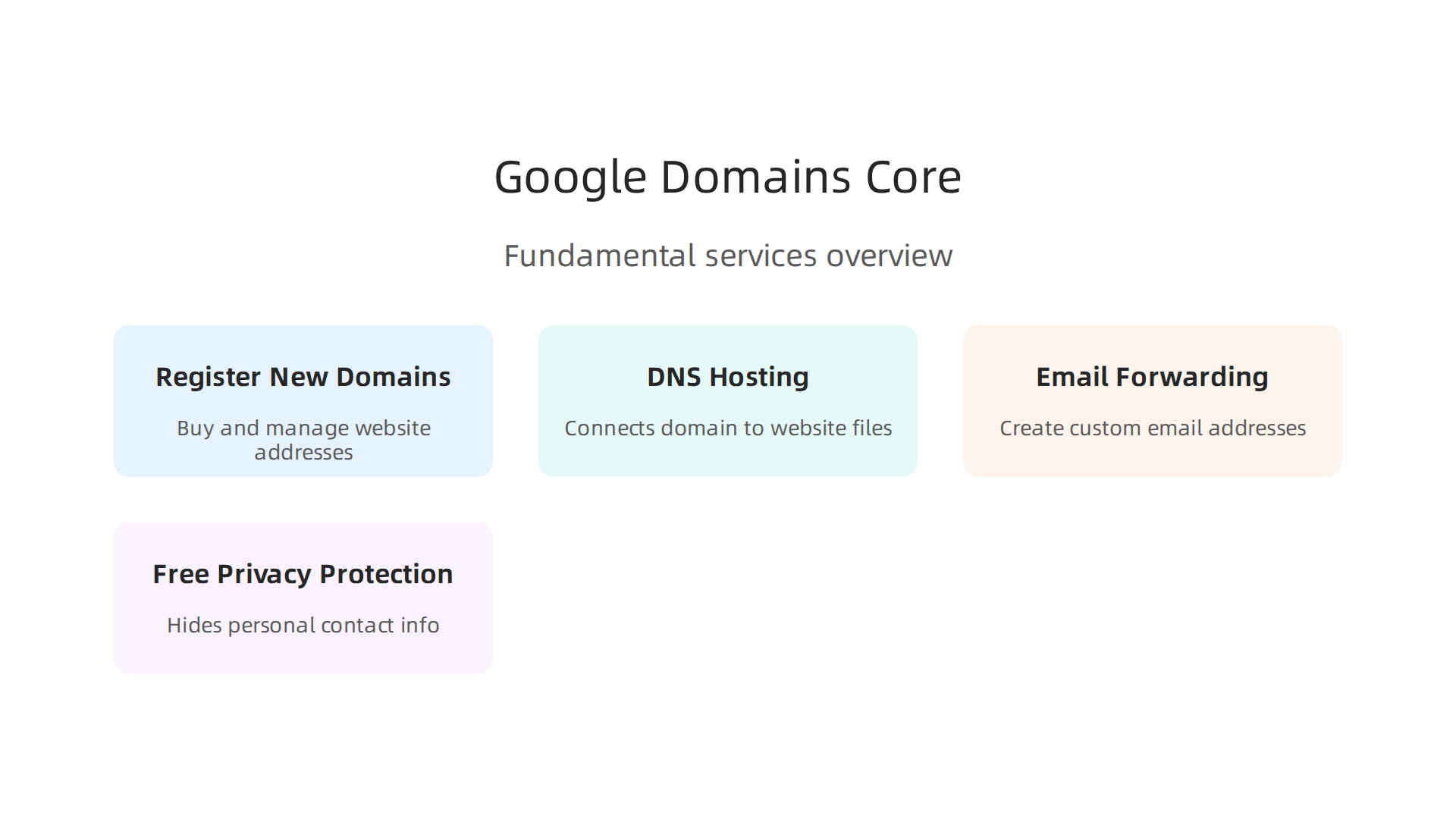
First, it lets you register new domain names. Second, it provides DNS hosting, which is the system that connects your domain name to your actual website files. Third, you get email forwarding and free privacy protection. That last one matters a lot. Privacy protection keeps your personal contact info hidden from public domain records. Many registrars charge extra for this. Google included it for free from day one.
According to a detailed Forbes review of Google Domains, the service earned praise for its fixed pricing and simple search tools. No teaser rates. No hidden fees. What you saw at checkout matched what you paid year after year.
The service was built to work smoothly with the rest of Google’s tools. If you use Google Workspace for business email, linking your domain takes just a few clicks. You can also connect it easily to Google Sites, Google Cloud, and other popular platforms. That seamless integration made it a favorite among small business owners who already relied on Google for their daily operations.
Now here is where things get tricky. In 2023, Google announced it would sell its domain business to Squarespace. By July 2024, all existing Google Domains customers had their accounts moved over. This means that as of 2026, new domain registrations happen through Squarespace’s platform, not directly through Google.
The core features people loved are still there, but the experience has shifted. If you want to understand how the new platform handles performance and security, check out this detailed comparison of Squarespace hosting performance and features.
So what does this mean for you? Google Domains is no longer a standalone service from Google. But the name and many of its original features live on under Squarespace’s management. You still get that clean interface. You still get free privacy protection. The main difference is who runs the show behind the scenes.
One thing to keep in mind. Google Domains handles registration and DNS management, but it never provided actual website hosting. You still need a separate hosting provider to store your website files and make them accessible to visitors. That is where a reliable platform like Prism WebHost comes in, offering secure infrastructure with fast servers and strong uptime guarantees to match your domain’s performance needs.

Understanding what Google Domains actually is helps you make smarter choices about where to register your next domain. The service has evolved, but its core mission remains the same. Give people a simple, trustworthy way to own their piece of the internet.
How Google Domains Works: Registration, Management, and Key Features
Let us walk through what happens when you actually use Google Domains. Even though the service now runs through Squarespace, the core steps remain nearly the same.
Step one: Searching for your domain
The process starts with a simple search. You type your desired name into the search bar, and the system instantly checks if it is available. The search tool also suggests alternative endings if your first choice is taken. According to the Google Domains Wikipedia page, Google built its search interface to be fast and easy to understand. No confusing filters. Just clear availability status and price.
Step two: Purchase and setup
Once you find an available domain, you add it to your cart. The price you see is the price you pay. No surprise fees at checkout. You complete the purchase, and the domain becomes yours for one year. Google handles the registration with the official domain registry behind the scenes.
After purchase, you get access to the management dashboard. This is where the real control lives.
The DNS control panel
Your DNS control panel is the command center for your domain. It lets you point your domain to your website, set up email services, and manage subdomains. You can add different record types like A records for your main site, CNAME records for subdomains, and MX records for email.
Inside the dashboard, you can also set up custom nameservers. This is useful if you want to use a third-party service to manage your DNS instead of the default setup.
Email forwarding made simple
One handy feature is email forwarding. You can create custom email addresses like hello@yourdomain.com and have them forward to your personal inbox. No need for a paid email plan just yet. This works great for small businesses testing the waters.
Free privacy protection included
Here is a big win. Google Domains included WHOIS privacy protection for free from day one. Many registrars charge extra for this service. WHOIS privacy hides your personal contact information from public domain records. That means strangers cannot look up your home address or phone number by checking who owns your domain.
DNSSEC for extra security
For users who want stronger security, Google Domains supported DNSSEC. This technology adds a layer of protection against certain types of attacks that could redirect your visitors to fake websites. It is not required for every website, but it matters if you run an e-commerce store or handle sensitive data.
One thing to remember. Google Domains only handles registration and DNS management. It never provided actual hosting. To make your website visible online, you need a separate hosting provider. That is where services like Prism WebHost come in, offering the infrastructure your domain needs to serve pages fast and securely.
In short, Google Domains made registering and managing your domain straightforward. The tools were built for people who wanted control without complexity. And even though the platform has changed, that spirit still lives on.
Pricing and Value: Is Google Domains the Right Choice for Your Business?
Now that you know how Google Domains works, the big question is whether it makes sense for your wallet.

Let us break down the costs and the real value you get.
What common TLDs actually cost
Google Domains kept its pricing simple. No teaser rates. No hidden fees. A Google Domains review for 2026 shows the standard .com domain was $12 per year for registration, renewal, and transfer. That is one flat price. The same $12 rate applied to .net domains too. For .org, it was also $12 per year.
Here is a quick look at how the most common endings stacked up:

| Domain Ending | Registration | Renewal | Transfer |
|---|---|---|---|
| .com | $12/yr | $12/yr | $12/yr |
| .net | $12/yr | $12/yr | $12/yr |
| .org | $12/yr | $12/yr | $12/yr |
| .co | $30/yr | $30/yr | $30/yr |
| .io | $30/yr | $30/yr | $30/yr |
The key detail is that renewal cost the same as the first year. That is rare in the domain world. Many registrars hook you with a $3 first year then triple the price at renewal. Google Domains never played that game.
How renewal prices compare to competitors
This is where the story gets interesting. Competitors like GoDaddy and Namecheap often advertise low introductory prices. But check the fine print. A .com domain might be $0.99 your first year and then jump to $18 or more at renewal. With Google Domains, what you saw was what you paid.
If you are building a long-term business, stable renewal pricing matters. You want to budget ahead without surprises. For more details on how renewal traps work, check this guide on domain name renewal price comparison to see exactly how much you could save by choosing a transparent registrar.
Free features that add real value
One reason Google Domains stood out is what came included. WHOIS privacy protection often costs $8 to $12 per year at other registrars. Google Domains gave it to you for free. That alone saves you over $100 across a typical 10-year ownership period.
You also got free email forwarding. That means you could create up to 100 custom email addresses and have them forward to your personal inbox. No extra monthly fee. No paid Google Workspace plan required.
And for businesses that wanted extra help, Google offered 1-on-1 support by phone and chat during business hours. That level of support is rare for a domain registrar.
So is it the right choice?
If you value honest pricing, free privacy, and simple management, Google Domains was a solid pick. The flat $12 rate for .com, .net, and .org meant you never had to wonder if your bill would spike.
But here is the catch. Remember that you still need separate hosting. A domain is just your address on the internet. To actually build a website, you need a hosting provider with fast servers and strong security. The two work together. A great domain at a fair price paired with good hosting gives your business a solid foundation.
Now let us see how Google Domains stacks up against the other big names. While honest pricing was a major strength, other registrars win in different areas like security, support, or extra features.
How the top registrars compare
The table below shows how Google Domains, GoDaddy, Namecloud, and Cloudflare line up on the things that matter most to business owners.
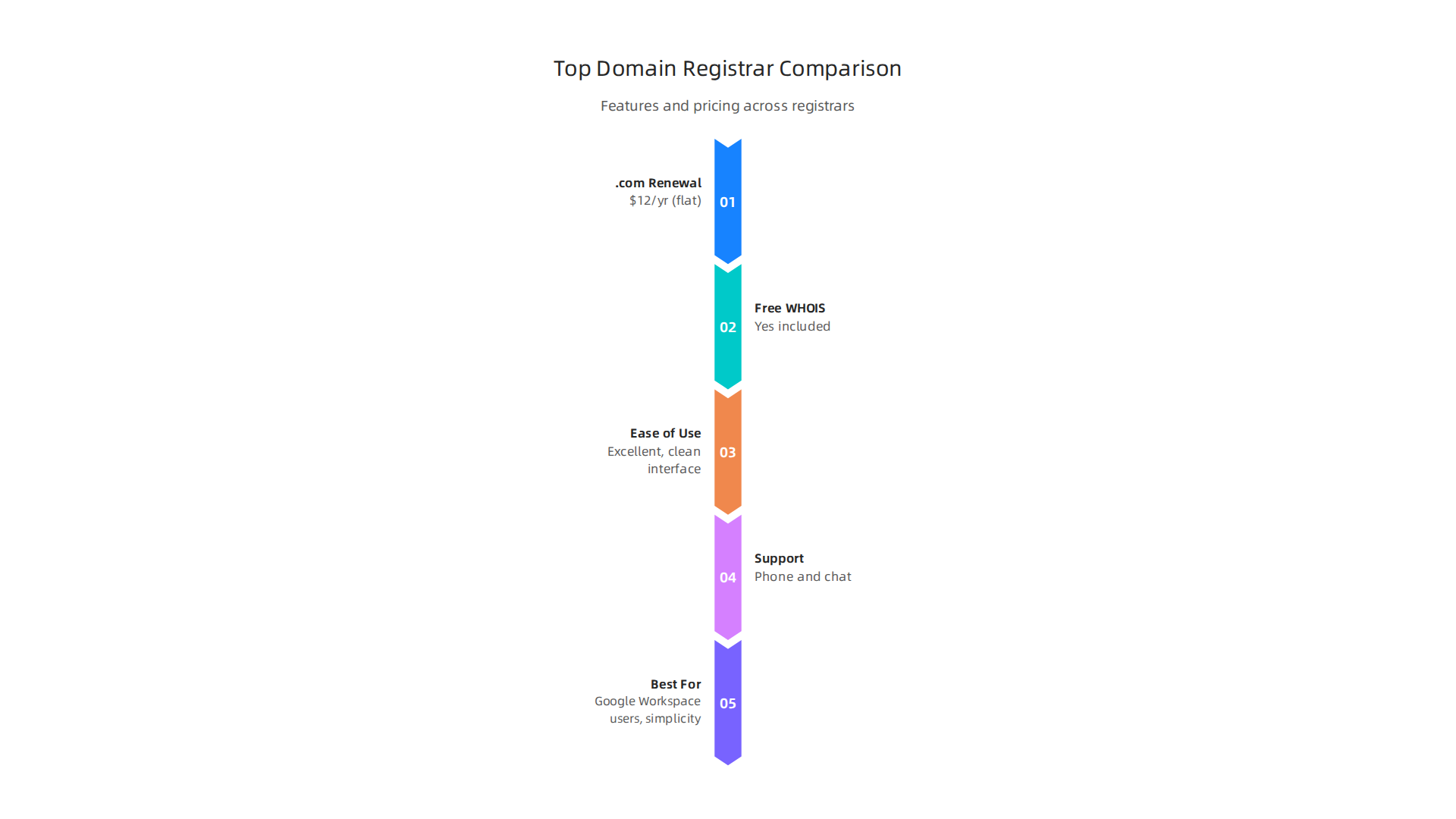
| Feature | Google Domains | GoDaddy | Namecheap | Cloudflare |
|---|---|---|---|---|
| .com renewal price | $12/yr (flat) | Starts around $18/yr after promo | Starts around $13/yr | $10.11/yr (at cost) |
| Free WHOIS privacy | Yes | No (adds $10 to $12/yr) | Yes | Yes |
| Ease of use | Excellent, clean interface | Good but full of upsells | Very good, simple layout | Good but technical |
| Support | Phone and chat (business hours) | 24/7 phone support | 24/7 live chat | Knowledge base only |
| DNS features | Standard (custom nameservers) | Standard | Standard | Advanced (fastest DNS, DDoS protection) |
| Best for | Google Workspace users and simplicity | All-in-one buyers and phone support | Budget-minded owners | Security and performance focused |
What each registrar does best
Google Domains was built for people who wanted a simple, no-surprises experience. The flat $12 price for .com, .net, and .org made budgeting easy. It connected directly to Google Workspace, which saved time for small teams. The control panel was clean and free of aggressive upsells. If you are comparing prices, our domain name renewal price comparison shows exactly how much that simplicity can save you over time.
GoDaddy is the biggest player for a reason. They offer constant discounts and 24/7 phone support, which is rare. But you have to watch the fine print. Their interface pushes hosting, SSL, and email add-ons at every step. That low first-year price can triple at renewal. GoDaddy works well if you want one company for everything and do not mind ignoring upsells.
Namecheap has earned a loyal following by keeping things fair.

Pricing is competitive and transparent. Free WHOIS privacy comes with every domain. The interface is straightforward without pushy marketing. Namecheap is a strong pick if you want a reliable domain without the hassle of aggressive cross-selling. If you are comparing other registrars too, take a look at our guide on reputable domain name registrars to see how they stack up.
Cloudflare takes a different approach. They sell domains at cost. No markup. A .com domain is roughly $10 per year. The tradeoff is that you must use Cloudflare DNS, which is incredibly fast and comes with built-in DDoS protection. This is a great fit if you are technically confident and want top-tier security and speed. For beginners, the interface can feel less welcoming.
Pair your domain with the right hosting
No matter which registrar you pick, your domain is just the address. The real engine of your website is your hosting provider. A great domain needs fast servers, strong security, and reliable uptime to turn visitors into customers. To build a complete foundation for your online presence, check out our guide on the best web hosting for small business in 2026.
Integrating Google Domains with Website Hosting and Other Services
Before Google Domains moved to Squarespace in 2024, many business owners had already pointed their domains to external services. The good news is that the DNS settings you need to know are still the same, even after the transition. If you are still managing a domain that started with Google, you can follow the same basic steps to connect it to your web host, website builder, or email provider. For a full picture of what changed during the migration, check out our Google Domains migration and next steps guide.
Point your domain to an external web host
To use a Google Domains domain with a hosting provider like Prism Webhost, you need to update your nameservers. Here is the simple process:
- Log into your Squarespace Domains account (which now manages the domain).
- Go to the DNS settings for your domain.
- Find the nameserver fields and replace the default Squarespace nameservers with the ones your host provides.
- Save the changes and wait for propagation. This can take up to 48 hours but often finishes within a few hours.
For the official walkthrough, see Google’s guide on how to connect your website to a domain registered through Google. The steps apply even though the management interface has moved to Squarespace.
DNS settings for website builders, e-commerce, and email
If you prefer to keep your DNS hosted with Google (or Squarespace) instead of changing nameservers, you can add specific records. This is common when you only need a single service, not a full web host.
- WordPress or website builders – Add an A record pointing to your hosting server’s IP address, or a CNAME record for a subdomain like www.
- Shopify or other e-commerce platforms – Shopify provides a set of DNS records you must add manually, including A records for the root domain and CNAME for the www version.
- Email services like Google Workspace – You will need to add MX records that Google provides. The setup is usually automatic if you purchased the domain alongside Workspace, but if not, you can enter the records in your DNS settings.
One of the biggest advantages of Google Domains was how easily it worked with Google Workspace. If your domain is still under Squarespace, you can add email records in the same way.
Tips for getting the most from your domain
When you build your site with a platform like WordPress or Shopify, your domain is the front door. Getting DNS right from day one prevents downtime and lost sales. After you point the domain, you need fast, secure hosting to deliver a great experience. That is where a reliable web hosting provider like Prism Webhost comes in. With features like LiteSpeed servers, free SSL, and DDoS protection, you can be confident your site will load quickly and stay safe.
If you ever run into trouble with DNS propagation or record setup, most hosting support teams can help guide you. And if you are moving a domain away from the Google Domains system entirely, the migration guide above walks you through the whole process.
Security and Privacy: How Google Domains Protects Your Online Presence
Now that you know how to connect your domain to hosting and services, let’s talk about keeping that domain safe from prying eyes and malicious attacks. When you register a domain, your personal information like your name, address, phone number, and email used to be publicly available in the WHOIS database.

This exposed domain owners to spam, identity theft, and unwanted solicitation. Google Domains changed that by making privacy protection a standard feature.
Default WHOIS privacy protection
One of the biggest selling points of Google Domains was that it automatically hid your personal contact details from the public WHOIS record. You did not have to opt in or pay extra. The service redacted your information by default, showing only the domain name and registrar details instead. This is still the case for domains that moved to Squarespace. According to the official page on The New Home for Google Domains, every eligible domain includes WHOIS privacy at no additional cost. This keeps your private contact information out of the hands of data scrapers and spammers. For small business owners, this is huge. You can focus on growing your brand without worrying about your home address being exposed every time someone looks up your domain.
Optional security features you can enable
Beyond basic privacy, Google Domains offered a few powerful tools to lock down your domain even further.

These features are still available through Squarespace after the migration.
- DNSSEC (Domain Name System Security Extensions) – This adds a digital signature to your DNS records. It helps prevent hackers from redirecting your website visitors to fake sites by tampering with DNS responses. If you run an e-commerce store or handle customer logins, DNSSEC is a must.
- Two-factor authentication (2FA) – Adding 2FA to your domain registrar account means even if someone steals your password, they cannot log in without your phone or authenticator app. This is one of the easiest ways to prevent domain hijacking.
- Account recovery options – Google Domains also let you set up backup codes and recovery email addresses. This makes it much harder to get locked out of your account or lose control of your domain.
These features work together to create a strong defense against common online threats. When you combine them with a secure hosting provider, your website becomes a much harder target.
How Google handles your data
Google’s approach to data privacy has always been transparent. Their privacy policy explains how they collect, use, and protect your information. For domain owners, the main takeaway is that Google does not share your personal registration data without your consent. They use your info to keep your account secure and to comply with legal requirements. Since the migration to Squarespace, these data handling practices have remained largely the same. Squarespace now manages the domains under a similar privacy framework.
If you are comparing registrars and want a service that values privacy and security, look for ones that offer default WHOIS protection, DNSSEC support, and strong account security. Learning how to find reputable domain name registrars that protect your business will save you headaches down the road. Whether you stay with Squarespace or transfer your domain elsewhere, make sure your personal info stays private and your domain stays locked down.
Summary
This article explains what Google Domains was, how it worked, and what changed after Google sold the service to Squarespace, so you can decide whether to use—or move—your domain today. It covers the core features (domain registration, DNS management, email forwarding, free WHOIS privacy), the hands-on steps for searching, buying, and configuring a domain, and clear guidance on pointing a domain to external hosts. The piece walks through transparent pricing and renewal practices, compares Google Domains with other registrars on cost and features, and highlights security options like DNSSEC and two-factor authentication. You’ll also find practical integration tips for website builders and email services, plus migration and troubleshooting advice for domains now managed in Squarespace. By the end, readers will understand costs, how to connect domains to hosting, how to protect their ownership, and which factors to weigh when choosing a registrar or transferring a domain.
