




Domain Cost Per Year What Determines Your Renewal Price and How to Lower It
Article
Introduction
Think of a domain name as your digital street address. It is the first thing people type to find your business online. But here is the catch: the price tag for that address can change a lot depending on where you buy it and how long you keep it.
Many business owners pick a registrar because they see a flashy first year deal like a domain $1 offer. They think that is the real cost. Then renewal time comes and the bill jumps to $15, $20, or even more. Suddenly that cheap start feels like a trap.

On top of that, there are hidden fees, premium TLD charges, and small annual ICANN fees that add up. According to the Elementor blog, a standard .com, .net, or .org domain usually costs between $10 and $20 per year for the first registration. But that is just the starting point. You also pay a small ICANN fee of about $0.18 each year, which supports the global domain system, as Network Solutions explains. That tiny fee is in every registration and renewal.
So what really determines your domain cost per year? In 2026, prices vary by the type of domain (TLD), the registrar you choose, and whether it is the first year or a renewal. Some registrars offer low intro rates but raise prices later. Others keep their renewal rates low from day one. If you want to avoid overpaying after year one, check out our guide on domain name renewal price comparison.
This guide breaks down exactly what affects the com domain price, the average cost for domain name across popular TLDs, and how to plan your online budget so you never get surprised again. We will also look at real domain registration prices and show you how to spot a good deal versus a short term trick. Let us get started.
Understanding Domain Pricing: What Determines the Cost?
So, why does the domain cost per year jump so much after the first year? And why do some domains cost $100 while others cost just $12? The system behind these numbers is simpler than you think.
It all starts with one main organization: ICANN. This global nonprofit oversees all domain names. They set the rules and fees that every registrar must follow. Even the registrars you buy from have to pay ICANN an annual accreditation fee of $4,000 per year, as shown in the FY26 Registrar Fee Schedule.
Here is how the price breaks down:
- The Registry sets the wholesale price. For example, Verisign runs the .com registry. They charge registrars a set fee for every com domain price they sell.
- The Registrar adds their markup. This is where competition happens. Some keep their markup small. Others use it to fund big marketing.
- ICANN adds a tiny fee. A mandatory fee of about $0.18 per year is added to every domain registration and renewal, according to Network Solutions. This supports the global domain system.
Because of these layers, the average cost for domain name for a standard .com, .net, or .org usually falls between $10 and $20 per year for the first registration, as Elementor notes.
The $1 Domain Trap
But here is the trick. If the wholesale cost to a registrar is around $8 to $10, how can they offer a domain $1 deal?
They lose money on purpose. That low price is only for year one. The NameSilo blog explains that some registrars, like GoDaddy, offer these crazy low rates but with strings attached. You might need to commit for three years or sign up for an expensive monthly membership. They bet that once your domain is parked with them, you will not bother moving it when the renewal price jumps to $15 or $20.
The domain registration prices you see in big ads are almost always just the intro rate. The real cost shows up at renewal time.
The Hidden Fees That Add Up
Besides the base domain cost per year, you need to watch for:
- Domain privacy protection. Some registrars charge $5 to $10 extra per year for this. Others include it for free.
- Premium TLDs. Extensions like .io, .co, or .ai have much higher registry fees. Their renewal prices stay high forever.
- ICANN fee. That small $0.18 charge shows up on every single bill.
Here is the bottom line: the first-year deal is a distraction. What really matters for your wallet is the renewal rate. Before you click "buy," do a quick domain name renewal price comparison to see what you will actually pay in years two, three, and five.
And once you understand the true cost of your domain, you need a hosting plan that is just as transparent. Prism Webhost gives you high-performance hosting infrastructure with clear, upfront pricing. No hidden fees. No surprise renewal jumps. Just reliable service that fits your real budget.
How TLD Affects the Price: .com vs .org vs .io vs Niche Extensions
So, which extension should you pick? It turns out the letters after the dot are the biggest factor in your domain cost per year.

The classic com domain price is your safe baseline. A .com usually costs between $10 and $15 per year for a standard registration, as Elementor explains. It is the most trusted extension worldwide. Most people type .com by default when they search for a business. That trust keeps the renewal rate stable.
But the moment you step away from .com, things change. Niche TLDs like .io, .agency, or .co are treated as premium. Their registry fees are much higher. That is why they often cost $30 to $60 per year and stay at that level forever. These domain registration prices reflect exclusivity, not hidden tricks.
Then there are the new gTLDs, like .online or .site. They often start with an attractive domain $1 or $2 first year. But the renewals jump unpredictably. Some registrars use these low intro rates to hook you, then raise the price to $20 or more in year two.
The simple rule is this: .com gives you the lowest long-term average cost for domain name. Always check the renewal price, not the first year. A cheap intro on a niche extension can cost you much more over time. For a full breakdown of what different TLDs really charge at renewal, check out our domain name renewal price comparison guide.
Average Domain Cost Per Year by TLD in 2026
The table below gives you a real-world look at domain cost per year across popular extensions in 2026.
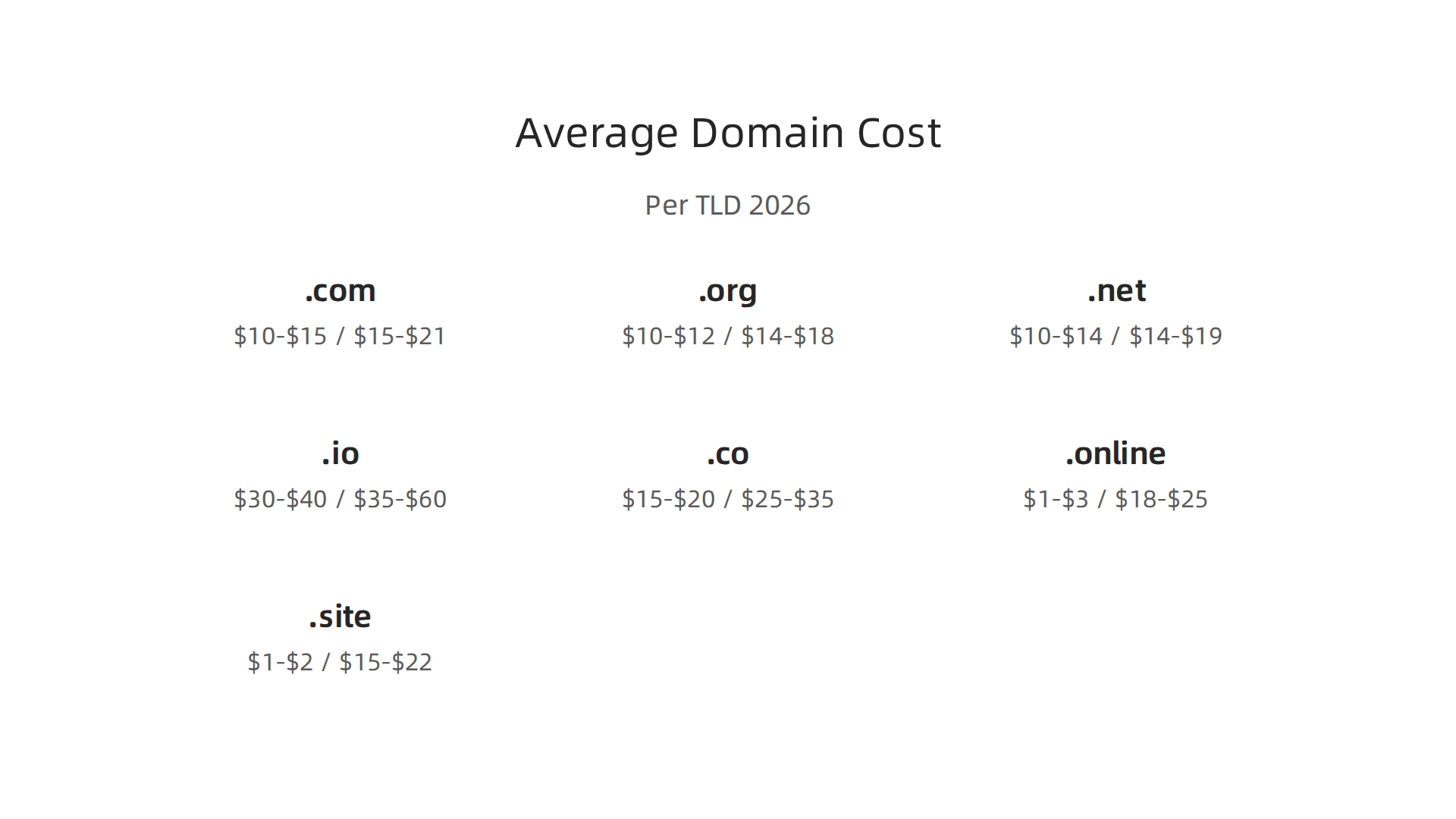
These numbers are averages, so your actual price may vary by registrar. But they show the pattern clearly: the first year is often a teaser, and the renewal is where the real cost lives.
| TLD | First Year Price | Renewal Price (Year 2+) |
|---|---|---|
| .com | $10 $15 | $15 $21 |
| .org | $10 $12 | $14 $18 |
| .net | $10 $14 | $14 $19 |
| .io | $30 $40 | $35 $60 |
| .co | $15 $20 | $25 $35 |
| .online | $1 $3 | $18 $25 |
| .site | $1 $2 | $15 $22 |
The classic com domain price stays the most affordable in the long run. Most people trust .com, and its renewal rate is the most stable. As Elementor explains, a standard .com registration costs about $10 to $15 initially. But renewals can go higher. Cybernews reports that a .com often renews around $21 per year at popular registrars. That is still lower than niche extensions.
Niche TLDs like .io or .co look premium from day one. Their first year and renewal are both high. There is no teaser with these. You pay the same high price every year.
Then there are the intro deals. Extensions like .online or .site can be as low as a domain $1 for year one. But the jump at renewal is shocking. A domain that costs $1.99 for the first year might renew at $22.99, making it more expensive in the long run than a domain that costs $12.99 from the start.
Why prices vary between registrars
The same TLD can cost very different amounts at different registrars. Some registrars add big markups to renewals. Others, like Cloudflare, offer no markup on domain names with automatic renewals. NameSilo shows a 5 year total .com cost of only $55.25 with free WHOIS privacy. Compare that to GoDaddy at $99.83 for the same period.
You also need to watch for hidden fees. The ICANN fee of about $0.18 to $0.20 per year is small, but things like WHOIS privacy ($5 $15/year) or a redemption fee ($100+) if you miss renewal add up fast. Palnode covers these hidden costs in detail.
How to avoid sticker shock at renewal
The trick is simple. Always check the renewal price before you buy. Do not fall for the cheap first year. Look at the total cost over 2 to 5 years. That gives you the true average cost for domain name for your budget.
Many registrars offer multi year discounts. Locking in a 3 or 5 year term at the renewal rate can save you money and protect you from future price increases. Upwork confirms that renewal fees often range from $15 to $40 per year depending on the registrar and extension.
If you want to avoid surprises, compare renewal rates early. Check out our domain name renewal price comparison guide for a breakdown of what different registrars really charge after year one.
Choosing a registrar with transparent pricing
The best way to control your domain cost per year is to pick a registrar that shows you the full picture from the start. Some registrars hide the renewal price in small print. Others, like Prism Web Host, make their domain pricing clear and upfront. No hidden fees, no surprise jumps. Just straightforward rates that help you budget for the long term.
Take a few minutes to compare your options. The right choice today will save you money every single year.
Hidden Fees and Renewal Pricing: What to Expect After Year One
You picked a great domain name. You paid a low first-year price. Feels good, right?
Then the renewal notice comes. And the price is way higher than you expected.
This is the most common surprise for new website owners. The domain cost per year jumps dramatically after year one. Sometimes by 50%, sometimes by 300%. As WebHostMost explains, domain renewal costs in 2026 range from $8 to $20 per year, but the jump from a teaser price to that real number can be shocking.
Elementor gives a clear example: a domain that costs $1.99 the first year can renew at $22.99. That makes it more expensive over time than a $12.99 domain. Cybernews confirms that a standard .com renews around $21 per year at many registrars.
But the renewal price jump is only part of the story. There are other fees that sneak up on you just as quickly.
WHOIS Privacy: Free or Fee?
WHOIS privacy hides your personal contact details from the public database. Some registrars give this for free. Others charge $8 to $12 per year for it. Palnode reports that WHOIS privacy costs $5 to $15 annually depending on the registrar.
If your registrar charges for privacy, that adds to your real com domain price. Compare this upfront. NameSilo offers free WHOIS privacy for life, which saves you $40 to $75 over five years compared to registrars that charge.
The ICANN Fee, Transfer Fees, and Late Penalties
There is always the ICANN fee. It is small, about $0.18 to $0.20 per year. Network Solutions notes that this is mandatory for every domain registration and renewal. It supports the global domain system.
Then there are transfer fees. If you want to move your domain to another registrar, expect to pay a transfer fee, often around $10 to $15. And if you miss the renewal date by a few days, the redemption fee can be $100 or more. Palnode warns that this fee applies if you let the domain expire.
How to Keep Your Domain Cost Per Year Low
The best way is to pick a registrar with transparent pricing from the start. Look for one that shows the renewal price, privacy cost, and all fees clearly. Porkbun is one registrar known for clear renewal rates that don’t surprise you later. Cloudflare Registrar is another option that charges no markup on domain names, with automatic renewals at cost.
You can also register for multiple years at once. This locks in the current renewal rate and protects you from future price increases. Upwork explains that renewal fees range from $15 to $40 per year depending on the registrar and extension. Locking in a 3 or 5 year term saves you both money and stress.
A good registrar will also offer easy integration with hosting. Prism Webhost combines domain management with secure, high-performance hosting. That way, your domain and website are in one place with no hidden surprises. For more tips on choosing a trustworthy registrar, see our guide on how to find reputable domain name registrars that protect your business.
Don’t let hidden fees ruin your budget. Check the renewal price, ask about privacy costs, and read the fine print before you buy. Your wallet will thank you.
Is It Cheaper to Buy a Domain from a Registrar or a Hosting Provider?

You see a hosting ad: “Free domain with any plan.” Sounds like a steal, right? But is it really cheaper than buying the domain separately from a registrar?
Here’s the honest answer: it depends on how long you plan to stay.
The “Free Domain” Trap
Many hosting providers offer a free domain for the first year when you sign up. That saves you around $10 to $15 upfront. But the catch is that the renewal price is often higher than what a standalone registrar would charge. As WebHostMost explains, domain renewal costs in 2026 range from $8 to $20 per year, but a hosting provider might charge $21 or more for the same .com renewal. That “free” first year can cost you an extra $5 to $10 every year after.
The Cybernews guide also points out that a standard .com renews around $21 at many popular hosts, while dedicated registrars like NameSilo or Porkbun may keep it under $10.
Why Standalone Registrars Can Be Better
Standalone domain registrars usually have more top-level domain (TLD) choices and better renewal rates. They compete on price, so you can find a .com for as low as $8 to $12 per year after the first year. Plus, you aren’t locked into a hosting provider if you want to switch later.
InstantDomainSearch notes that a $1.99 promo renewing at $21.99 is a $20 markup. A registrar with transparent pricing avoids that surprise. For a deeper look at how to pick a trustworthy registrar, check our guide on how to find reputable domain name registrars that protect your business.
When Bundling Makes Sense
Bundled hosting and domain can save you money upfront. You get one bill, one login, and often free WHOIS privacy. But the NameSilo blog warns that bundled hosting often starts at $3/month, then jumps to $15/month at renewal. The “free” domain hides the true cost until you see the renewal bill.
Which One Should You Choose?
If you want the lowest domain cost per year over the long term, buy your domain from a standalone registrar with low renewal rates. If you value convenience and don’t mind paying a little more later, a bundling offer can work, especially if you plan to stay with that host for years.
The smart move is to compare the total cost over three to five years, not just the first year. For help calculating that, see our guide on how to calculate your true web hosting cost and avoid hidden fees in 2026.
If you want a hosting provider that offers clear domain pricing and reliable performance, consider Prism Webhost. They combine domain management with secure hosting so you don’t have to guess what you’ll pay next year.
How to Save on Domain Costs Without Sacrificing Quality
So you know the difference between registrar and hosting pricing. Now let’s talk about how to actually lower your domain cost per year without ending up with a bad provider.
Here are three proven strategies that work in 2026.
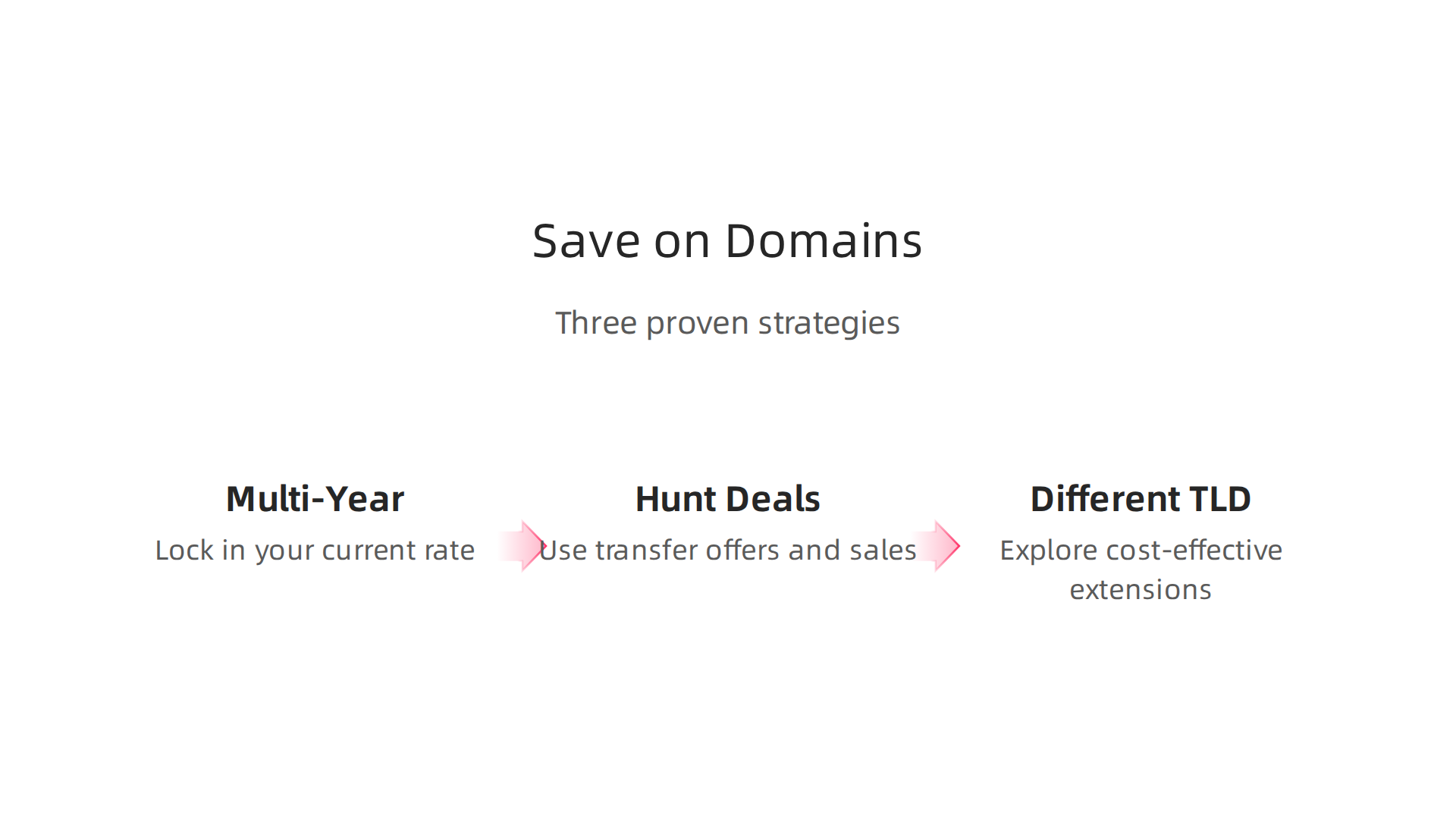
Lock In Your Rate with Multi-Year Registration
Here’s a simple trick that many people miss. When you register a domain for one year, you pay the promo price. But when renewal comes, the price jumps. The WebHostMost guide on domain renewal cost shows that some registrars hike rates by 300% after year one.
The fix? Register your domain for multiple years upfront. Most registrars let you buy up to 10 years at once. That locks in the current com domain price and protects you from future increases. A NameSilo analysis of cheapest domain registrars in 2026 shows that a 5-year commitment can save you nearly $45 compared to renewing year by year with a costly provider.
Hunt for Deals and Transfer Offers
You do not have to pay full price. Registrars run sales all the time. Black Friday, New Year, and even random Tuesday promotions can drop the domain registration prices way down. The MediaOptions guide on domain promotions explains that timing your purchase around these events can cut your costs significantly.
Another smart move? Use domain transfer deals. Many registrars offer cheap transfers that add a year to your expiration date. The Palnode article on domain costs says transfers usually take five to seven days and can save you money if your current renewal is expensive.
One savvy trick from NamePros: turn off auto-renewal to avoid early renewals that lock you into higher rates. Some registrars renew domains well in advance, and you might pay more than you need to.
Pick a Different TLD
A .com is the classic choice. But it is not always the cheapest. The average cost for domain name for a .com in 2026 sits between $8 and $20 per year depending on the registrar. But other extensions like .io, .co, or .org can cost less or more.
Cloudflare’s low cost domain solution offers domains at cost with no markup, meaning you pay exactly what the registry charges. No hidden fees, no inflated renewals. That is a great option if you want a domain $1 type deal without the catch.
If you want to explore all your options, check out our breakdown of cheapest domain extensions and the real costs and risks before choosing.
The bottom line? You do not have to overpay for a domain. Register for multiple years, watch for sales, pick the right extension, and you will keep your domain cost per year low without sacrificing quality.
Beyond the Domain: Total Cost of Ownership for Your Online Presence
So you have found a cheap domain and locked in a good rate. That is a smart start. But your domain is just the beginning. The real cost of running a website goes way beyond the domain cost per year.
Think of your domain like the address of a store. It tells people where you are. But you still need a building, lights, shelves, and a phone line. That building is your hosting. The lights are your security features. The phone line is your email.
In 2026, the average cost for domain name is between $10 and $20 per year. That is a small piece of the puzzle. The GoDaddy blog on website costs explains that hosting alone ranges from $5.99 to $24.99 per month. That works out to $72 to $300 per year. And that is just for basic shared hosting.
Here is a quick look at the full monthly picture:
| Component | Typical Monthly Cost |
|---|---|
| Shared hosting | $3 to $10 |
| SSL certificate | $0 to $10 |
| Professional email | $3 to $10 per mailbox |
| Website builder subscription | $10 to $30 |
| Security and backups | $2 to $15 |
These numbers come from the Squarespace guide on website costs, which notes that hosting ranges from $3 to $50 per month. The JIM article on small business website costs adds that ignoring ongoing expenses like hosting, SSL, and security patches can add $435 to $3,210 per year to your real budget.
That is a big jump from a simple com domain price renewal.
Plan for Growth
Here is something many people miss. As your business grows, your needs grow too. A cheap shared hosting plan works for a small blog. But what happens when you get 10,000 visitors a month? Your site slows down. Your security needs increase. You need more bandwidth and better support.
This is why you need to think about scalability from day one. The Namesilo comparison of domain vs hosting bundles warns that promotional hosting rates often jump from $3 per month to $15 per month at renewal. That "free domain" you got with the bundle? It masks the true cost until you are locked in.
For performance that scales with you, consider a hosting provider that offers enterprise-grade security and reliable uptime without hidden fees. Prism Web Host provides features like DDoS protection, free SSL, and automated backups starting at a fair price.
A Practical Next Step
To avoid surprises, calculate your full budget before you buy. Add up the domain, hosting, SSL, email, and any extras you need.

Keep the domain registration prices low, but do not sacrifice quality on the services that keep your site running fast and secure. If you want a deeper look at hosting costs, check out our guide on web hosting cost in 2026 and how to compare pricing models.
The bottom line? Your domain cost per year is just the entry fee. The real investment is in the services that power your online presence. Plan for the full picture, and you will save money and headaches down the road.
Summary
This article explains how much a domain really costs per year by breaking down the players and fees behind every registration: ICANN, registries, and registrars. It shows why first‑year promos (like $1 offers) are often loss leaders and why renewal prices—and hidden charges such as WHOIS privacy, ICANN fees, transfers, and redemption penalties—determine your long‑term expense. You’ll get average 2026 price ranges for common TLDs (.com, .org, .io, .co, .online, .site), learn how registrars differ on renewals, and see clear strategies to avoid sticker shock: check renewal rates, lock multi‑year terms, hunt transfers and promotions, or pick low‑markup registrars. Finally, the guide places domain cost in the bigger picture of hosting, SSL, email, and scaling so you can budget accurately and choose the best provider for both price and quality.
